


Warning: Do not remove the expansion tank cap while the engine is hot, to avoid hot fluid splashing out. Cover the cap with a thick cloth and slowly turn it counterclockwise. Wait until the pressure in the system drops, then completely unscrew the cap.
Draining liquid
1. Allow the engine to cool.
2. Remove the expansion tank cap.
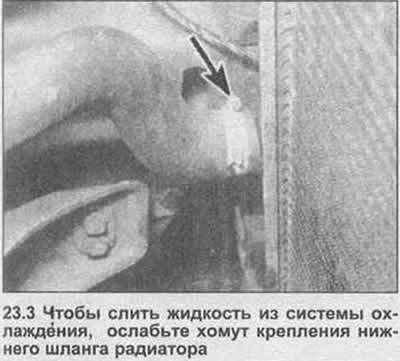
3. Place a suitable container under the lower radiator hose. Disconnect the hose from the radiator and wait until the liquid has completely drained (see illustration).
4. There is no drain plug on the cylinder block, so the fluid cannot be drained completely.
Washing
5. If the coolant is not replaced in time, the antifreeze mixture will become diluted and the efficiency of the cooling system will gradually decrease, as the channels will narrow due to rust and other deposits.
6. Drain the system and remove the thermostat. Temporarily install the thermostat housing and reconnect the hose.
7. Insert a garden hose into the disconnected lower radiator hose. Direct a stream of clean water into the radiator and continue flushing until clean water flows out of the opposite hole.
8. After flushing, install the thermostat and connect all system hoses.
9. If after a sufficiently long time the water flowing out still does not become clear, flush the radiator with a special cleaning agent. It is important to carefully follow the instructions of the manufacturer of the agent.
10. If the coolant has been replaced regularly, flushing is not required.
Filling
11. Make sure all hoses and clamps are in good condition.
12. Fill the system through the expansion tank cap.
Article posted on Internet portal [OpelBook.ru]
13. Add coolant slowly to prevent air locks.
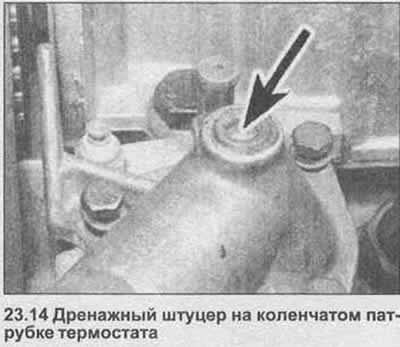
14. Most models have a cooling system with automatic air bleed. On models with a different type of system, unscrew the fitting on the thermostat elbow while filling the system (see illustration).
15. Start the engine and warm it up to normal operating temperature. Then turn off the engine and wait until it cools down. Check the system for leaks, especially around the components you removed during the previous work. Check the coolant level in the expansion tank and top it up if necessary.
16. Check that all hose clamps are securely fastened.
Antifreeze mixture
17. Use only ethylene glycol based antifreeze. Antifreeze quantities and temperature limits are listed in the Specifications.
Visitor comments