


Contents: Bosch spark plugs ⬇ Beru candles ⬇
The spark plug consists of a central electrode, an insulator, and a side electrode. The central electrode is fixed in the insulator. A spark jumps between the central and side electrodes, igniting the combustible mixture. The condition of the spark plugs determines the ease of starting the engine, the stability of its idling, the responsiveness of the car, and its maximum speed. Therefore, you should not change the type of spark plugs installed by the manufacturer without special reasons. These spark plugs have an optimal heat rating for a given engine. The heat rating characterizes the degree of thermal conductivity of the spark plug. The lower the heat rating, the higher the thermal conductivity of the spark plug (it dissipates heat better), which prevents pre-ignition and increased carbon formation. A spark plug with a higher heat rating has a higher self-cleaning temperature. This leads to more intense carbon formation, especially when the engine does not reach its operating temperature due to low-speed driving (city driving and short distance travel in winter).
The heat rating is indicated in the spark plug designation. The designation is deciphered as follows.
Bosch spark plugs

1 W — thread M 14x1.25 with flat sealing surface, for 21 mm wrench, F — thread M 14x1.25 with flat sealing surface, for 16 mm wrench, M — thread M 18x1.5 with flat sealing surface, for 25 mm wrench, H — thread M 14x1.25 with conical sealing surface, for 16 mm wrench, D — thread M 18x1.5 with conical sealing surface, for 21 mm wrench.
2 R - there is a noise suppression resistor
3 — Heat rating. The range of numbers is from 06 ("cold") to 13 ("hot"). Number 7 corresponds to the old designation 175, number 6 — 200-225, etc.
4 A - thread length 12.7 mm, normal position of the thermal cone, B - thread length 12.7 mm with protrusion of the thermal cone, C - thread length 19 mm, normal position of the thermal cone, D - thread length 19 mm, normal position of the thermal cone, three side electrodes, L - thread length 19 mm with large protrusion of the thermal cone.
5 — Central electrode material: C — copper-nickel alloy, S — silver, P — platinum, O — standard spark plug with reinforced electrode.
(Material was taken from a resource: opelbook)
Beru candles

1 — Thread size (in this case M14x1.25).
2 — Design feature. K — conical sealing surface, R — presence of a noise-suppressing resistor.
3 — Heat rating. The decoding is the same as for Bosch spark plugs, except for Silverstone spark plugs: here the designation S6 corresponds to the old designation 145-200, and S7 — 200-225.
4 — Thread length. The decoding is the same as for Bosch spark plugs, except for Silverstone spark plugs: here S6 is a short thread, S7 is a long thread.
5 — Central electrode material. U — copper-nickel alloy. A spark plug with a silver central electrode is designated Silverstone. According to Vega, its service life is 50,000 km. If engine operating conditions differ significantly from normal ones and problems with its operation arise, appropriate spark plugs should be selected. If the spark plugs have a large layer of carbon deposits, this means that they do not heat up to the self-cleaning temperature during engine operation (result of short distance travel). In this case, it is recommended to replace the spark plugs with others that have a higher heat rating. If the car is used mainly at high speeds, it is recommended to install spark plugs with a lower heat rating.
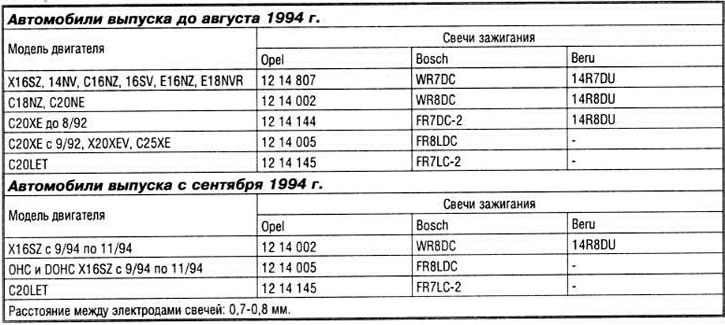
Recommended spark plugs for Opel Vectra/Calibra
Visitor comments