


2. The main components of the contactless ignition system are the control unit, ignition coil and distributor driven by the camshaft.
3. The system uses very high voltage and therefore appropriate precautions must be taken when working with the ignition on.
4. The Hall effect system consists of a permanent magnet, a detector/amplifier and a 4-blade impeller. When one of the blades covers the detector/amplifier, no voltage is generated in the detector and the control unit passes current through the low voltage winding of the coil.
5. Due to the rotation of the impeller, the blade stops covering the detector and it enters the magnetic field of the permanent magnet. Due to the Hall effect, a small voltage is generated in the detector plate, which is then amplified and causes the control unit to interrupt the current supply to the primary winding of the coil.
Material copied from this portal: OpelBook.ru
6. The control unit includes a circuit that switches off the low voltage circuit if the time interval between two consecutive signals exceeds 1.5 seconds. Thus, the coil and internal circuits are protected in case you inadvertently leave the ignition on.
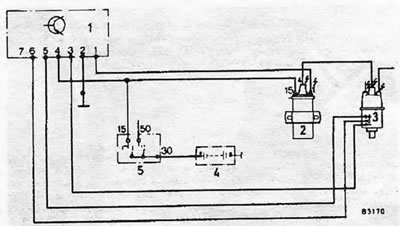
Figure 4.6. Bosch electronic ignition system diagram: 1. Control unit; 2. Ignition coil; 3. Distributor; 4. Battery; 5. Ignition switch.
7. We recommend limiting the disassembly of the distributor of this type of system to those operations specified in the following sections.
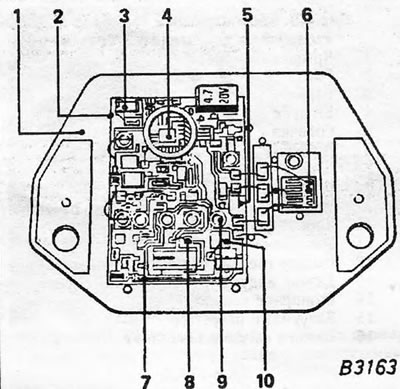
Figure 4.7. Control unit of the Bosch electronic ignition system: 1. Metal substrate; 2. Thick film board; 3. Capacitor chip; 4. Regulator of closed state of contacts; 5. Precision resistor (for measuring current); 6. Transistor output stage; 7. Conductors; 8. Diode chip; 9. Contacts for connecting wires; 10. Zener diode chip.
8. The ballast resistor is not used with contactless ignition systems, but can sometimes be found on them as part of other wiring. Once you find a ballast resistor, keep in mind that it does not perform any function and can be ignored.
Visitor comments