


Warning: Please note that dust generated by wear of the friction disc linings may contain asbestos, which is harmful to health. Never blow off dust with compressed air and try not to inhale it. Do not use gasoline-based solvents to clean clutch components. Use only a special cleaner or methylated spirits.
Removal
1. Remove the transmission (see the relevant section).
2. Before removing the clutch, make alignment marks on the pressure plate assembly and flywheel with chalk or marker.
3. Working in a diagonal pattern, loosen the pressure plate bolts evenly and gradually, turning them half a turn at a time, then loosen the bolts by hand.
Warning: It is critical to loosen the pressure plate bolts evenly to avoid distorting the diaphragm spring. On solid flywheel models (for a composite flywheel this is impossible) opel dealers use a special tool to compress the diaphragm spring, then fix it in this position with special clamps (see illustration 6.3). Removing these brackets and installing them on the new pressure plate requires the use of a press.
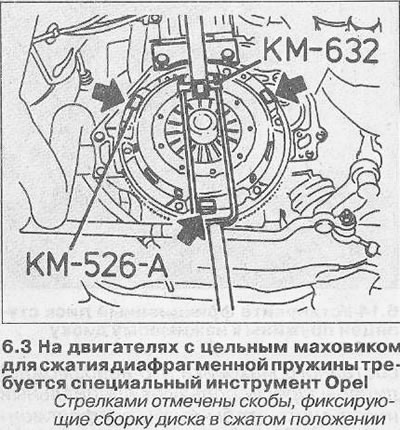
4. Remove the pressure plate assembly and remove the friction disc, noting its orientation.
Inspection
Note: Due to the length and complexity of the procedures for removing and installing clutch components, it is recommended that the friction disc, pressure plate assembly and release bearing be replaced after each engine or transmission removal.
5. Remove the clutch assembly.
6. When cleaning clutch components see Warning, given at the beginning of this Chapter.
7. Inspect the friction disc linings. If they are cracked, burnt, worn or otherwise damaged, or contaminated with oil/grease (black shiny spots), the friction disc must be replaced.
8. If the linings are still serviceable, check the hub grooves for wear. Make sure the damper springs are in good condition and securely attached, and that all rivets are in place. If not, replace the friction disc.
9. If the friction lining is contaminated with oil, it may be caused by a leak at the crankshaft seal, oil pan/cylinder block joint, or release cylinder assembly (via the transmission input shaft seal or O-ring). Replace the crankshaft oil seal or oil pan gasket (see the relevant section) before installing a new friction disc. Assembly of the release cylinder is described in Chapter 4 this section.
10. Inspect the pressure plate assembly for damage and signs of wear. Shake it to check for broken rivets and diaphragm spring support rings. Check that the plates that secure the pressure plate to the clutch housing do not show signs of overheating (bright yellow or blue spots). If the diaphragm spring is worn or damaged, or if its pressure has weakened, replace the pressure plate.
11. Inspect the working surfaces of the pressure plate and flywheel; they must be clean, perfectly flat and smooth. If one of the components has either changed colour due to overheating or cracked, it should be replaced. However, minor damage of this nature can sometimes be ground off using sandpaper.
12. Make sure that the release bearing rotates smoothly and easily, without noise or jerks. Also check its surface - it should be smooth and free of cracks, pitting and worn areas. If there is any doubt about its condition, replace the bearing (see Chapter 4 of this section).
Installation
13. Make sure the flywheel and pressure plate running surfaces are clean and smooth. Remove protective grease from new components with solvent.
14. Install the friction disc with the spring hub towards the pressure plate (see illustration).
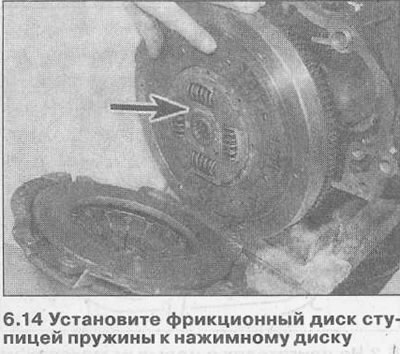
15. Install the pressure plate assembly, aligning the marks made during removal. Insert the pressure plate bolts, but tighten them only by hand so that the friction disc can still move.
Source is on the website (OPELBOOK.ru)
16. The friction disc must be centered so that when the transmission is installed, its input shaft can pass through the disc hub.
17. To do this, insert a screwdriver or any long rod through the friction disc into the recess in the end of the crankshaft and move the disc in the desired direction so that the crankshaft recess is exactly in the center of the disc hub. Alternatively, you can use a special centering tool (see illustration) or make a homemade tool from a metal or wooden pin, close in diameter to the recess in the crankshaft and having a thickening in the place of contact with the hub of the friction disk, corresponding to the diameter of the disk hole.
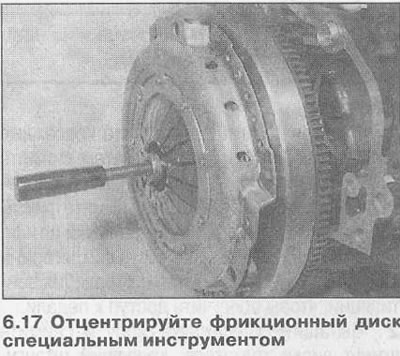
18. Once the friction disc is centered, tighten the pressure plate bolts evenly and in a diagonal sequence to the specified tightening torque Specifications. When finished, remove the centering tool. Where necessary, remove the clamping brackets from the pressure plate.
Warning: It is critically important to tighten the pressure plate bolts evenly to avoid distorting the diaphragm spring.
19. Install the transmission (see the relevant section).
Visitor comments