


Contents: Distributor ⬇ Ignition coil ⬇ Idle speed control knob ⬇ Crankshaft speed and position sensor ⬇ Controller ⬇
Below is a description of only those components of the system "Motronic ML4.1", which are not part of the fuel injection system "LE-Jetronic" and are not described in the relevant subsection (see above).
Distributor
The ignition distributor is installed at the end of the camshaft and is driven by it accordingly. It only performs the function of distributing high-voltage current to the spark plugs. The distributor can only be installed in one position and does not require any adjustments during operation.
Ignition coil
Like a regular ignition coil, the ignition coil of the system "Motronic ML4.1" converts the low voltage of the primary circuit into the high voltage of the secondary circuit required to break through the spark gap between the spark plug electrodes and ignite the working mixture.
Idle speed control knob
The idle speed regulator is located in the bypass air channel, made parallel to the throttle valve, in place of the additional air supply valve. It is an actuator electric motor with a permanent magnet. A flap is installed on the anchor shaft, which rotates. overcoming the force of the spring
When the throttle valve is closed, the air channel 8 is blocked to a certain degree by the regulator flap, which ensures the required engine crankshaft speed at idle.
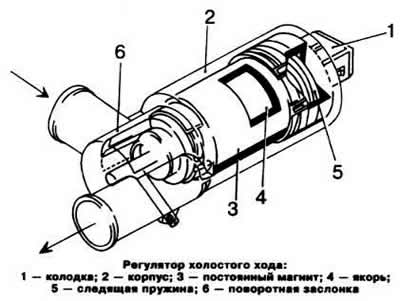
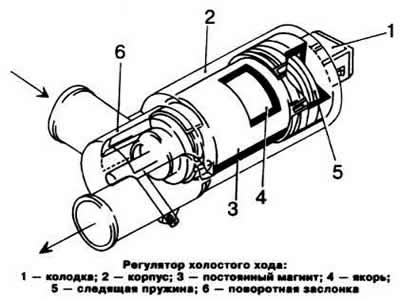
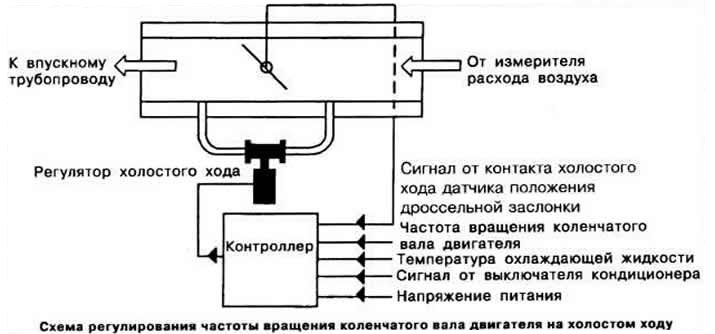
The idle speed regulator is controlled by commands from the controller control units, which determine the degree of opening of the rotary valve depending on the incoming information (see diagram). At the same time, the controller changes the ignition timing accordingly. When the air conditioner is turned on at idle, the controller receives a signal from the air conditioner switch and, on command, the idle mode increases to 1000 rpm. This increases the efficiency of the air conditioner and ensures uninterrupted engine operation at idle.
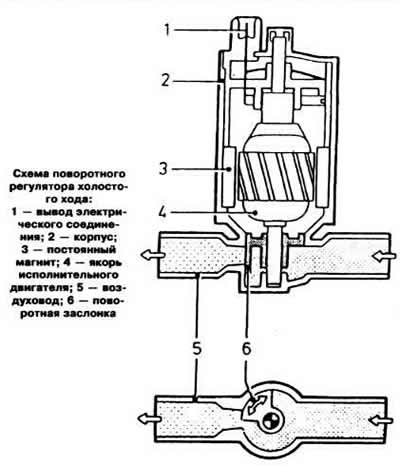
When starting a cold engine and during warm-up, the idle speed regulator functions as an additional air supply valve, ensuring that the idle speed is maintained within specified limits regardless of the engine load.
Crankshaft speed and position sensor
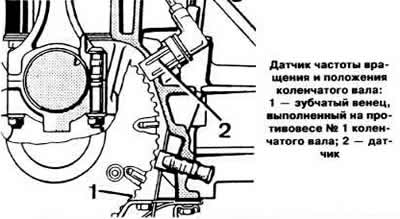
The crankshaft speed and position sensor is mounted on the engine cylinder block opposite the toothed rim made on the first counterweight of the engine crankshaft. It generates a voltage pulse when the toothed rim passes through its magnetic field.
When the rim teeth pass in front of the magnetic sensor, the air gap between the rim and the sensor changes. The changing leakage flux induces a sinusoidal alternating voltage in the sensor winding, the amplitude of which depends on the peripheral speed of the toothed rim, the air gap between the rim tooth and the sensor, the shape of the teeth, the magnetic characteristics of the sensor and the mounting bracket.
Depending on the engine crankshaft speed, voltage pulses of 0.5-100 V are sent from the sensor to the controller, which are converted by the controller input stage each time the counting circuit is set to zero into rectangular voltage pulses of constant amplitude, which are necessary for the operation of subsequent controller circuits.
The angular gap between the rim teeth is 6. One tooth is missing on the rim. When a toothless section of the rim passes in front of the sensor, which serves as a marker, the controller receives a pulse of the initial position of the crankshaft.
If the engine does not start or starts with difficulty, the cause may be a malfunction of this sensor.
Controller
The controller processes the information received from the sensors and controls the ignition and fuel injection programs according to its own program.
The controller includes an analog-to-digital converter that converts analog signals from sensors into digital form, a microprocessor, input circuits and output circuits with power amplification stages.
Each engine model corresponds to a specific type of controller. Therefore, when installing a new controller, it is necessary to make sure that its markings are identical to those of the failed device.
Visitor comments