


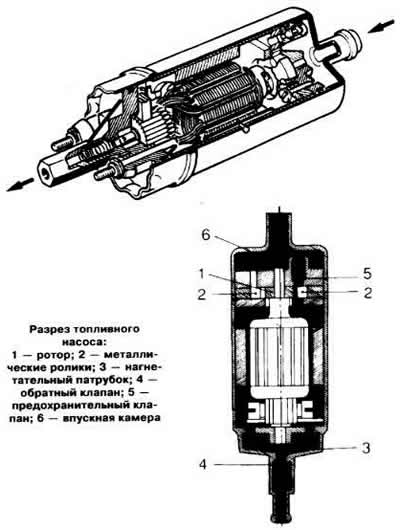
Fuel pump, rotary. Rotor 1 (see picture) the rotor of the pump is eccentrically mounted on the shaft of the electric motor with permanent magnets. In the chambers located along the circumference of the rotor there are metal rollers 2, which under the action of centrifugal force are pressed against the surface of the pump housing, providing a reliable seal. Fuel sucked into the gaps between the rollers and the pump housing is fed into the discharge pipe 3. When the engine is stopped, the check valve 4 closes the fuel supply channel. As soon as the fuel pressure exceeds 4 kg/cm³, the ball of the safety valve 5 closes the fuel supply channel from the inlet chamber 6.
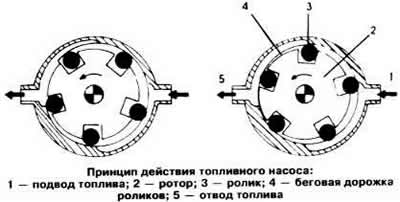
To maintain the required fuel pressure in the system, the fuel pump supplies a quantity of fuel that exceeds the engine's fuel consumption. For example, at full load, 70% of the fuel pumped by the pump drains into the tank after passing the pressure regulator.
The fuel pump is switched on by a relay that is triggered at a certain engine crankshaft speed when the starter is engaged. If the engine stops with the ignition on, the pump electric motor power supply circuit is immediately broken.
If the engine does not start or starts with difficulty, idles unstably, stalls regardless of the operating mode, and does not develop full power, then the cause may be a malfunction of the fuel pump.
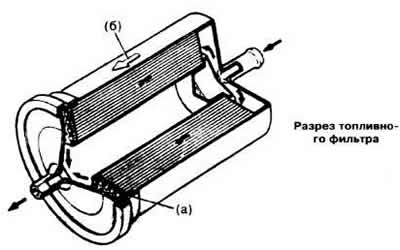
The fuel filter is installed on the discharge line after the fuel pump. The filter housing contains a porous paper filter element with a retention capacity of 8-10 microns and a filter surface of about 3000 cm³. Mesh metal filter "a" (see picture) traps particles of the filter element. Therefore, the filter must be installed strictly according to the arrow "6", showing the direction of fuel flow.
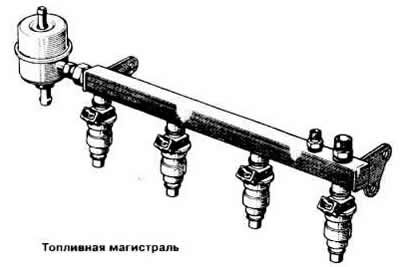
The fuel line has seats for the injection nozzles, and a pressure regulator is installed at its end. The fuel line functions as a storage tank and supplies fuel to the nozzles under the same pressure.
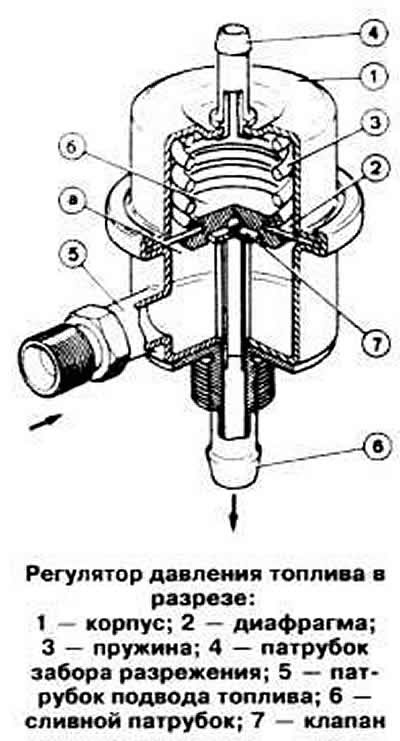
The diaphragm pressure regulator maintains a constant injection pressure regardless of the vacuum in the intake manifold. It consists of a metal housing 1 (see picture), diaphragm 2, spring 3, branch pipe 4 for taking vacuum from the intake manifold, branch pipe 5 for supplying fuel, drain pipe 6 and valve 7.
Article posted on an online resource (OPELBOOK)
If the fuel pressure in chamber "a" becomes greater than the force of spring 3, valve 7 opens and excess fuel drains into the tank. Chamber "b" is connected by a hose to the intake manifold, depending on the vacuum in which spring 3 acts on valve 7 in such a way that the pressure difference between chamber "a" and the intake manifold is always constant. As a result, regardless of the engine load, the differential pressure supplied to the injectors remains unchanged.
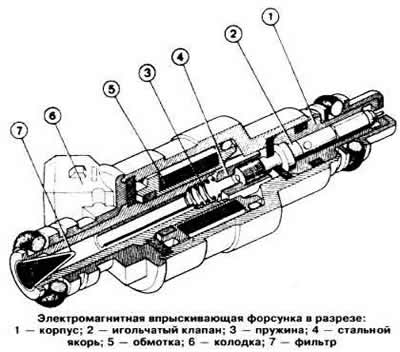
The amount of fuel injected depends only on the duration of the injector opening, determined by the electronic control unit based on information received from the sensors. The composition of the combustible mixture injected into the cylinders is the same, since the injectors are connected in parallel and open and close simultaneously. The injectors inject fuel twice for each revolution of the crankshaft, i.e. only half the amount of fuel required for the working stroke is injected at a time.
Difficulty starting, failure to start the engine, as well as its unstable operation at idle indicate a possible malfunction of the injectors.
The air flow meter consists of the following main parts: housing, pressure damper 1 (see picture), compensation valve 2, damper 3, potentiometer 4, intake air temperature sensor 5, bypass channel 6 and adjusting screw 7 for mixture quality (composition).
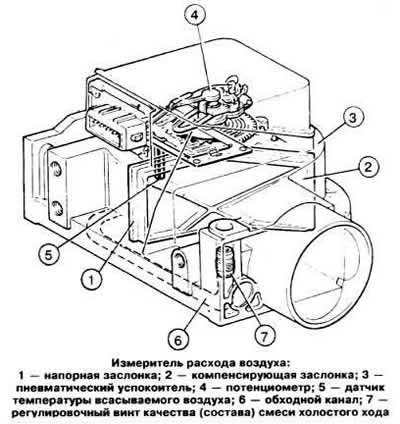
The operation of the measuring device is based on the so-called resistance of the environment. It measures the force acting on the flap 1, which the air flow entering the engine makes turn at a certain angle, overcoming the force of the spiral spring. The torque of the spring is selected so that the flap creates an insignificant loss of pressure. To prevent the pressure flap from swinging under the action of fluctuations in the gas flow occurring in the intake manifold, there is a pneumatic damper 3, in which a compensating flap 2 is located, having the same working surface as the pressure flap. The volume of the damper, as well as the gap between the compensating flap and the housing, are selected so that the pressure flap is able to track rapid changes in air flow during acceleration.
The potentiometer connected to the axis of the pressure flap converts the mechanical displacement of the pressure flap into a change in electrical voltage, which is transmitted to the electronic control unit for precise fuel dosing. The internal geometry of the meter provides a logarithmic correlation between the air flow and the angular position of the pressure flap. This allows for precise calculation of the optimal composition of the combustible mixture in non-load modes of engine operation.
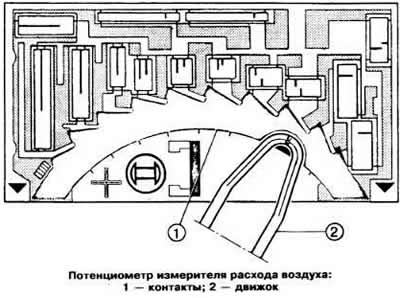
The potentiometer is installed in a sealed housing from which moisture has been completely removed. It consists of a ceramic base with a series of contacts 1 (see picture) and several resistors whose resistance values are corrected by laser. The resistance of the resistors is constant and does not depend on sharp temperature fluctuations in the engine compartment. Engine 2 is connected to the pressure valve and provides electrical communication with the contacts. To eliminate the influence of the battery voltage on the signal emitted by the potentiometer, the electronic control unit takes into account the difference between this voltage and the output voltage of the air flow meter.
The intake air temperature sensor is connected in parallel with the electric circuit of the meter. It is a resistor with a negative temperature coefficient, i.e. its resistance decreases with increasing temperature. The signals coming from the sensor change the output signal of the meter depending on the temperature of the incoming air. If the engine does not start or starts with difficulty, stalls after starting, if the fuel consumption is too high, and the carbon monoxide content in the exhaust gases does not correspond to the norm, then the cause of this may be a faulty intake air sensor.
The bypass channel under the pressure valve serves to pass air at idle speed. The quality (composition) of the mixture is regulated by changing the flow section of the bypass channel with the adjusting screw 7.
A faulty air flow meter can cause the following engine problems:
- the engine does not start or starts with difficulty;
- the engine starts and stalls;
- the engine runs unsteadily at idle;
- the engine does not have sufficient throttle response;
- increased fuel consumption;
- the engine stalls in all modes;
- the carbon monoxide content in the exhaust gases does not meet the standard;
- the engine does not develop full power.
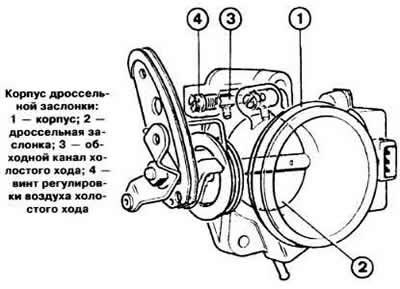
The throttle body consists of the body itself 1 (see picture), throttle valve 2, bypass channel 3 of idle speed and screw 4 of adjustment of air of idle speed. The quantity of air entering the engine. is determined by opening of throttle valve 2, mechanically connected with accelerator pedal. At idle speed with closed throttle valve the air necessary for formation of combustible mixture enters into the intake channel of the engine through gaps between edges of throttle valve and bypass channel 3. The quantity of air passing through bypass channel 3, and, consequently, the speed of rotation of crankshaft of the engine at idle speed is regulated by screw 4.
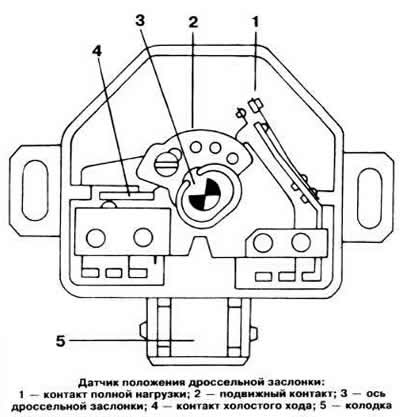
The sensor, mounted on the throttle valve axis, has two switching contacts for both end positions of the throttle valve. On the central contact 3 (see picture) the sensor has a movable contact 2, which, in accordance with the position of the throttle valve, closes and opens contact 4 of idle speed or contact 1 of full load. When closed (idling) or fully open throttle (full load) the corresponding signals are sent to the control unit, which, based on them, stops generating injector control pulses or issues commands to enrich the mixture.
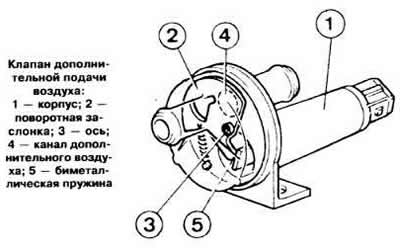
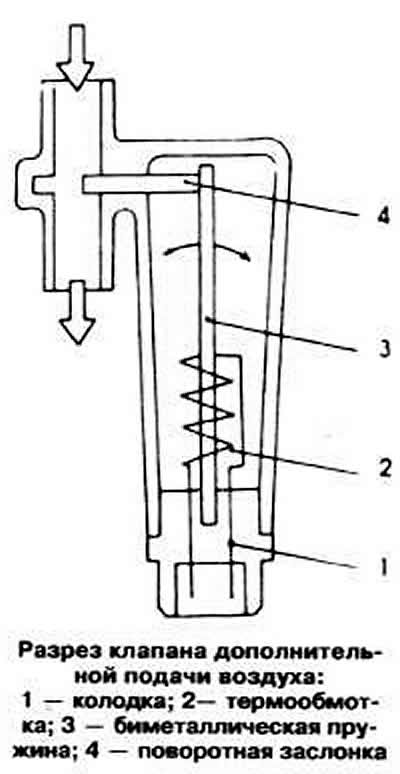
The additional air supply valve serves to increase the crankshaft speed during engine warm-up. It is installed in the air channel, made parallel to the throttle valve, through which the air flow measured by the air flow meter passes. When starting a cold engine, the additional air supply channel is opened by the rotary valve flap, which moves when the bimetallic spring is heated. As the engine warms up, the additional air supply channel gradually closes. If the engine does not start or starts with difficulty, stalls after starting, and also if the crankshaft speed does not increase as the engine warms up, then this may be due to a malfunction of this valve.
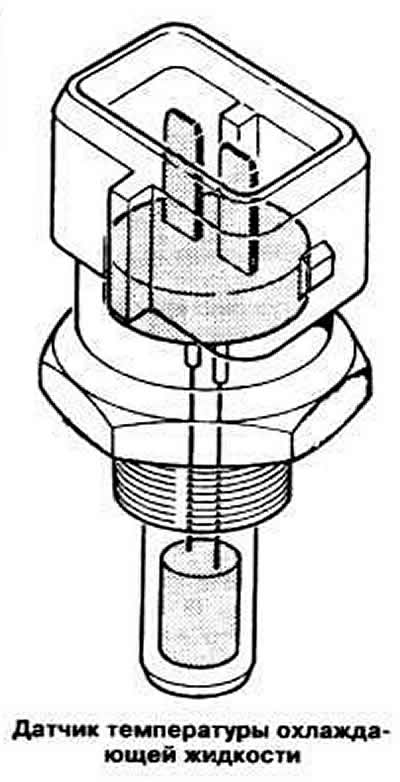
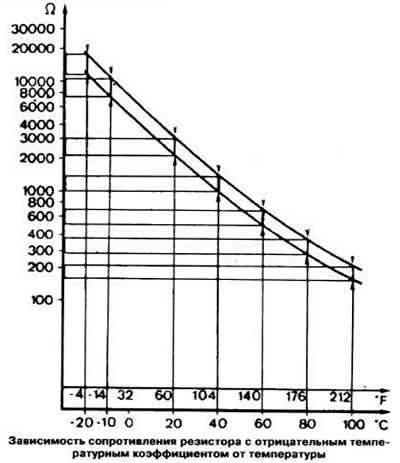
During engine warm-up, the control unit ensures enrichment of the combustible mixture based on an electrical signal coming from the coolant temperature sensor installed in the cylinder head. The sensor is a resistor with a negative temperature coefficient, i.e. its resistance decreases as the temperature increases (see graph). If the engine does not start or starts with difficulty, stalls after starting, and also with increased fuel consumption and abnormal CO content in the exhaust gases, it is necessary to check the serviceability of the coolant temperature sensor.
The electronic control unit processes information about the engine operating mode (intake air volume and temperature, crankshaft speed, coolant temperature and load) and converts it into an electronic pulse that determines the moment and duration of injection. The duration of the control pulses depends primarily on the amount of incoming air and the engine speed.
When starting the engine cold and then warming it up, it is necessary to enrich the working mixture significantly. For this purpose, the control unit issues commands to increase the duration of fuel injection by the injectors after processing the electrical signals coming from the coolant temperature and intake air sensors.
When the throttle valve is closed, the engine crankshaft rotates at a higher frequency, the control unit stops fuel injection. This is due to considerations of fuel economy and reducing the toxicity of exhaust gases. The generation of injector control pulses stops when the idle contact of the throttle position sensor closes (i.e. when the accelerator pedal is released), if the crankshaft speed exceeds the set value. When the engine speed decreases to the value entered into the control unit memory, the unit again begins to issue control pulses to the injectors, the duration of which will be determined by the coolant temperature. In order to prevent a sharp change in engine torque, when injection is resumed, the injectors inject fuel in two stages: first, only a small portion of the fuel dose is sprayed, and then the rest of the fuel is injected within a few tenths of a second.
Visitor comments