


Place the crankshaft in the main bearings.
Check the clearance between the bearing shells and the crankshaft journals using a calibrated plastic wire.
Thoroughly clean the working surfaces of the liners and the corresponding journal and place a piece of plastic wire on its surface.
Depending on the type of journal being checked, install the connecting rod with cover or the main bearing cover on the journal and tighten the mounting nuts or bolts as specified in subsection "Design and technical characteristics".
Remove the lid and use the scale on the packaging to determine the gap size by flattening the wire (see the values in the subsection "Design and technical characteristics").
If the clearance is less than the maximum, these liners can be used again. If the clearance is greater than the maximum, the liners on these journals must be replaced with new ones. If the crankshaft journals are worn and ground to the repair size, it is necessary to install liners of the corresponding repair size.
Determine the axial displacement of the crankshaft, which is limited by the liners with thrust flanges on the middle support. Check the axial clearance between the thrust flanges of the liners and the thrust surfaces of the crankshaft as follows:
- install the indicator on the magnetic stand on the crankshaft nose and insert the end of the screwdriver as shown in the photo;
- move the shaft with a screwdriver and check the axial clearance using the indicator (see the values in the subsection "Design and technical characteristics").
If the clearance is greater than the permissible value, grind the crank cheeks and main journals to the repair size and install liners with thrust flanges and the remaining main bearing liners of the corresponding repair size.
Install the liners in the block bed and in the crankshaft main bearing caps, having previously lubricated the inner surfaces of the liners with engine oil. Lubricate the bearing surfaces of the rear main bearing cap with sealant and place a bead of sealant with a diameter of about 6 mm in the grooves of the cap (shown by the arrow in the photo). Tighten the main bearing cap bolts as specified in subsection "Design and technical characteristics".
Note: Before tightening the front main bearing cap bolts, align the front main bearing cap.
After making sure that the crankshaft rotates freely and there is no jamming, install the flywheel and tighten its mounting bolts to the specified torque, having first lubricated them with a locking compound.
Using a mandrel, press the piston pin out of the connecting rod without heating. The piston pin cannot be reused.
Select pistons in accordance with the cylinder size group and observing installation clearances (see subsection "Design and technical characteristics").
Heat the connecting rod to a temperature of 280°C in an electric furnace or on a heating plate with a power of 1500-2000 W, controlling the heating temperature with a thermochromic pencil.
Install the conductor (KM 427 for engines "13N", "13S", KM 337 for engines "16S", "18E", "18SE", KM 634-6 for engines "14NV", "16SV", "C16N₂", KM 634-3 for other engines) and the mandrel into a new piston pin, lubricated with engine oil, and push the pin into the piston hole.
Quickly clamp the heated connecting rod in a vice.
Orient the piston relative to the connecting rod as shown in the photo.
When connecting a new piston to a connecting rod, observe the assembly dimensions (see subsection "Design and technical characteristics").
Quickly push the piston pin into the connecting rod hole until the mandrel shoulder rests against the piston skirt.
Note: To ensure proper connection of the pin to the connecting rod, press the pin as quickly as possible, since the connecting rod cools quickly, and after cooling, it will not be possible to change the position of the pin without deforming it.
Using a piston ring expander, install the piston rings into the grooves; check the gaps in the locks and position the ring locks 180° apart. In this case, position the locks of the upper and lower disc of the oil scraper ring at a distance of 25-50 mm, respectively, to the left and right of the expander lock.
Using a piston ring compressor, install the piston with the connecting rod into the cylinder.
Install new connecting rod cap bolts and tighten them as specified in subsection "Design and technical characteristics".
Warning: Connecting rods without bearing shells must differ from each other in weight by no more than 8 g. When replacing a connecting rod, it is necessary to weigh it and install a new connecting rod of exactly the same weight.
Install the cylinder head and camshaft bearing housing as shown above.
Install the oil pump and oil pan.
Warning: The short oil pan mounting bolt is installed on the timing drive side as shown in the photo.
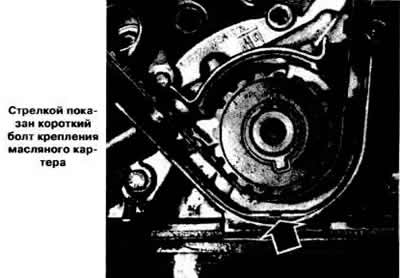
Install the water pump if it was removed.
Install the lower rear timing belt cover in place (see photo).
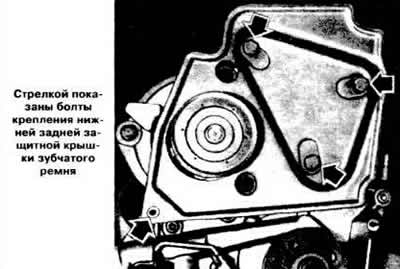
Place the camshaft drive belt on the pulleys, then install the crankshaft pulley.
Turn the crankshaft until the mark on the crankshaft toothed pulley aligns with the alignment protrusion on the cylinder block and the mark on the camshaft toothed pulley aligns with the mark on the upper rear protective cover of the toothed belt (see photo) or with the mark on the camshaft bearing housing.
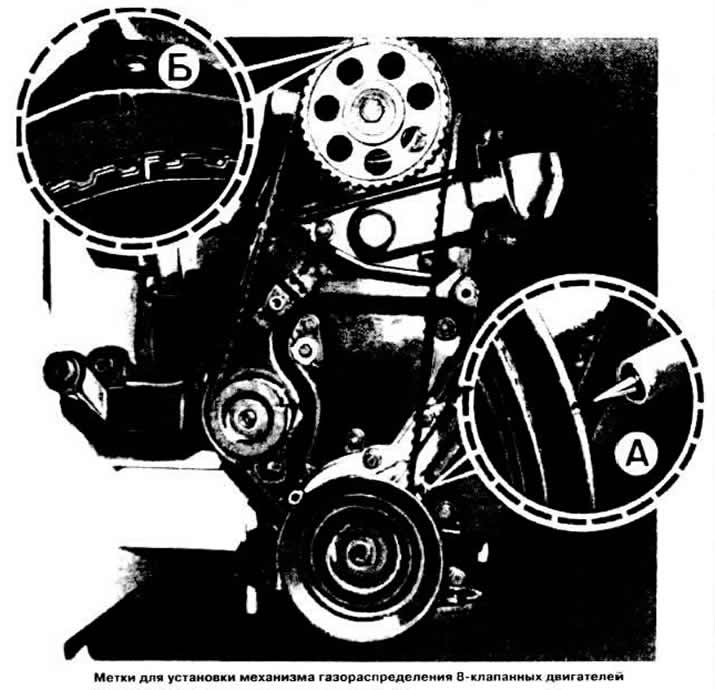
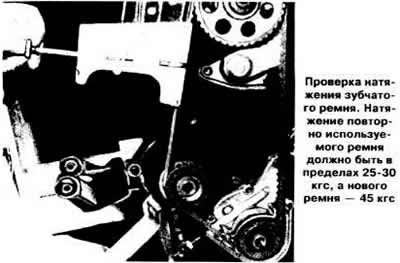
Adjust the tension of the toothed belt by turning the water pump housing (see photo), checking the belt tension with a special device.
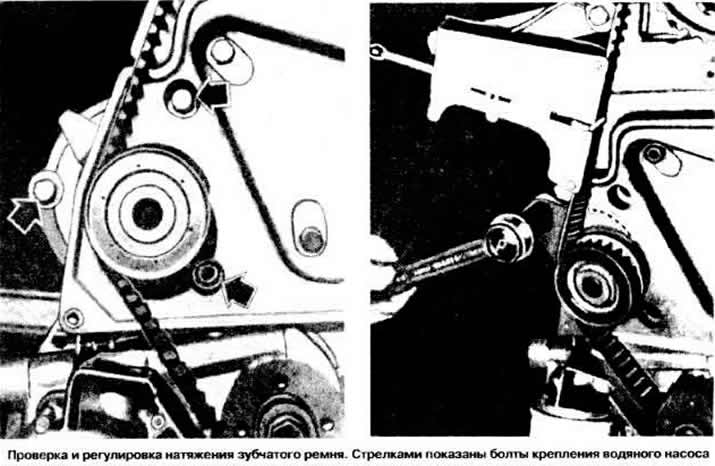
Note: Installation of the timing drive of a 16-valve engine is described in the corresponding subsection, see above.
Install the front timing belt cover.
Install the generator, put the drive belt on the pulleys.
Visitor comments