


Contents: Fuel consumption, CO emissions ⬇ Type, properties and volumes of…⬇ Recommended fuel ⬇ Recommendations for choosing the…⬇ Air conditioning refrigerant ⬇ Coolant type ⬇ Fuel tank cap ⬇
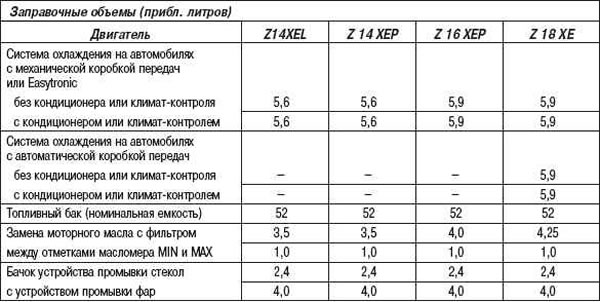
Filling volumes and operating materials used
Fuel consumption, CO emissions
For determining fuel consumption, regulation 80/1268/EEC, last amended in 1999/100/EG, has been in force since 1996.
The instructions take into account real traffic conditions: driving in the city is assessed with a coefficient of approximately 1/3, and driving outside the city with a coefficient of approximately 2/3 (fuel consumption in the city and outside the city). Cold starts and acceleration phases are taken into account.
In addition, an integral part of the instructions is the indication of CO₂ emissions.
The data provided cannot be used to draw conclusions about how much fuel each specific vehicle consumes.
When determining fuel consumption according to standard 1999/100/EC, the vehicle's tare weight is taken into account, which is also determined according to this standard. Additional special equipment of the vehicle may increase the weight somewhat and, with it, fuel consumption and CO₂ emissions.
Type, properties and volumes of working fluids
Use of leaded gasoline and abuse of fuel additives may result in failure of the catalytic converter of exhaust gases, non-compliance with toxicity requirements of the exhaust and engine failure. On diesel models, under no circumstances use additives for winter operation that increase fuel fluidity. If these requirements are not met, in the event of engine failure, the manufacturer's warranty obligations do not apply to this vehicle.
Recommended fuel
Petrol engines
Use unleaded gasoline with an octane rating of at least 95 (by research method).
Diesel engine
Use diesel fuel with a cetane number of at least 50.
[Text copied from this portal: OPELBOOK.ru]
Depending on the ambient temperature, operate your vehicle on summer or winter grade diesel fuel.
- At temperatures above –7°C – summer grade fuel
- At temperatures below –7°C – winter grade fuel
Warning! It is prohibited to fill the car with liquid fuel intended for domestic heating boilers, gasoline and any flammable liquids except diesel fuel. If unsuitable fuel is used, the engine will be seriously damaged.
Warning! Do not fill your car with summer grade diesel fuel if the ambient temperature is below -7°C. When cooled, paraffin crystals precipitate intensively in summer fuel, which clog the fuel filter. In this case, the engine may stop or work intermittently.
If unleaded super fuel is not available, fuel with an octane rating of 91 can be used, avoiding high engine loads and full vehicle loading, as well as driving in the mountains with a trailer or with a heavy load - this reduces engine power and torque. Knock controller depending on the type of fuel filled (its octane number) automatically adjusts the ignition system.
Note: Engines adjusted at the manufacturer to run on gasoline with an octane rating of AI-95 can be used without restrictions on AI-98 gasoline, but this will not lead to increased fuel economy or improved performance of the vehicle.
Recommendations for choosing the viscosity of motor oil (gasoline engines)
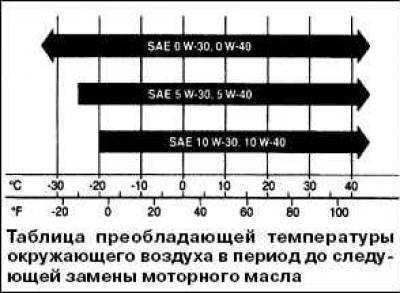
It is recommended to use motor oil with a viscosity of 5W-30; if such oil is not available, follow the diagram provided, taking into account the prevailing ambient temperatures.
Air conditioning refrigerant
Fill the air conditioning system of the vehicle with refrigerant HFC-134a (R-134a) or similar operating material, fully equivalent to the specified in its properties. Using another refrigerant will lead to serious damage to the air conditioning system and the need for a complete replacement of the system.
It is not recommended to release the refrigerant into the atmosphere. The refrigerant HFC-134a (R-134a), used in cars, does not have a harmful effect on the ozone layer of the atmosphere. However, the release of the refrigerant into the atmosphere may contribute to global warming to a small extent.
Coolant type
Only red should be used (dark orange), silicate-free antifreeze recommended by Opel, with the number 19 40 650/09 194 431 on the label. With prolonged use, the color of the antifreeze may turn yellow. This does not affect the properties of the coolant, so it can be used until the next scheduled maintenance.
Attention! It is prohibited to use green-blue antifreezes/antifreezes containing silicate in the cooling system. It is not recommended to add any additives to the antifreeze (including for sealing the system and eliminating minor leaks).
Fuel tank cap
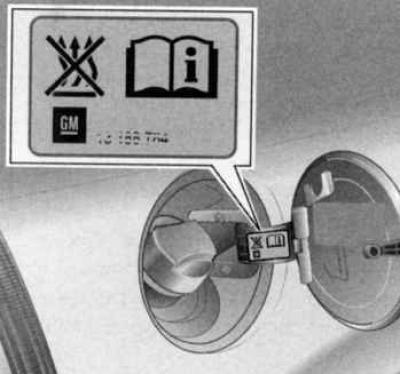
When replacing the fuel filler cap, only install the original cap issued by Opel for this model, as only it ensures full functionality. On vehicles with diesel engines, a special fuel filler cap is installed.
Visitor comments