
OpelBook.ru
Cars AvtoVAZ Cars Mitsubishi Cars BMW Cars Mercedes Cars Nissan Cars Toyota Cars Chevrolet
English Русский
Български
Беларускі
Український
Српски
Hrvatski
Română
Polski
Slovenský
Magyar
 |  Sitemap  |  Contacts  |    


Main Astra Corsa Insignia Kadett Omega Vectra Zafira Others Articles
Astra F (1991-1998, petrol) Astra G (1998-2004, petrol) Astra G (1998-2004) Astra H (2004-2009) Astra J (2009-2015, petrol)
  • Main
  • Astra
  • Astra J
  • Chassis
  • Wheels and tires
  • Classification of tires

Classification of tires (Opel Astra J)

            0

Depending on the operating conditions, the following classes of tires are distinguished.

1. Summer tires — are intended for use in the summer period, mainly on highways. The tread pattern consists of blocks or ribs separated by grooves (as a rule, not wide).

2. All season tires types M+S (Mud + Snow) and R+W (Road + Winter) – designed for use in both winter and summer. Provide acceptable performance characteristics for year-round use on highways and dirt roads. The pattern is more sparse than that of summer tires and may have microgrooves (lamellas) that provide traction on icy and snowy roads.

3. Winter tires — are used on winter roads and are:
  • non-studded - made from soft types of rubber, most often with a directional pattern with a large number of sipes and intended mainly for use on cleared roads;
  • studded or with stud option — made of medium-hard rubber, with studs or marked places for stud mounting. The tread pattern is sparse, with a developed network of lamellas. Provides good cross-country ability in deep snow and removes slush well. Studded tires have better grip on ice and packed snow compared to non-studded winter tires. However, studs worsen grip on hard road surfaces and create increased noise.

Attention! Do not forget that in accordance with the requirements of traffic regulations, when using studded tires on a car, you must place a triangular warning sign with the letter "W" on the rear window. This will help drivers of cars following you to choose the correct distance, taking into account the higher braking capabilities of your car on slippery surfaces.
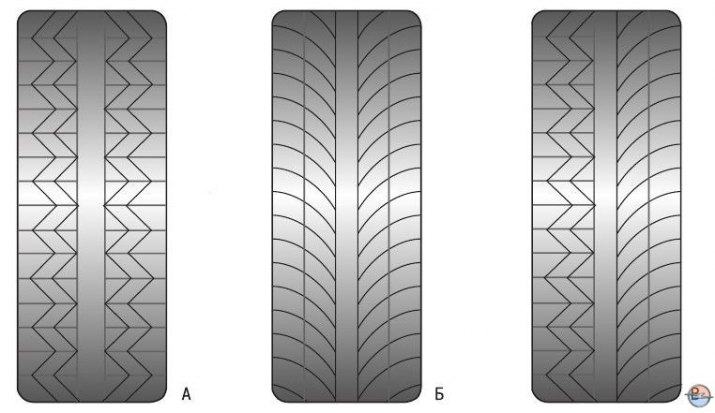


Fig. 1. Types of tread patterns:

Fig. 1. Types of tread patterns:
A - non-directional; B - directional; B - symmetrical


Depending on the arrangement of the elements tread pattern the tires can be non-directional, directional or asymmetrical:
  • non-directional pattern (see Fig. 1, A) - symmetrical relative to the radial plane of the wheel (passing through its axis of rotation). It is the most universal, so most tires are produced with this pattern;
  • directional drawing (see fig 1, B) - symmetrical relative to the central plane of rotation of the wheel (passing through the middle of the tread). It has an improved ability to drain water from the contact patch with the road and reduced noise. The spare wheel only matches the direction of rotation of the wheels on one side of the car, but its temporary installation on the other side is permissible provided that the vehicle is driven at low speeds.
  • asymmetrical pattern (see fig 1, B) – asymmetrical relative to the central plane of rotation of the wheel. It is used to implement different properties in one tire. For example, the outer side of the tire works better on dry roads, and the inner side on wet roads.

Tires are also distinguished by the method sealing the cavity. Tires come with or without a tube.


Tubeless tires are generally considered more reliable than tires with a tube because when a tire is punctured, air only leaves it through the puncture hole, while in tires with a tube, air flows out of the tire cavity around the entire circumference of the mounting hole, since the tightness of this connection is broken. Therefore, a tubeless tire leaves more time for maneuvering before driving on a damaged wheel becomes dangerous. In addition, tubeless tires are lighter than their counterparts with a tube. On the side of a tubeless tire, you can find the designation "TUBELESS", "TL", on board the chamber – "TUBETYPE", "TUBED TIRE".

[Article posted on a web portal: www.OpelBook.ru]
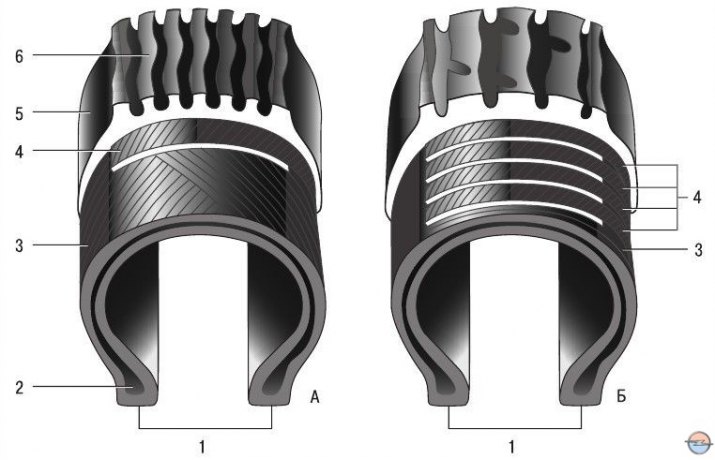
Fig. 2. Types of tire carcass: A – diagonal tire; B – radial tire; 1 – landing surfaces; 2 – rim; 3…

Fig. 2. Types of tire carcass: A – diagonal tire; B – radial tire; 1 – landing surfaces; 2 – rim; 3 – cord threads; 4 – breaker; 5 – sidewall; 6 – protector


According to the arrangement of the threads in the carcass and breaker, tires are divided into diagonal and radial:
  • diagonal tires A (Fig. 2), the carcass of which consists of one or more pairs of cord layers arranged so that the threads of adjacent layers cross. You most likely will not have to choose tires by this feature, since bias tires have almost completely been replaced by radial tires. The design of bias tires is outdated, but they continue to be produced in small quantities because they are relatively cheap to produce. The only advantage of these tires is that they have a stronger sidewall;
  • radial tires B, in which the carcass cord is stretched from one side to the other without overlapping of the threads. The direction of tension of the threads follows from the name.

The thin soft shell of the carcass is covered on the outer surface with a powerful flexible breaker - a belt made of high-strength non-stretchable cord, usually steel. Therefore, to the inscription "RADIAL" (radial) "BELTED" is often added to the sidewalls of tires (girt) or "STEEL BELTED" (belted with steel).


This arrangement of cord layers reduces the tension in the threads, which allows for a reduction in the number of layers, gives the carcass elasticity, reduces heat generation and rolling resistance.

Radial tires have many advantages, they are more comfortable, durable, stable, and have lower rolling resistance. Diagonal tires are preferable off-road and with high impact loads on the wheel.


This article is available at russian, bulgarian, belarusian, ukrainian, serbian, croatian, romanian, polish, slovak, hungarian
Checking the article: Trifonova Emilia

Share information:

Previous articles
Opel Astra J: Wheels and tires
Next articles

Features of tire design
Checking the radial and lateral runout of the disc
Wheel rim markings
Tire markings
Tips for choosing tires
Tubeless tire repair
Tips for using wheels
Wheel storage


See similar ones from other Opel car manuals:
▶ Checking the condition of the tires and their inflation… Opel Corsa B (1993-2000)
▶ Tires with the specified direction of rotation Opel Insignia A (2008-2017)
▶ Car wheels and tires Opel Kadett E (1984-1995)
▶ Wheels and tires Opel Omega A (1986-1993)
▶ What tires should I install? Opel Vectra B (1995-2002, petrol)
Link to this page in different formats

Visitor comments


No comments yet


How much will 46 + 19 =


Astra J (2009-2015, petrol) 
  • General information
  • Vehicle device
  • User manual
  • Faults en route
  • Maintenance
  • Power unit
  • Engine repair
  • Cooling and lubrication system
  • Engine power system
  • Exhaust system
  • Transmission
  • Clutch
  • Car gearbox
  • Drive shafts
  • Chassis
  • Front suspension
  • Rear suspension
  • Steering
  • Brake system
  • Wheels and tires
  • Body
  • Exterior
  • Interior
  • Doors and windows
  • Body Care
  • Heating and air conditioning
  • Security systems
  • Electrical equipment
  • Equipment and devices
  • Lighting and signaling
  • Power devices
  • Electrical circuits
Astra H (2004-2009) 
  • General information
  • Introduction to the guide
  • Troubleshooting
  • User manual
  • Maintenance
  • Power unit
  • Engine repair
  • Cooling and heating
  • Power and exhaust system
  • Ignition system
  • Launch and charge system
  • Transmission
  • Mechanical gearbox
  • Automatic gearbox
  • Drive shafts
  • Chassis
  • Brake system
  • Car suspension
  • Steering
  • Body
  • Interior
  • Exterior
  • Electrical equipment
  • Equipment and devices
  • Electrical circuits
Astra G (1998-2004) 
  • General information
  • Introduction to manual
  • User manual
  • Maintenance
  • Power unit
  • SOHC gasoline engines
  • DOHC gasoline engines
  • Diesel engines 1.7 and 2.0
  • Engine repair
  • Cooling system
  • Supply system
  • Injection system (gasoline)
  • Injection system (diesel)
  • Exhaust system
  • Charge and launch system
  • Ignition system (gasoline)
  • Preheat system (diesel)
  • Transmission
  • Manual gearbox
  • Automatic gearbox
  • Clutch
  • Drive shafts
  • Chassis
  • Brake system
  • Wheel suspension
  • Steering
  • Body
  • Exterior
  • Interior
  • Doors and windows
  • Ventilation and heating
  • Electrical equipment
  • Equipment and devices
  • Electrical circuits
Astra G (1998-2004, petrol) 
  • General information
  • User manual
  • Car care
  • Maintenance
  • Power unit
  • Single shaft engines
  • Twin shaft engines
  • Engine repair
  • Cooling and heating
  • Fuel and exhaust systems
  • Starting and charging system
  • Ignition system
  • Transmission
  • Clutch
  • Mechanical gearbox
  • Automatic gearbox
  • Drive shafts
  • Chassis
  • Brake system
  • Car suspension
  • Steering
  • Body
  • Interior
  • Exterior
  • Electrical equipment
  • Equipment and devices
  • Wiring diagrams Opel Astra
  • Wiring diagrams Opel Zafira
Astra F (1991-1998, petrol) 
  • General information
  • Maintenance
  • Power unit
  • Engine in car
  • Engine removed
  • Cooling system
  • Heating and ventilation
  • Fuel supply (carburetor)
  • Fuel supply (injector)
  • Emission control
  • Ignition system
  • Transmission
  • Clutch
  • Mechanical gearbox
  • Automatic gearbox
  • Drive shafts
  • Chassis
  • Brake system
  • Car suspension
  • Steering
  • Body
  • Exterior
  • Interior
  • Electrical equipment
  • Equipment and devices
  • Electrical circuits
OpelBook.ru © 2017–2026 · Mobile version · · Sitemap: EN BG BY UA RS HR RO PL SK HU · Feedback · Site search
Astra F, petrol · Astra G, petrol · Astra G · Astra H · Astra J, petrol · Corsa B · Corsa C, petrol · Corsa C · Insignia A · Kadett D · Kadett E · Omega A · Omega B · Omega B2 · Vectra A, petrol · Vectra A · Vectra B, petrol · Vectra B · Vectra C · Zafira A, petrol · Frontera A, petrol · Frontera B · Ascona C · Vivaro A ·
We want your visit to be comfortable 🤝! We use cookies 🍪 to make that happen.