
If the front tires are noticeably worn, it is recommended to change them with the rear ones.
When replacing, always install less worn tires in front.
When changing wheels, take care not to damage the paintwork of light alloy rims.
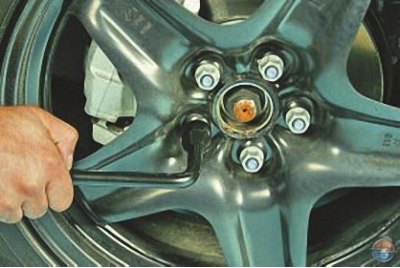
Tighten the wheel nuts gradually, through one.
Tire break-in. New tires have a smooth outer surface, so they are subjected to break-in. The initial break-in wear makes the tire rougher.
The first 200 km of the car should be driven very carefully (especially on wet surfaces).
Wheel balancing carried out to compensate for uneven weight distribution. When driving, the imbalance makes itself felt in the form of vibration, which is transmitted to the steering wheel. Steering wheel vibration due to wheel imbalance occurs in a certain speed range and disappears when the speed decreases or increases. Wheel imbalance can cause damage to joints, steering and shock absorbers. Be sure to balance the wheels after 20,000 km of the car or after any tire repair.
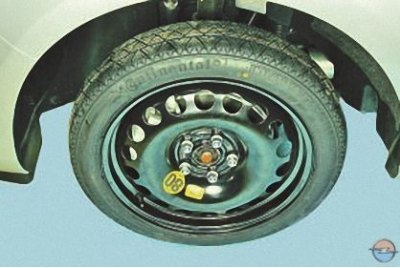
Spare wheel (small size) Can be installed on both front and rear axles.
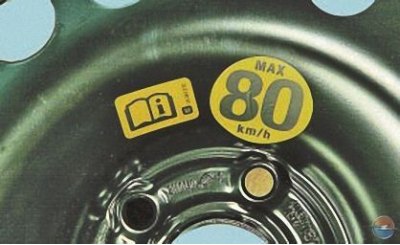
However, the maximum speed of the car when driving with such a wheel should not exceed 80 km / h.
Attention! When driving with a small spare wheel installed, try to avoid sudden braking, as in this case the anti-lock brake system (ABS) may not work correctly.
Repair the damaged stock wheel as soon as possible and install it in place of the spare.
Tire pressure check. The check is carried out with a special tire pressure gauge. Check pressure only when tires are cold. Tire pressure values are given in table. 1 in the article Wheel check.
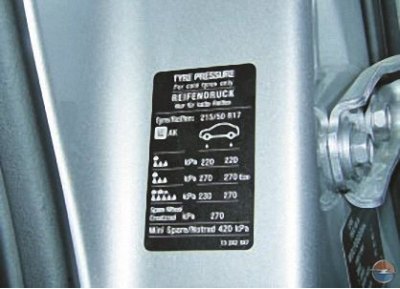
The tire pressure of the wheels can also be found on a plate affixed to the B-pillar in the driver's door opening.
Notes:
- Air pressure should only be checked with cold tires. The tires can be considered cold if at least three hours have passed since the car was stopped, or if after a long parking of the car you have driven a distance of no more than 1 km. After driving a car for a distance of several kilometers, the tires have time to heat up and the air pressure in them increases by 30-40 kPa (0.3–0.4 kgf/cm2) compared to the cold state. This is not a malfunction.
- Do not reduce the air pressure in warm tires to bring it to the nominal value that is set for cold tires. Otherwise, the tires will run at reduced air pressure.
The frequency of checks is once a month or when servicing the car.
It is advisable to check the pressure before long trips, since at this time the maximum temperature load on the tires is reached. When driving long distances at high speeds and under-inflated tires, more energy is expended to deform the tire, causing the tire to overheat, and the profile ply or even rupture may occur.
Visitor comments