


Towing a damaged vehicle
Strictly speaking, the vehicle should be towed with the drive (front) wheels off the ground (it's best to use a tow truck platform). If you have to tow your vehicle with the front wheels on the ground, follow these guidelines. Avoid towing your vehicle with all four wheels on the ground for long distances.
The vehicle is towed using a special removable towing eye, which is stored together with the on-board tool kit in the luggage compartment (see Chapter "Controls and operating techniques", Section 17). The holes for the sockets for its installation on the right side of the front and rear bumpers are covered with decorative covers (see illustration 11).
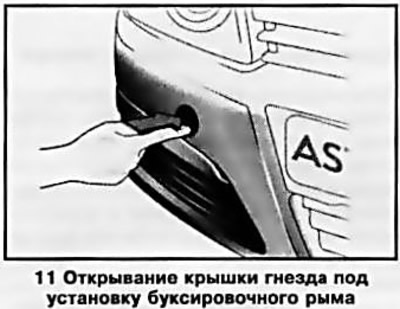
If you need to tow your vehicle, open the mounting socket cover in the front bumper by turning it counterclockwise (see illustration 12) screw in the towing eye and tighten it until it stops, so that the eye of the eye is in a horizontal position.
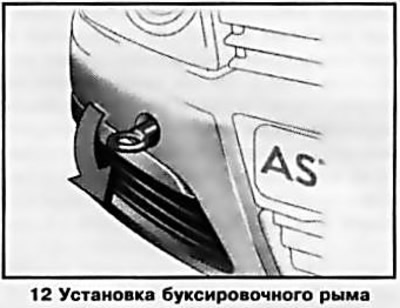
Use only a towing cable specifically designed for this purpose, or better yet, a rigid bar.
Attention: When choosing a cable or rod, make sure in advance that their design allows them to be secured to the eye of the towing eye!
Attach the towing rope/rigid bar to the eye.
Turn on the ignition to unlock the steering wheel and operate the brake lights, horn and windscreen wipers (see Chapter "Controls and operating techniques", Section 17).
Note: Models equipped with the Open system&Start, do not tow with a flat battery or other problems with the power supply system, as it will be impossible to remove the steering wheel lock! If the battery is flat, try to turn on the ignition from an auxiliary source (see below).
When towing a damaged vehicle, the transmission must be in neutral/selector lever in the "N" position. Do not forget to release the parking brake lever and turn on the hazard warning lights.
Before starting to move, drivers of both vehicles (towing and towed) the route should be agreed upon among themselves.
Remember that when the engine is off, the car's braking efficiency is significantly reduced due to the fact that the brake booster stops functioning, and you should press the foot brake pedal with significantly more force than usual - the stopping distance will increase. When maneuvering, you will have to apply more force to the steering wheel, since the power steering pump will also not function.
If necessary, activate the air circulation system (with appropriate equipment) and close the windows to prevent exhaust gases from the towing vehicle from entering the passenger compartment.
Movement should be carried out only at moderate speeds, along the shortest route and in compliance with traffic regulations. Avoid sudden braking, acceleration and maneuvering. Remember that when towing a car along the edge of a dirt road, there is always a risk of skidding to the side of the road.
Models equipped with automatic transmission (AT) can be towed on all four wheels in forward motion at a speed not exceeding 80 km/h and for a distance not exceeding 100 km. Attention: Failure to comply with the specified restrictions may result in transmission failure! If it is necessary to exceed these figures, as well as in the event of AT failure, towing is permitted only with the leading (front) wheels off the ground!
Article posted on a web portal (www.OPELBOOK.ru)
Warning: Towing vehicles equipped with Easytronic gearbox is prohibited if the automatic clutch was manually disengaged when the power supply was interrupted - contact a specialist vehicle recovery service for assistance (preferably to partners of the Opel company)!
In the event that another vehicle needs towing assistance, the towing eye is screwed into the socket on the rear bumper - the requirements for installing the eye are the same as when installing it in the front.
When starting off and changing gears, the driver of the towing vehicle must pay special attention to the smooth release of the clutch. The driver of the towed vehicle must try to keep the towing strap taut at all times to avoid jerking and running over it with the wheels (for these reasons, using a rigid bar is preferable).
Caution: Excessive traction force may cause damage to vehicles!
Towing for the purpose of starting the engine
It is not possible to start the engine of the models covered by this Manual by towing or pushing. The vehicles are equipped with a catalytic converter of exhaust gases - starting the engine by towing or pushing may lead to its failure. In addition, on models equipped with the Open&Start, if the battery is discharged, it is impossible to release the steering wheel lock. If necessary, use an auxiliary power source (see below).
Visitor comments