


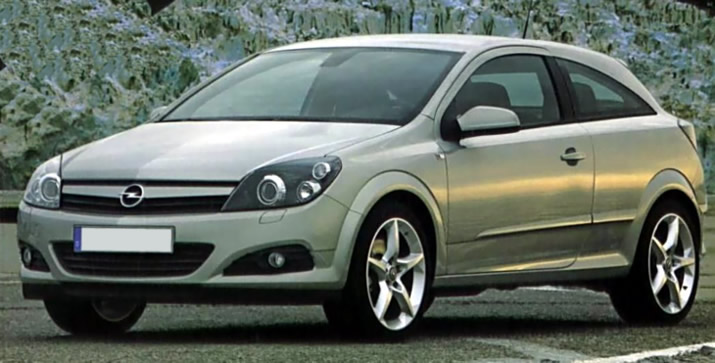
The new Opel Astra H model replaced the previous Astra G model and was presented to the automotive world at the Frankfurt Motor Show. Its presentation took place in the spring of 2004 in Andalusia (Spain). Since March 2004, a 5-door Hatchback has appeared on the market, followed by a station wagon model with a longer wheelbase in the fall, a sporty three-door Astra GTC in March 2005, and a Cabrio in September 2005.
This model is a clear indicator of the dynamics of the development of the Opel company, and allowed it to take one of the leading places among cars of the "compact" class. According to the company's representatives. The Astra G models successfully implemented the principle of ensuring maximum comfort and convenience for both the driver and passengers. The 3rd generation car inherited all the best features of its predecessor. Perfect ergonomics of the driver's seat, a wide range of steering column settings in two planes and driver's seat adjustment (including height), touch-sensitive steering column switch levers, plus conveniently located buttons for controlling the windows, mirrors, audio system and the presence of an on-board computer create a feeling of unity with the car.
The design of the car 8 as a whole creates a mood of speed, a sense of movement and impetuosity when looking at even a stationary car. The stiffening rib in the center of the hood in combination with the expressive decorative radiator grille is a reflection of the power and dynamism in the design of the car. The new Opel Astra offers a wide range of options, including light-alloy wheels, allowing you to give the car an even more impressive look.
The main focus of the designers when creating the car was to tie the interior and exterior design. The new cars have an increased interior space of 14 cm in length, 2 cm in width and 4 cm in height compared to the previous ones, which made it possible to provide passengers in the back seat with comfort comparable to that of cars of a higher class.
The source is on the online website OpelBook
In July 2005, the Opel Zafira B was launched. The Zafira's platform and suspension are borrowed from the Astra, but the body is of the High Capacity Station Wagon type. Not only does the Zafira have seven passenger seats arranged in three rows, it can quickly transform into a spacious truck, thanks to the rear rows of seats folding flush with the floor of the cabin.
The new Opel Astra/Zafira models offer ample opportunities to highlight the individuality of each driver, not only through design solutions.
The model range is traditionally distinguished by an extremely wide range of engines offered to consumers*. A full list of engines used to equip the models under consideration is given in the Specifications at the beginning of Chapter 2. Almost all engines are in-line 4-cylinder, 16-valve units with an overhead camshaft (DOHC) and are installed in the front part of the car transversely to the plane of symmetry of the latter. The most widely represented models on the Russian market are those equipped with petrol engines with working volumes of 1.4 l (90 hp), 1.6 l (105 hp) and 1.8 l (125 hp). Recently, models with more powerful engines have begun to appear - 2.0 l and 2.2 l (Zafira). The engines meet all modern requirements for the content of toxic components in exhaust gases. In addition, the 1.4 l and 1.6 l petrol models can be equipped with the "Twinport" system, which allows reducing fuel consumption when the engine frequently runs at idle and low speeds, which is especially important for the urban cycle.
All petrol models are equipped with an electronic fuel injection system. Turbocharged diesel engines are equipped with a highly fuel-efficient electronically controlled direct fuel injection system and a common fuel rail for all cylinders ("Common Rail"). Intercooler (intercooler), which increases the efficiency of the turbocharger, is included in the standard equipment of all diesel models.
To ensure the transmission of torque from the engine to the front drive wheels, a 5- or 6-speed manual gearbox (MCG) or a 4-speed automatic transmission (AT) is installed, as well as an Easytronic robotic gearbox - for more details, see Chapters 6 and 7.
The brake system is equipped with a standard vacuum booster. Most models use disc brakes on the front and rear wheels. On earlier models with small and medium engine displacements, rear drum brakes can be installed. A novelty of the brake system is the anti-rollback function - the system allows the driver to move off without using the parking brake. When the brake pedal is released, the brake pressure is maintained in the working circuit for another 1.5-2 seconds, which allows you to hold the car in place. The standard equipment of the 3rd generation Astra / Zafira provides for the mandatory installation of ABS. The fully independent front suspension consists of MacPherson struts and transverse lower arms. The rear suspension is with a torsion beam and two longitudinal arms, - for more details, see. Chapter 10. The creators of the new Astra have provided an original option - a system that monitors tire pressure and informs the driver about the need to pump up a particular wheel. Optionally, some models of the Station Wagon/Zafira are equipped with an automatic height control for the rear axle.
Steering - rack and pinion, with electric hydraulic booster, the steering mechanism is located behind the engine. The electric power steering pump does not require special maintenance. The hydraulic fluid reservoir is built into the pump assembly, - see. Chapter 10.
Both series (Astra and Zafira) are equipped with front and side airbags installed as standard equipment. Head airbags may be optional. An engine immobilization system is used to protect against theft. The standard infotainment system is equipped with a security code.
The active safety system of the new Opel Astra may include an interactive vehicle control system (Interactive Driving System - IDS). It is designed to compensate for high lateral acceleration and ensure precise cornering, fast and precise steering response, reduced braking distance and maintaining directional stability in emergency braking and maneuvering. IDS ensures unmistakable control of the vehicle in any situation. For some Opel Astra models, IDS is supplemented by the dynamic stabilization system (ESP+).
At the owner's request, some models can be equipped with a speed control system (tempostat). The detail to which the designers and engineers of the new Opel Astra/Zafira paid special attention is the headlights. At the owner's request, the Astra H models can be equipped with bi-xenon headlights and an adaptive front lighting system - for the first time among cars of this class. The headlights are covered with transparent polymer caps on the outside.
For the car enthusiast, Astra/Zafira cars are easy to maintain, maintenance costs are kept to a minimum, and most components requiring frequent attention are easily accessible.
With regular and proper maintenance, the Astra/Zafira will serve its owner for many years, remaining reliable and very economical.
Visitor comments