


Contents: VIN Decoding ⬇ Decoding engine designation ⬇
Improving the manufactured products is a continuous process of any flow production. At the same time, in the automotive industry, except for cases of major design changes of models coming off the conveyor, the results of the modification process are not covered in the vehicle operating manual. However, the manufacturer draws up numbered lists of manufactured spare parts, due to which the information encoded in the identification numbers of the car is of particular importance when purchasing the latter. When ordering the required spare part, try to provide the seller with as complete information about your car as possible. Be sure to provide the model name, year of manufacture, as well as the body/chassis and powertrain numbers.
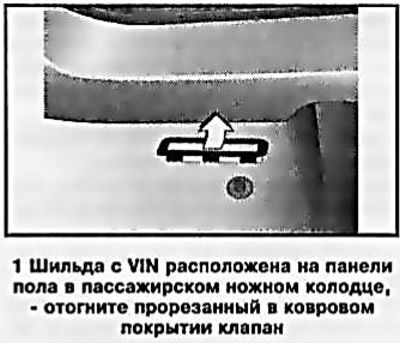
The vehicle identification number (VIN) plate is located to the right of the front passenger seat - there is a special valve in the carpet (see illustration 1).
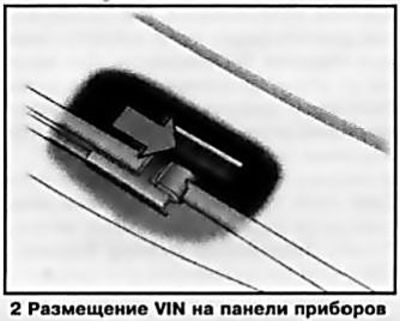
Note: On some models, the VIN is stamped on a plate that is attached to the vehicle's instrument panel on the left side under the windshield, so that it can be read from the outside (see illustration 2).
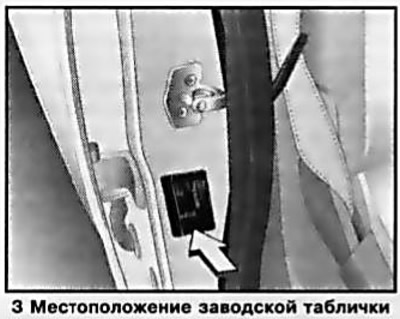
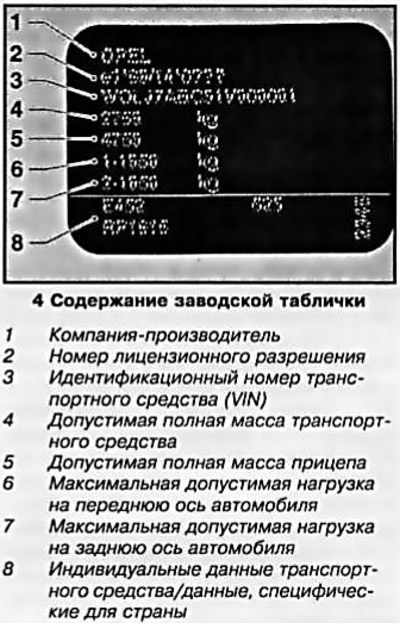
The VIN is also duplicated on the manufacturer's plate, fixed in the driver's door opening on the central pillar (see illustration 3), in addition to the identification number, the plate also contains some other data (see illustration 4).
VIN Decoding
Example:

- 1 Manufacturer code: WOL — Adam Opel AG.
- 2 Specialized version: 0 - does not belong to the number of special vehicles.
- 3 GM code: A — Astra-H.
- 4 Model range: H — Astra-H, M — Zafira-B.
- 5 GM-code of the vehicle configuration
- 6 Body type: 48 - 5-door Hatchback, 35 - Station wagon, 08 - 3-door Hatchback, Astra GTC, 75 - Zafira-B.
- 7 Year of model release: 4 - 2004, 5 - 2005, etc. up to 9 - 2009, A - 2010, B -2011, etc.
- 8 Manufacturer's code: 1 — Russelsheim, 2 — Bochum.
- 9 Serial number.
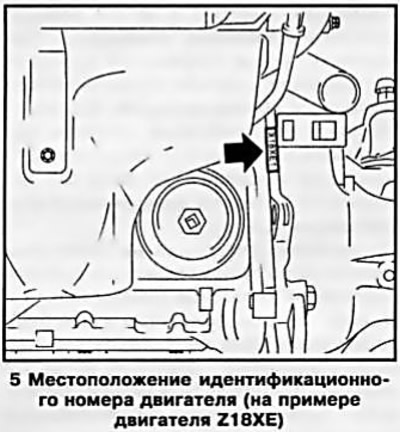
The engine designation and number are stamped on the left side of the cylinder block (see illustration 5).
Decoding engine designation
Example:

- 1 Exhaust toxicity standard: Z — compliance with EURO-4 standard.
- 2 Working volume (displacement): 18 - 1.8 l. 19 - 1.9 l. etc.
- 3 Compression ratio: L = 8.5-9.0; N = 9.0-9.5; S = 9.5-10.0; X = 10.0-11.5; Y > 11.5. Note: For diesel engine, the designation "Y" is not significant.
- 4 Fuel: E = gasoline, D = diesel.
- 5 Features (modification): R/H — high-boost, L — low-boost; P - Twinport system; T — turbocharging. Note: The letters "H", "R" and "L" are added to the designation of base engines whose performance is improved. For example, the Z18XER engine (140 hp) is a modification of the Z18XE engine (125 hp).
Visitor comments