


Contents: Engine cooling system ⬇ Interior heating and ventilation…⬇ Air conditioning system ⬇ Precautionary measures ⬇
Engine cooling system
Typical diagram of the functioning of the cooling system of an internal combustion engine
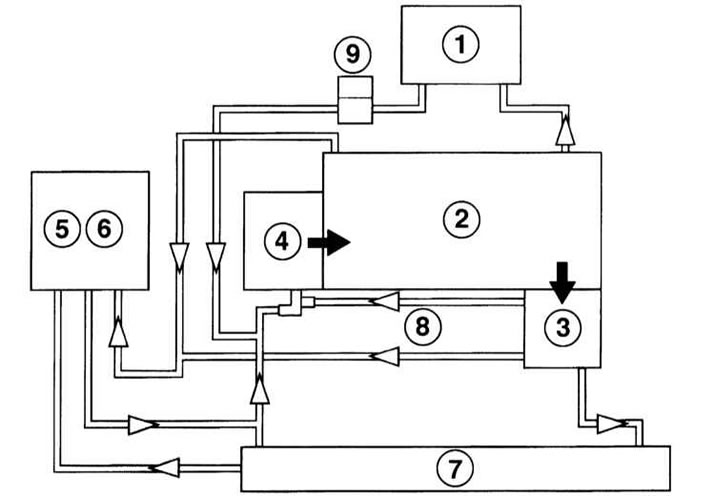
1 — Heater
2 — Power unit
3 - Thermostat
4 - Water pump
5 - Expansion tank
6 - Lid with valve
7 — Radiator
8 - Bypass hose
9 — Oil radiator
All models of the vehicles considered in this Manual are equipped with a positive pressure engine cooling system with thermostatic control of the working fluid circulation. The water pump is fixed to the engine block and pumps the coolant through the cooling tract of the latter. The flow of liquid washes the areas of each of the cylinders in the block, after which it is directed to the rear of the engine. Cooling channels laid in the block and cylinder head casting provide intensive cooling of the intake and exhaust ports, spark plug installation areas and exhaust valve guides (see illustration Typical diagram of the functioning of the cooling system of an internal combustion engine).
From the moment the engine is started, the cooling system goes through three operating modes: at the first stage, until the coolant temperature rises above a certain value, it circulates in a small circle from the working circuit of which the radiator is excluded. As the liquid heats up further, the plate valve of the gas-filled thermostat included in the system tract opens and the radiator is included in the circulation circuit. Then, when the coolant temperature reaches the next control value, a temperature-sensitive switch is triggered, ensuring the activation of the cooling system fan, the additional air flow pumped by it significantly increases the efficiency of the radiator heat exchanger.
The cooling system has a sealed design and is tightly closed with a radiator cap capable of withstanding a certain excess pressure, which increases the boiling point of the coolant and, accordingly, the efficiency of heat removal through the radiator. When the internal pressure in the system exceeds a certain value, the spring-loaded plate of the safety valve mounted in the radiator cap rises above its seat, ensuring the flow of excess coolant through the connecting (overflow) tube into the expansion tank. As the system cools, the liquid automatically returns from the tank to the radiator.
Adding coolant to the system is done through the neck of the expansion tank (see Chapter Routine maintenance), which simultaneously also acts as a receiver, accumulating the excess liquid displaced from the radiator.
Due to the listed design features, such a cooling system is called closed, since it excludes any functional losses of the working fluid.
Interior heating and ventilation systems
The main components of the interior heating system are a 4-speed electric fan and a heat exchanger, housed in a box-shaped heater housing, fixed under the vehicle's instrument panel. The heat exchanger is connected to the engine cooling system via rubber hoses (see illustration Typical diagram of the functioning of the cooling system of an internal combustion engine). The heater/air conditioner control unit is mounted in the vehicle's instrument panel. The coolant heated in the engine circulates through the heater's heat exchanger, giving off its heat to the air filling the casing. When the interior heating is turned on, the plate damper opens, as a result of which the internal volume of the heater casing is connected to the interior volume. When the fan is turned on, the impeller of the latter begins to drive the air supplied to the interior through the heat exchanger, ensuring its intensive heating.
Air is supplied to the passenger compartment through the front-level deflectors (two central and two lateral), footwell nozzles and windshield deflector. On Zafira models, air is additionally supplied to the rear of the cabin through deflectors installed in the rear of the central console.
For detailed instructions on how to use controls for the operation of heating, ventilation and air conditioning systems, see. User manual.
Air conditioning system
The operating principle of the air conditioning system
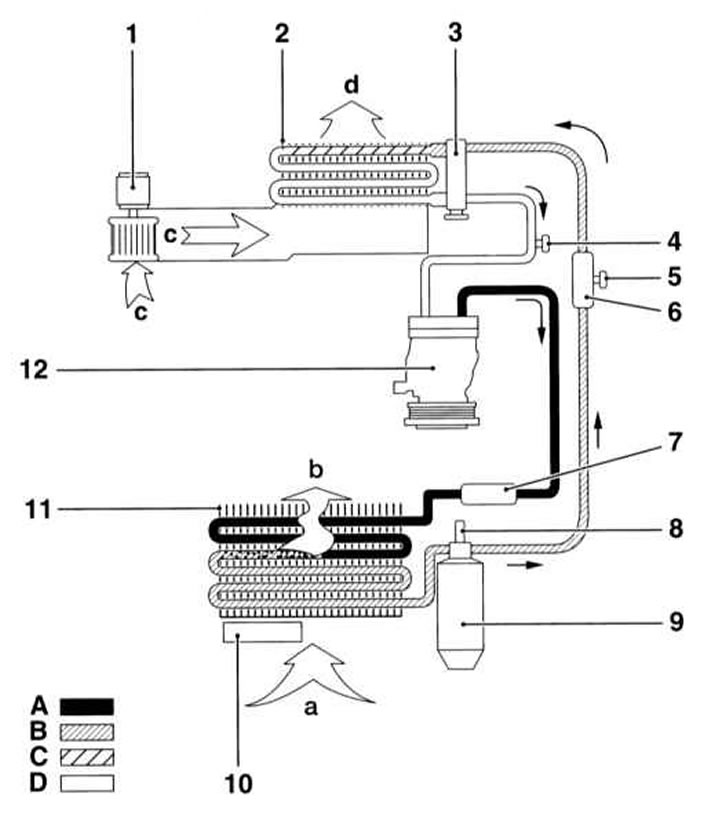
1 - Fan
2 - Evaporator
3 - Expansion valve
4 — Low pressure circuit service connector
5 — High-pressure circuit service connector
6 - Pulsation damper
7 — Pulsation damper
8 — Pressure switch sensor
9 — Receiver-dryer
10 - Additional fan
11 — Capacitor
12 — Compressor
a - Inlet flow of cold air passed through the condenser heat exchanger
b — The output flow of heated air, driven through the condenser heat exchanger and having removed heat from the refrigerant
c — Air flow created by the fan
d — Air flow passed through the evaporator heat exchanger
A — Gas phase of the high-pressure circuit
B — Liquid phase of the high-pressure circuit
C — Liquid phase of the low-pressure circuit
D — Gas phase of the low-pressure circuit
Article posted on a web portal OPELBOOK
The air conditioning system consists of a condenser installed in front of the radiator, an evaporator located next to the heater heat exchanger, a compressor mounted on the engine block, and a filter receiver-dryer (battery), equipped with a high-pressure reducing valve. All components are interconnected by refrigeration lines (see illustration The operating principle of the air conditioning system).
The fan drives the air entering the cabin through the evaporator heat exchanger, which operates in the opposite mode to the radiator. The refrigerant pumped through the heat exchanger boils and, evaporating, takes excess heat from the air. The temperature inside the cabin decreases to the required comfortable value (at the operator's choice). The compressor keeps the refrigerant circulating in the system by pumping the heated liquid through the condenser, where it cools and returns to the evaporator.
For detailed instructions on how to use controls for the operation of heating, ventilation and air conditioning systems, see. User manual.
Precautionary measures
To avoid scalding, never remove the expansion tank cap or disconnect any cooling system components when the engine is hot. If it becomes necessary to remove the expansion tank cap before the coolant has completely cooled, (although such situations should be avoided if possible), you should first release excess pressure in the system. Wrap the tank cap with a thick layer of rags, then slowly unscrew until hissing occurs. When the hissing indicating the release of steam stops, slowly unscrew the cap to the end. If the hissing does not resume at the last stage of unscrewing, the cap can be removed. During the entire procedure, do not bend your face over the neck of the tank, put on rubber gloves to protect your hands.
Try to avoid antifreeze getting on exposed skin and body panels. Accidental splashes should be washed off immediately with plenty of clean water. Never leave drained or fresh coolant stored in an open container. Wipe up spills with a rag immediately. Remember that the sweet smell of antifreeze can attract the attention of children and animals. Even a small amount of coolant getting into the digestive tract of a living organism can have the most serious consequences, including death.
Visitor comments