
OpelBook.ru
Cars AvtoVAZ Cars Mitsubishi Cars BMW Cars Mercedes Cars Nissan Cars Toyota Cars Chevrolet
English Русский
Български
Беларускі
Український
Српски
Hrvatski
Română
Polski
Slovenský
Magyar
 |  Sitemap  |  Contacts  |    


Main Astra Corsa Insignia Kadett Omega Vectra Zafira Others Articles
Vectra A (1988-1995, petrol) Vectra A (1988-1995) Vectra B (1995-2002, petrol) Vectra B (1995-2002) Vectra C (2002-2008)
  • Main
  • Vectra
  • Vectra B
  • Power unit
  • Diesel engine 2.0 liters
  • Top dead center (TDC) of the piston of the first cylinder

Top dead center (TDC) of the piston of the first cylinder (Opel Vectra B)

            0

Top dead center of a piston is the point through which each piston passes as the crankshaft rotates. Each piston reaches the TDC position at the end of the compression stroke, and again at the end of the exhaust stroke. The TDC of the piston of the first cylinder in the compression stroke is used to set the engine timing mechanism. Cylinder N1 is on the toothed belt side. The engine crankshaft rotates clockwise when viewed from the right side of the car.

1. Remove the ground cable from the battery. To improve access to the crankshaft pulley, apply the handbrake, raise the front of the car and secure it on stands.

2. To check camshaft cam location, remove the cylinder head cover or remove the brake vacuum pump with the timing gear mounting hole visible on the camshaft.

3. Turn the engine with a wrench on the crankshaft pulley until the timing mark on the crankshaft pulley aligns with the pointer. In this case, the pistons of the first and fourth cylinders are at the top dead centers.
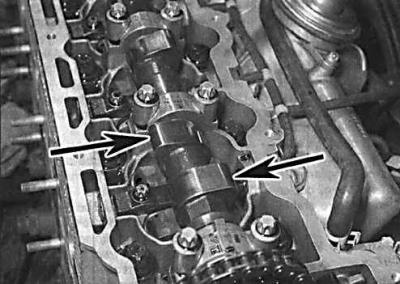
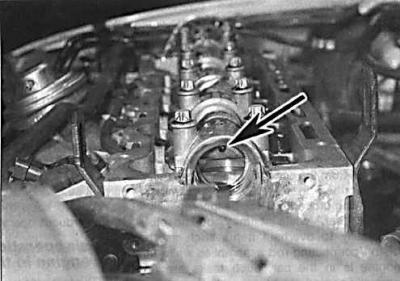
3. Turn the engine with a wrench on the crankshaft pulley until the timing mark on the crankshaft…


3. Turn the engine with a wrench on the crankshaft pulley until the timing mark on the crankshaft…


4. To determine which piston is in the compression stroke, check the position of the camshaft lobes. If the piston of the first cylinder is in the compression stroke, the camshaft lobes of the first cylinder (indicated by arrows in the photo on the left) will be directed upwards and the valve timing mechanism installation hole (indicated by the arrow in the photo on the right) on the left side of the camshaft will be in the upper position. If the cams of the first cylinder of the camshaft are pointing down, turn the engine crankshaft 360°.
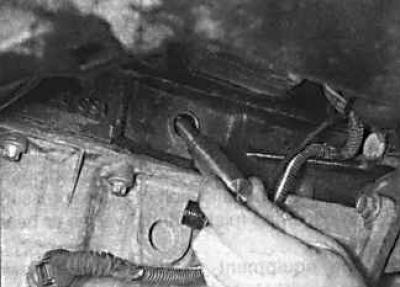


4. To determine which piston is in the compression stroke, check the position of the camshaft…


5. Remove the crankshaft position sensor from the engine block.
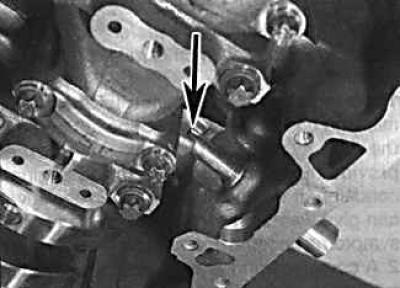
5. Remove the crankshaft position sensor from the engine block.


6. To lock the crankshaft in the position where the piston of the first cylinder is at top dead center in the compression stroke, install the pin through the hole of the crankshaft sensor on the front of the cylinder block.

(The source is on the online website www.opelbook.ru)


This article is available at russian, bulgarian, belarusian, ukrainian, serbian, croatian, romanian, polish, slovak, hungarian
Checking the article: Pavlovsky Nikolay

Share information:

Previous articles
Opel Vectra B: Diesel engine 2.0 liters
Next articles

Checking the compression pressure
Technical specifications
General information about 2.0 liter engine repair
Checking and adjusting the valve timing mechanism
Cylinder head cover — removal and installation
Crankshaft pulley — removal and installation
Chain cover — removal and installation
Chain tensioners — removal and installation
Chains and sprockets — removal and installation


See similar ones from other Opel car manuals:
▶ Bringing the piston of the first cylinder to the top dead… Opel Astra H (2004-2009)
▶ Bringing the piston of the first cylinder to the position… Opel Corsa B (1993-2000)
▶ Setting the piston of cylinder No. 1 to top dead center… Opel Omega B2 (1999-2003)
▶ Cylinder head cover Opel Insignia A (2008-2017)
▶ Cylinder head specifications Opel Kadett E (1984-1995)
Link to this page in different formats

Visitor comments


No comments yet


How much will 11 + 27 =


Vectra C (2002-2008) 
  • General information
  • User manual
  • Vehicle device
  • Maintenance
  • Troubleshooting
  • Power unit
  • Engine repair
  • Cooling system
  • Power and control system
  • Engine electrics
  • Transmission
  • Clutch
  • Car gearbox
  • Drive shafts
  • Chassis
  • Car suspension
  • Steering
  • Brake system
  • Body
  • Exterior
  • Interior
  • Doors, locks and windows
  • Heating and ventilation
  • Electrical equipment
  • Equipment and devices
  • Headlights and lighting
  • Electrical circuits
Vectra B (1995-2002) 
  • General information
  • User manual
  • Weekly checks
  • Maintenance (gasoline)
  • Maintenance (diesel)
  • Troubleshooting
  • Power unit
  • SOHC gasoline engine
  • DOHC petrol engine
  • Diesel engine 1.7 liter
  • Diesel engine 2.0 liters
  • Engine repair
  • Cooling system
  • Fuel system (gasoline)
  • Fuel system (diesel)
  • Charging system
  • Launch system
  • Ignition and preheat
  • Transmission
  • Clutch
  • Mechanical gearbox
  • Automatic gearbox
  • Drive shafts
  • Chassis
  • Brake system
  • Wheel suspension
  • Steering
  • Body
  • Exterior
  • Interior
  • Doors and windows
  • Heating and ventilation
  • Electrical equipment
  • Equipment and devices
  • Electrical circuits
Vectra B (1995-2002, petrol) 
  • General information
  • Maintenance
  • Help with malfunctions
  • Power unit
  • Engine repair
  • Exhaust system
  • Cooling system
  • Fuel system
  • Multec injection system
  • Four point injection
  • Transmission
  • Clutch
  • Gearbox and drive
  • Chassis
  • Wheel suspension
  • Steering
  • Brake system
  • Wheels and tires
  • Body
  • Exterior
  • Interior
  • Electrical equipment
  • Fuses and electronics
  • Power devices
  • Ignition system
  • Lighting and signaling
  • Equipment and devices
  • Heating and ventilation
  • Electrical circuits
Vectra A (1988-1995) 
  • Power unit
  • Engine repair
  • Ignition system
  • Lubrication system
  • Cooling system
  • Injection system
  • Fuel system (carburetor)
  • Fuel system (diesel)
  • Exhaust system
  • Transmission
  • Clutch
  • Car gearbox
  • Chassis
  • Front suspension
  • Rear suspension
  • Steering
  • Brake system
  • Wheels and tires
  • Body
  • Exterior
  • Interior
  • Electrical equipment
  • Electrical circuits
Vectra A (1988-1995, petrol) 
  • General information
  • User manual
  • Maintenance
  • Power unit
  • SOHC engine
  • DOHC engine
  • Cooling and ventilation
  • Fuel system (carburetor)
  • Fuel system (injector)
  • Exhaust converter
  • Transmission
  • Clutch
  • Mechanical gearbox
  • Automatic gearbox
  • Drive shafts
  • Chassis
  • Brake system
  • Car suspension
  • Steering
  • Body
  • Body elements
  • Electrical equipment
  • Power devices
  • Equipment and devices
  • Electrical circuits
OpelBook.ru © 2017–2026 · Mobile version · · Sitemap: EN BG BY UA RS HR RO PL SK HU · Feedback · Site search
Astra F, petrol · Astra G, petrol · Astra G · Astra H · Astra J, petrol · Corsa B · Corsa C, petrol · Corsa C · Insignia A · Kadett D · Kadett E · Omega A · Omega B · Omega B2 · Vectra A, petrol · Vectra A · Vectra B, petrol · Vectra B · Vectra C · Zafira A, petrol · Frontera A, petrol · Frontera B · Ascona C · Vivaro A ·
We want your visit to be comfortable 🤝! We use cookies 🍪 to make that happen.