


Contents: General information ⬇ Towing hitch ⬇ Basic characteristics of driving…⬇ Recommendations for driving a car…⬇
General information
Note: Towing a trailer reduces the service life and fuel economy of the vehicle, as the load on the components involved in transmitting torque increases (from the engine to the tires). In this regard, towing a trailer is not allowed at the initial stage of vehicle operation with a mileage of less than 800 km! During the first 800 km of the first towing of a trailer, driving at a speed of more than 80 km/h is not allowed!
Comply with the regulations regarding the maximum permissible weight of the towed trailer (see Specifications).
Before towing, make sure that both the trailer and the vehicle itself are in good technical condition. Use only certified coupling devices, the installation of which should be entrusted to experienced specialists. Similar requirements apply to the connection of the brake system and signal lights of the trailer.
Note: On models equipped with the parking assistance system, it is not possible to install a towing hitch.
When towing, try to select the speed and other driving parameters based on the weight of the trailer.
Remember that a trailer increases the actual weight of the vehicle, and do not exceed the maximum permissible vehicle weight and maximum load on its rear axle.
Towing hitch
The installation dimensions of the towing hitch are given in Specifications.
If equipped accordingly, the vehicle is equipped at the factory with a towing hitch with a removable ball joint.
On the Corsa C model, the ball joint is secured with a fastening strap in the spare wheel well together with the on-board tool kit (see illustration 32.1). Note: Combo models may be equipped with a non-removable ball joint.
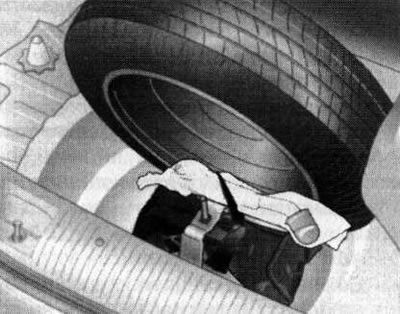
32.1. Storage of the removed ball joint of the towing hitch
To install the ball joint:
- Remove the plug (see illustration 32.2) from the ball joint seat and put it in the luggage compartment, remove the ball joint from the luggage compartment, remove the cover;
- Grasp the top and bottom of the ball joint latch (1) stops and pull it back, lock the latch in this position by pressing the lever (2) (see illustration 32.3);
- Insert the ball joint into the mounting socket and push forward with force until it locks into place (see illustration 32.4), then, pressing the lock button, install the protective cover on the latch levers - when the cover is fixed, the button should return to its previous position (see illustration 32.5)If the cover does not lock, repeat the installation of the ball joint;
- Check the reliability of the ball joint fixation.
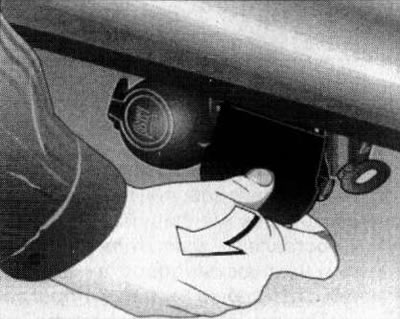
32.2. Removing the ball joint seat plug |
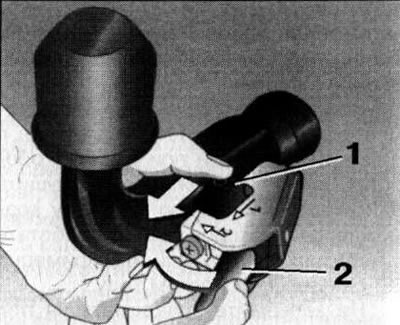
32.3. Preparing for ball joint installation |
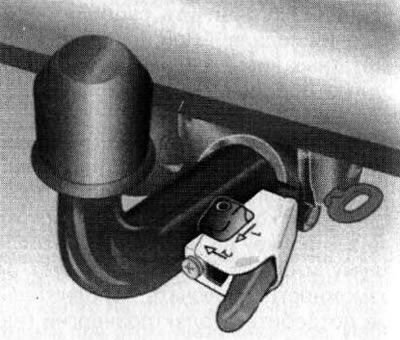
32.4. Ball joint of the towing hitch in the installed position |
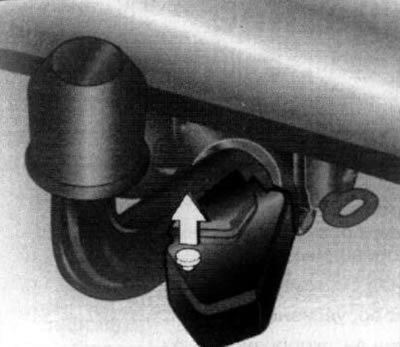
32.5. Installing the protective cover |
Note: Driving with a trailer is only permitted with a correctly installed ball joint. If you have any difficulties installing the support, please contact an Opel service station for advice.
If the trailer is equipped with a brake system, attach the safety cable to the eye (see illustration 32.6).
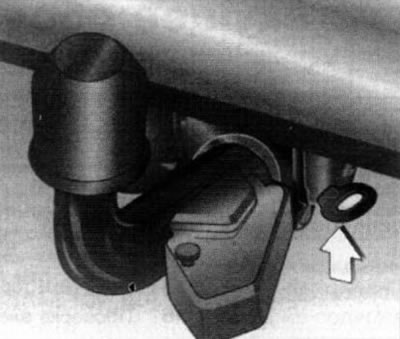
32.6. Eye for attaching the trailer safety rope
Dismantling of the support is carried out in reverse order.
Attention: When driving without a trailer, the ball joint must be removed without fail!
Attention: Cleaning the ball joint by blowing hot steam or other high-pressure devices is not permitted!
Basic characteristics of driving with a trailer
Trailer load
The actual trailer load is the difference between the actual total weight of the trailer and the support load in the trailered state. To check the trailer load, only the trailer wheels should be placed on the scale.
Only drivers with sufficient experience in towing large or heavy trailers should operate the vehicle with the full permitted trailer load.
The permissible trailer load values depend on the type of vehicle and engine, and exceeding them is prohibited. The permissible trailer load is recorded in the vehicle documents. In the absence of a special entry, the permissible trailer load value is applicable for climbs with a slope of no more than 12%.
These permissible values characterize the vehicle's capabilities only for the specified climbs at an altitude of up to 1000 m above sea level (NN - normal zero). At high altitudes, due to the rarefied air, engine power is reduced - to calculate the maximum permissible trailer load, it is necessary to reduce its standard value by 10% for every 1000 m above sea level.
Note: When driving on roads with a slight slope (less than 8%), there is no need to reduce the trailer load.
Support load
Support load (vertical load on the towing hitch) - is the force with which the trailer presses on the coupling support of the towing hitch. This force can be adjusted by distributing the weight when loading the trailer.
The maximum permissible support load of the towing vehicle is indicated on the type plate of the towing hitch and in the vehicle documentation (as a rule - 50 kg). It is necessary to try to always maintain this value, especially for heavy trailers.
Attention: The support load must be at least 25 kg!
When measuring the support load, it is necessary to set the drawbar of the loaded trailer to the same height at which it will be after the trailer is attached to the loaded vehicle. This is especially important for two-axle trailers.
Rear axle load
On Corsa C models, when a trailer is attached and the towing vehicle is fully loaded, including the weight of all passengers, the load on the rear axle must not exceed the permissible load (see Specifications) more than 45 kg, while the standard gross weight should not be exceeded by more than 15 kg. If the permissible load on the rear axle is greater, do not exceed the speed of 100 km/h.
Note: If the traffic rules establish lower speeds when operating a vehicle with a trailer, follow the rules.
On Corsa van models, exceeding the maximum axle load limits is not permitted!
Tire pressure
When operating a vehicle with a trailer, you should constantly ensure that the appropriate air pressure in the tires is maintained depending on the load of the vehicle and trailer (see Specifications), make appropriate adjustments if necessary.
Recommendations for driving a car with a trailer
When operating a vehicle with a trailer, please consider the following recommendations:
a) Additional trailer load significantly affects the operation of all vehicle systems and changes the operating parameters of the engine, controls, brakes and other systems.
b) Before starting the trip, check the serviceability of the towing hitch and the functionality of the brake system (with appropriate equipment) and external light signaling of the trailer.
c) Avoid sudden acceleration and braking, as well as sudden maneuvers when turning or changing lanes.
d) When towing a trailer, the vehicle is more susceptible to deviation from straight-line movement under the influence of gusts of crosswind, uneven road surfaces and aerodynamic disturbances from passing trucks, etc.
e) Observe the established traffic rules speed limit, especially on roads with slippery surfaces. The permitted speed for cars with a trailer is always lower than for a regular car. In any case, when driving with a trailer, it is not recommended to exceed 80 km/h.
f) On diesel models, on inclines of 10% or more, do not exceed 30 km/h in first gear and 50 km/h in second, and when equipped with AT, drive in first gear without exceeding 40 km/h.
g) When driving with a trailer, the braking distance of the vehicle increases significantly compared to normal driving conditions - keep a safe distance from the vehicle in front. In case of emergency braking, keep the brake pedal fully depressed until the vehicle comes to a complete stop.
h) If the trailer starts to "swerve" while driving, you should reduce the speed until you come to a complete stop - do not try to compensate for the trailer's swaying by manoeuvring the steering wheel.
i) On long descents the load on the brakes increases significantly, so engine braking should be used. The choice of gear should be made in accordance with the general rule of driving on descents: "Descend in the same gear in which the car can climb the slope".
j) After stopping on a steep incline, difficulties may arise when starting the car, especially on models with a manual transmission. In this case, hold the car from rolling using the parking brake. To start moving, depress the clutch pedal and set constant medium engine speed by pressing the gas pedal (gasoline engines - from 2500 to 3000 rpm, for diesel engines - from 2000 to 2500 rpm), then slowly release the parking brake lever and release the clutch pedal, smoothly increasing engine speed. On cars with AT/Easytronic in automatic mode, it is enough to fully depress the gas pedal. Before starting off in extreme conditions (high trailer weight, driving in mountainous conditions with steep climbs) you should turn off unnecessary energy consumers, such as rear window heating, air conditioning, and front seat heating.
k) When parking, it is recommended to place wheel chocks under the wheels of the car and trailer - stopping on steep slopes is not recommended. If equipped, always use the parking brake of the trailer.
l) When loading, the heaviest items should be placed above the trailer axle, and all manufacturer's recommendations should be followed.
Visitor comments