


Attention: The jack included in the standard vehicle package is intended only for short-term lifting of the vehicle when changing a wheel! When carrying out any other repair or maintenance work, the vehicle should be lifted using a hydraulic (or cart) jacks and must be installed on special supports placed under the load-bearing points of the bottom.
Warning: Never start the engine of a raised vehicle - it is dangerous!
Park the car on a flat horizontal surface, preferably with a hard surface. Set the steering wheel to neutral position - the front wheels should be turned along the longitudinal axis of the car.
Firmly apply the parking brake Move the selector lever to the "P" position (models with AT)/engage reverse/forward gear (models with manual transmission/Easytronic) and turn off the engine.
If necessary, put up an emergency stop sign and perform other actions provided for by the traffic rules.
Remove all passengers from the vehicle and ensure that they do not obstruct traffic or are at risk of injury while the tire is being changed.
Chock the wheel diagonally opposite the one to be replaced (see illustration 5).
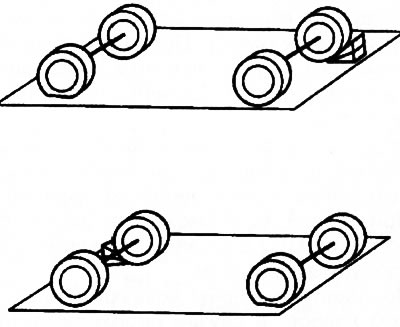
5. The wheel chock is installed under the wheel located diagonally relative to the corner of the vehicle being jacked up
Attention: Do not perform the procedure on a slope, ice or other slippery surface, and if you cannot completely remove the car from the roadway, wait for the arrival of road service specialists!
Prepare the necessary tool (jack, wheel wrench) and a spare wheel - a description of the standard storage locations for the corresponding on-board tools and spare wheel is given in Chapter "Controls and operating techniques".
Note: Depending on the configuration, a compact spare wheel or a repair kit may be supplied instead of a full-size spare wheel (see also Chapter 1, Section 5).
Attention: It is strictly forbidden to change several wheels at the same time!
Using a special hook included in the on-board tool kit or a screwdriver, remove the decorative/protective wheel cap (if available) (see illustration 6). Note: On some models, the cap is secured to the wheel with wheel bolts, which at this stage should only be loosened! On cars with alloy wheels, pry with a screwdriver (see illustration 7), remove the wheel bolt caps.
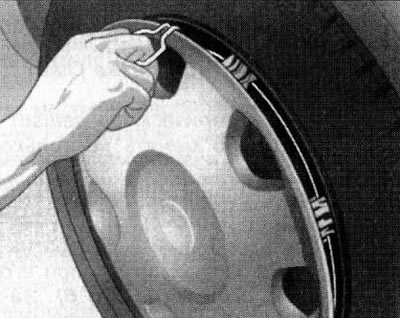
6. Removing the decorative cap
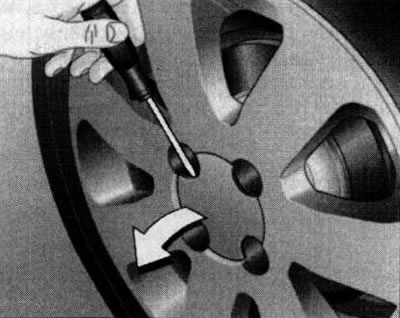
7. Removing the caps of the alloy wheel mounting bolts
Using a wheel wrench, loosen the mounting bolts of the wheel to be replaced by 1 + 2 turns.
On some models, the jack mounting locations are covered with decorative caps (see illustration 8), - release them by sliding out the covers.
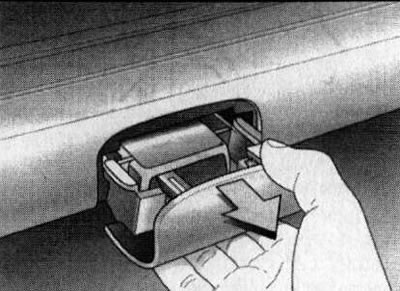
8. On models with the corresponding configuration, pull out the special decorative covers of the jack mounting locations
When performing work, use only the standard jack. Place the jack head under the appropriate point under the body threshold, - make sure that the jack is positioned strictly vertically (see illustration 9), and its heel rested on the ground with its entire surface. Try to install the jack on a hard surface, if necessary, you need to put some hard pad with a sufficiently developed surface under it (for example, a piece of board at least 1 cm thick, which is useful to have in a car).
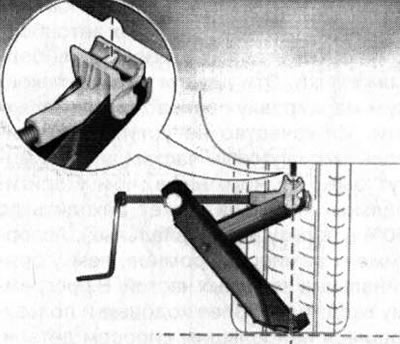
9. Correct installation of the jack
Attention: Remember that regardless of the slope, the jack must always be in a strictly vertical position!
Source is on the website: OpelBook
Rotate the jack until the distance from the ground to the threshold of the car is completely selected, make sure that the jack is in the correct position. Using the handle, hang up the damaged wheel.
Loosen the wheel bolts and replace the wheel. Clean the mating surfaces before installing the spare wheel. Tighten the bolts one by one.
Lower the jack until the tire touches the ground and tighten the wheel bolts diagonally. Have the bolts tightened to the required torque at a service station as soon as possible using a special wrench
Check the air pressure in the spare tire and adjust it if necessary (see Chapter 1, Section 5).
Reinstall the cap and bolt caps of the alloy wheels (with appropriate equipment).
Note: When designed accordingly, the cap is put on before tightening the bolts.
Do not start the engine until the jack is removed. Place the removed wheel and tool in their proper places.
When using a lift, its levers must be installed under the same support points as when installing a jack (see illustration 10). To avoid damage to the underbody, use suitable wooden or rubber pads.
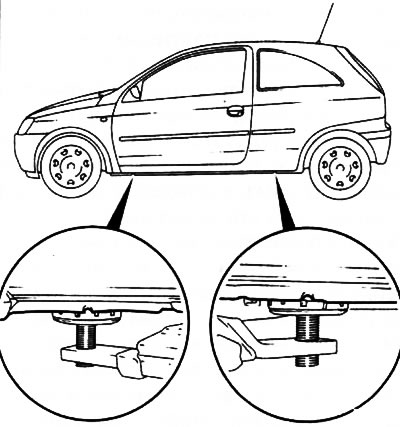
10. Lift lever mounting points (1)
After approximately 100 km of driving, it is necessary to check the tightening of the wheel bolts.
Visitor comments