
OpelBook.ru
Cars AvtoVAZ Cars Mitsubishi Cars BMW Cars Mercedes Cars Nissan Cars Toyota Cars Chevrolet
English Русский
Български
Беларускі
Український
Српски
Hrvatski
Română
Polski
Slovenský
Magyar
 |  Sitemap  |  Contacts  |    


Main Astra Corsa Insignia Kadett Omega Vectra Zafira Others Articles
Astra F (1991-1998, petrol) Astra G (1998-2004, petrol) Astra G (1998-2004) Astra H (2004-2009) Astra J (2009-2015, petrol)
  • Main
  • Astra
  • Astra J
  • Body
  • Exterior
  • Features of the body design

Features of the body design (Opel Astra J)

            0

The body of the Opel Astra J car is a five-door hatchback, load-bearing structure, all-metal. The body frame includes the base, sidewalls, roof and parts connected to each other by electric welding (point, seam and arc). The body is a non-separable structure with sufficient rigidity and carries all the vehicle units, body attachments and interior parts.

The hinged units include the side doors, hood, tailgate, front fenders, front and rear bumpers. The side doors, hood, tailgate are attached to the body with hinges, the front fenders - with bolts.

The side doors are equipped with electric windows for the front and rear doors.

The side door and side panel glass, as well as the rear door glass, are bent, polished, and tempered. The windshield glass is three-layered. The windshield glass, rear door glass, and side panel glass are glued into the corresponding openings of the body. The rear door glass is equipped with electric heating.

Both bumpers are plastic. The front and rear bumpers are painted in body color, attached to the body with bolts, screws and plastic clips. The radiator grille is removable, consists of two parts (upper and lower), attached with plastic holders to the front bumper.

The front seats are separate, with mechanical adjustment of the longitudinal position, the angle of the backrest and the lumbar support in the backrest of the driver's seat. Electric heating of the front seats is provided.

The headrests of the seats are easily removable, height-adjustable, and are installed on the backs of all seats. Three headrests are installed on the back of the rear seat.


The rear seat includes two cushions and two backrests. If necessary, the cushions and backrests of the rear seat can be folded in parts to increase the capacity of the luggage compartment. In the right backrest there is a hatch closed with a folding cover for transporting long objects (for example, skis).

The rear seat belts for all passengers are inertia-type.

To improve passive safety, the car is equipped with the SRS system. It includes two frontal, two side airbags and front seat belt pretensioners that are triggered in the event of an accident.

The car's interior is equipped with an energy-absorbing instrument panel, a cigarette lighter, sun visors, and a heating, ventilation and air conditioning system or climate control (depending on the configuration), rear view mirror, handrails.

The volume, temperature, direction and intensity of air flows are regulated by switches installed in the control unit of the heating, ventilation and air conditioning system.
The volume, temperature, direction and intensity of air flows are regulated by switches installed…


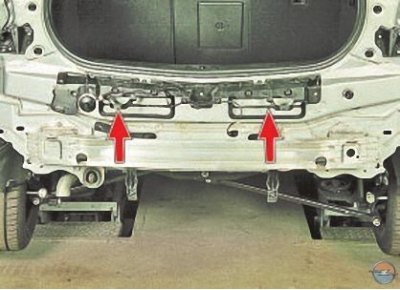
Exhaust ventilation of the body is carried out through deflectors with valves, which are installed under the rear bumper (in the photo the bumper is removed for clarity).


For towing another vehicle (or using it as a towing vehicle), in the front and rear parts of the body there are specially designed threaded sockets, closed with plugs in the bumpers, for installing a removable eye.

Useful tips


When parking the car for a long time, do not cover the body with a cover made of thick material. A cover that gets wet in the rain creates a steam "bath" when heated in the sun, the paintwork of the body underneath it can peel off and swell. In addition, under gusts of wind, the cover moves and erases the paint on the protruding parts of the body.

Do not place rubber objects on the body. After some time, the rubber will leave a residue on the coating (especially light) indelible stains.

If over time the rubber parts on your car's body become unsightly, wipe them with hand cream containing glycerin or silicone grease sold in auto parts stores.

From time to time, pass a thin metal plate between the side glass and the rubber strip on the door to remove dust and sand and protect the glass from scratches.

After washing, be sure to remove the rubber mats and dry the interior. Moisture under the mats is the main cause of floor corrosion.

[Article posted on Internet portal: Opelbook.ru]


This article is available at russian, bulgarian, belarusian, ukrainian, serbian, croatian, romanian, polish, slovak, hungarian
Checking the article: Trifonova Emilia

Share information:

Previous articles
Opel Astra J: Exterior
Next articles

Removal and installation the radiator grille
Removal and installation mudguards
Removal and installation the front bumper
Removal and installation the rear bumper
Removal and installation the front wing
Removal and installation the air intake box grille


See similar ones from other Opel car manuals:
▶ Features of the car body design Opel Corsa C (2000-2006, petrol)
▶ Design features and operating principle Opel Kadett E (1984-1995)
▶ Features of the lighting system Opel Insignia A (2008-2017)
▶ Structural safety of the body Opel Omega A (1986-1993)
▶ Body check Opel Vectra A (1988-1995, petrol)
Link to this page in different formats

Visitor comments


No comments yet


How much will 29 + 13 =


Astra J (2009-2015, petrol) 
  • General information
  • Vehicle device
  • User manual
  • Faults en route
  • Maintenance
  • Power unit
  • Engine repair
  • Cooling and lubrication system
  • Engine power system
  • Exhaust system
  • Transmission
  • Clutch
  • Car gearbox
  • Drive shafts
  • Chassis
  • Front suspension
  • Rear suspension
  • Steering
  • Brake system
  • Wheels and tires
  • Body
  • Exterior
  • Interior
  • Doors and windows
  • Body Care
  • Heating and air conditioning
  • Security systems
  • Electrical equipment
  • Equipment and devices
  • Lighting and signaling
  • Power devices
  • Electrical circuits
Astra H (2004-2009) 
  • General information
  • Introduction to the guide
  • Troubleshooting
  • User manual
  • Maintenance
  • Power unit
  • Engine repair
  • Cooling and heating
  • Power and exhaust system
  • Ignition system
  • Launch and charge system
  • Transmission
  • Mechanical gearbox
  • Automatic gearbox
  • Drive shafts
  • Chassis
  • Brake system
  • Car suspension
  • Steering
  • Body
  • Interior
  • Exterior
  • Electrical equipment
  • Equipment and devices
  • Electrical circuits
Astra G (1998-2004) 
  • General information
  • Introduction to manual
  • User manual
  • Maintenance
  • Power unit
  • SOHC gasoline engines
  • DOHC gasoline engines
  • Diesel engines 1.7 and 2.0
  • Engine repair
  • Cooling system
  • Supply system
  • Injection system (gasoline)
  • Injection system (diesel)
  • Exhaust system
  • Charge and launch system
  • Ignition system (gasoline)
  • Preheat system (diesel)
  • Transmission
  • Manual gearbox
  • Automatic gearbox
  • Clutch
  • Drive shafts
  • Chassis
  • Brake system
  • Wheel suspension
  • Steering
  • Body
  • Exterior
  • Interior
  • Doors and windows
  • Ventilation and heating
  • Electrical equipment
  • Equipment and devices
  • Electrical circuits
Astra G (1998-2004, petrol) 
  • General information
  • User manual
  • Car care
  • Maintenance
  • Power unit
  • Single shaft engines
  • Twin shaft engines
  • Engine repair
  • Cooling and heating
  • Fuel and exhaust systems
  • Starting and charging system
  • Ignition system
  • Transmission
  • Clutch
  • Mechanical gearbox
  • Automatic gearbox
  • Drive shafts
  • Chassis
  • Brake system
  • Car suspension
  • Steering
  • Body
  • Interior
  • Exterior
  • Electrical equipment
  • Equipment and devices
  • Wiring diagrams Opel Astra
  • Wiring diagrams Opel Zafira
Astra F (1991-1998, petrol) 
  • General information
  • Maintenance
  • Power unit
  • Engine in car
  • Engine removed
  • Cooling system
  • Heating and ventilation
  • Fuel supply (carburetor)
  • Fuel supply (injector)
  • Emission control
  • Ignition system
  • Transmission
  • Clutch
  • Mechanical gearbox
  • Automatic gearbox
  • Drive shafts
  • Chassis
  • Brake system
  • Car suspension
  • Steering
  • Body
  • Exterior
  • Interior
  • Electrical equipment
  • Equipment and devices
  • Electrical circuits
OpelBook.ru © 2017–2026 · Mobile version · · Sitemap: EN BG BY UA RS HR RO PL SK HU · Feedback · Site search
Astra F, petrol · Astra G, petrol · Astra G · Astra H · Astra J, petrol · Corsa B · Corsa C, petrol · Corsa C · Insignia A · Kadett D · Kadett E · Omega A · Omega B · Omega B2 · Vectra A, petrol · Vectra A · Vectra B, petrol · Vectra B · Vectra C · Zafira A, petrol · Frontera A, petrol · Frontera B · Ascona C · Vivaro A ·
We want your visit to be comfortable 🤝! We use cookies 🍪 to make that happen.