
OpelBook.ru
Cars AvtoVAZ Cars Mitsubishi Cars BMW Cars Mercedes Cars Nissan Cars Toyota Cars Chevrolet
English Русский
Български
Беларускі
Український
Српски
Hrvatski
Română
Polski
Slovenský
Magyar
 |  Sitemap  |  Contacts  |    


Main Astra Corsa Insignia Kadett Omega Vectra Zafira Others Articles
Omega A (1986-1993) Omega B (1993-1999) Omega B2 (1999-2003)
  • Main
  • Omega
  • Omega B2
  • General information
  • Maintenance
  • Front axle and steering

Front axle and steering (Opel Omega B2)

            0

Contents: Tie Rod End and Ball Joint Dust Caps…⬇ Power Steering - Checking Fluid Level ⬇
In accordance with the maintenance plan, the following work must be performed on this unit:
  • Tie rod ends. Check for play, condition of fastening and dust caps.
  • Ball joints. Check dust caps.
  • Power steering. Check the fluid level, top up if necessary. Visually inspect the steering gear, power steering pump, all pipes and the tightness of their connections.

Tie Rod End and Ball Joint Dust Caps - Check


1. Place the front of the vehicle on jack stands.

2. Check the ball joint caps on the left and right sides for damage by shining a flashlight on them (see arrows in the illustration).
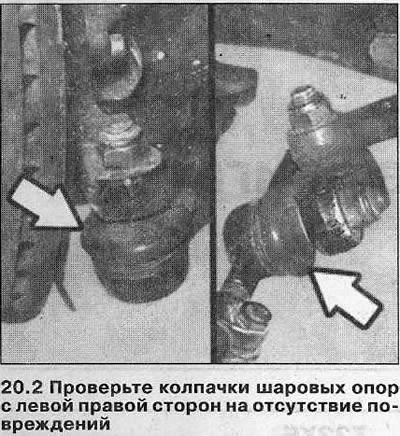
2. Check the ball joint caps on the left and right sides for damage by shining a flashlight on them…


3. Replace damaged caps. For safety reasons, replace the corresponding ball joint together with the cap, because if dirt gets into it, it will certainly break the support.

Power Steering - Checking Fluid Level


The oil level in the power steering reservoir should be checked with the engine turned off.

4. Unscrew the power steering reservoir cap and remove it. Wipe the dipstick on the cap with a clean, lint-free cloth (see illustration).
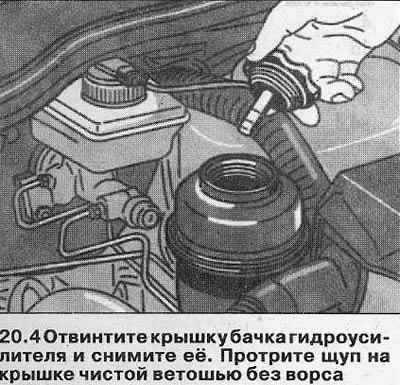


4. Unscrew the power steering reservoir cap and remove it. Wipe the dipstick on the cap with a…


5. Replace the cap and remove the dipstick. The oil level in the tank should be between both marks on the dipstick. If the engine is warm, the fluid level in the tank may be near the upper mark. When the oil is cold, its level should not be below the minimum mark. If necessary, adjust the oil level. You can add Dextron lit transmission oil. Be sure to add only fresh oil, because even the slightest contamination will lead to malfunctions in the power steering.

6. Add oil, start the engine and turn the steering wheel from lock to lock several times with the engine running. This will remove air from the power steering.

It is recommended to check the tightness of the steering control when adding fluid to the reservoir.


This article is available at russian, bulgarian, belarusian, ukrainian, serbian, croatian, romanian, polish, slovak, hungarian
Checking the article: Shapovalov Yaroslav

Share information:

Previous articles
Opel Omega B2: Maintenance
Next articles

Wheels and tires
Brake fluid — replacement
Brake fluid — checking the level
Brakes. Tires. Wheels
Gearbox and final drive
Spark plugs — removal, inspection and installation
Body. Interior equipment


See similar ones from other Opel car manuals:
▶ Front Wheel Hub Bracket (Steering Knuckle) — Removal and… Opel Astra G (1998-2004, petrol)
▶ Removal and installation the front axle stabilizer Opel Corsa C (2000-2006, petrol)
▶ Replacing the steering knuckle and front suspension fork GNB Opel Insignia A (2008-2017)
▶ Annual technical inspection of the front suspension and… Opel Kadett D (1979-1984)
▶ Front suspension and axle shafts. Design and general… Opel Vectra A (1988-1995)
Link to this page in different formats

Visitor comments


No comments yet


How much will 27 + 18 =


Omega B2 (1999-2003) 
  • General information
  • User manual
  • Maintenance
  • Troubleshooting
  • Power unit
  • Petrol 4-cylinder
  • Petrol 6-cylinder
  • Engine overhaul
  • Diesel engines 2.0 l
  • Diesel engines 2.5 l
  • Cooling and heating
  • Injection system (gasoline)
  • Fuel system (diesel)
  • Fuel system
  • Exhaust system
  • Ignition system
  • Transmission
  • Clutch
  • Mechanical gearbox
  • Automatic gearbox
  • Main gear and shafts
  • Chassis
  • Brake system
  • Car suspension
  • Steering
  • Body
  • Body elements
  • Electrical equipment
  • Equipment and devices
  • Electrical circuits
Omega B (1993-1999) 
  • General information
  • User manual
  • Tips for the car owner
  • Maintenance (gasoline)
  • Maintenance (diesel)
  • Power unit
  • Petrol engine SOHC 2.0 l
  • Petrol engine DOHC 2.0 l
  • Petrol engines 2.5 and 3.0 l
  • Repair of gasoline engines
  • Diesel engine 2.0 l
  • Diesel engine repair 2.0 l
  • Diesel engine 2.5 l
  • Cooling and heating
  • Power system (petrol)
  • Emission reduction
  • Fuel system (diesel 2.0 l)
  • Fuel system (diesel 2.5 l)
  • Launch system
  • Ignition system
  • Transmission
  • Clutch
  • Mechanical gearbox
  • Automatic gearbox
  • Drive shafts
  • Chassis
  • Brake system
  • Wheel suspension
  • Steering
  • Body
  • Exterior
  • Interior
  • Doors and windows
  • Electrical equipment
  • Equipment and devices
  • Wiring diagrams (early)
  • Wiring diagrams (late)
Omega A (1986-1993) 
  • General information
  • User manual
  • Maintenance
  • Changes and additions
  • Troubleshooting
  • Power unit
  • Gasoline engines
  • Diesel engines
  • Cooling system
  • Fuel system (gasoline)
  • Fuel system (diesel)
  • Ignition system
  • Transmission
  • Clutch
  • Mechanical gearbox
  • Automatic gearbox
  • Cardan shaft
  • Drive shafts
  • Chassis
  • Brake system
  • Car suspension
  • Steering
  • Body
  • Exterior
  • Interior
  • Electrical equipment
  • Power devices
  • Lighting and appliances
  • Electrical circuits
OpelBook.ru © 2017–2026 · Mobile version · · Sitemap: EN BG BY UA RS HR RO PL SK HU · Feedback · Site search
Astra F, petrol · Astra G, petrol · Astra G · Astra H · Astra J, petrol · Corsa B · Corsa C, petrol · Corsa C · Insignia A · Kadett D · Kadett E · Omega A · Omega B · Omega B2 · Vectra A, petrol · Vectra A · Vectra B, petrol · Vectra B · Vectra C · Zafira A, petrol · Frontera A, petrol · Frontera B · Ascona C · Vivaro A ·
We want your visit to be comfortable 🤝! We use cookies 🍪 to make that happen.