


Note: Opel is constantly improving the design and configuration options of its vehicles. The latest models equipped with diesel engines, as well as a 1.6-liter gasoline engine, may be equipped with 6-speed manual transmissions - they are not discussed in this Manual.
2. All boxes have full synchronization. The transmission number is applied to the nameplate or stamped/engraved on the box housing (see accompanying illustrations).
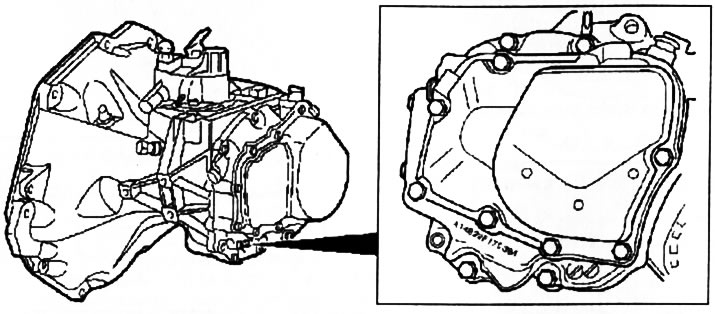
8.2a. Identification number of F13/F17/F17+ and Easytronic gearboxes
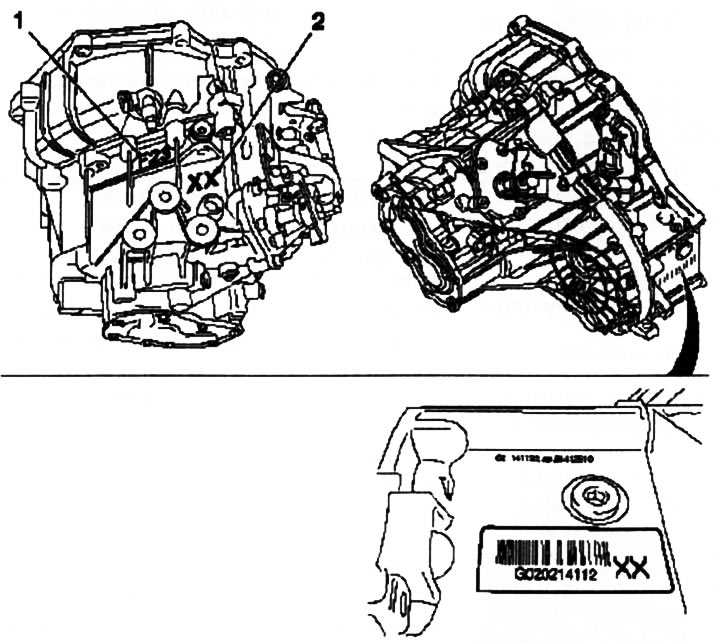
8.2b. Identification number of the manual transmission F23
3. Depending on the model and configuration, there may be several options for converting the power flow in the gearbox - on the F13/F17/F17+ manual transmission, only two shafts are involved in transmitting the power flow - the primary (leading) and secondary (output) shafts, and on the F23 manual transmission, the flow is converted using an additional intermediate shaft.
4. All shafts of the manual transmission are located parallel to the axes of the crankshaft and drive shafts in such a way that their teeth are in constant engagement. In the neutral position, the gears of the secondary shaft rotate freely on it, excluding the transmission of torque to the driven gear of the main gear.
Material copied from this website www.opelbook.ru
5. Gear selection is performed by means of a shift lever, which is located on the floor and is located on the central console. The gearbox drive can be made in the form of a rod or cables. When a gear is selected, the drive makes the corresponding shift fork move, thereby ensuring the displacement of the synchronizer clutches in constant engagement along the assembly of the corresponding shaft. The introduction of the synchronizer clutch into engagement with the teeth of the corresponding gear on the secondary shaft makes the box provide the required gear ratio corresponding to the selected gear. The design of the synchronizers ensures the necessary smoothness and noiselessness of the shifts. The synchronizing cones are formed by the machined surfaces of the brake rings and gears.
6. The authors of this Manual do not recommend that car owners perform major repairs of the gearbox on their own. A high-quality repair of the gearbox will require a fairly large amount of special equipment. During assembly, it is necessary to perform a number of precise measurements and, by selecting adjusting washers, rings and spacer bushings, accurately set a number of gaps. However, independent dismantling of the gearbox from the car will significantly reduce material costs.
Note: If the car is under warranty service, find out in advance about the conditions for fulfilling contractual obligations and the possibility of independently dismantling the manual transmission.
7. The overhaul of the manual transmission should be entrusted to specialists of the car service. But it should be borne in mind that repairing the box in the conditions of the service station is a rather expensive operation. Therefore, it is necessary to consider the possibility of replacing the failed unit with a new or restored one. Information on the repair and replacement of the transmission can be obtained at Opel service stations.
Visitor comments