


The tire pressure loss monitoring system continuously monitors the rotation speed of all wheels. If the pressure in one of the tires drops, the diameter of that wheel decreases and it rotates faster than the other wheels - the corresponding indicator lamp should light up on the instrument cluster (in red) (see Section 16). In this case, you should immediately pull off the road to a safe place, stop and check the tire pressure. If necessary, replace the damaged wheel with the spare.
The system is activated after the ignition is turned on and allows detecting a drop in pressure at a driving speed of 30 km/h and above.
Please note: The tire pressure loss monitoring system does not replace manual monitoring with a verified pressure gauge!
After adjusting the tire pressure, as well as after replacing a tire or wheel, the system must be initialized by pressing the appropriate switch - see Section 17.
Note: The system can only be initialised if all tyres are at the specified air pressure (see Specifications).
Option B
The tire pressure monitoring system continuously monitors the air pressure and rotation speed of all four wheels while driving. Each wheel has a built-in pressure sensor. The sensors take pressure readings in each tire every minute and transmit them to the control unit. If deviations from the specified pressure values are detected in one or more tires, a corresponding message is displayed on the information display (see below).
Note: Current tire pressure values can be displayed on the graphic information display on models equipped with a trip computer (see section 17).
DDS operates when all four wheel sensors are in good condition and all tires are inflated to the prescribed pressure. The system automatically detects changes in tire pressure depending on the vehicle's load.
The system is activated after the ignition is turned on and allows you to monitor the air pressure in the tires at a driving speed of 30 km/h and above.
Please note: The tire pressure monitoring system does not replace manual monitoring with a verified pressure gauge!
If the vehicle is equipped with a set of tires that are not equipped with the appropriate sensors, the loss of air pressure in the tires will be monitored as in the system described above (option A).
Warning messages
Depending on the version, the information display may display messages using abbreviations. To remove a warning message from the display screen, you must confirm receipt by pressing the appropriate button (see section 17).
Below are examples of informational messages:
"Tyre pressure check rear leftturn (value in bar)" (see illustration 27.1) — the graphic information display will simultaneously show a diagram indicating the rear left wheel and the current tire pressure value.
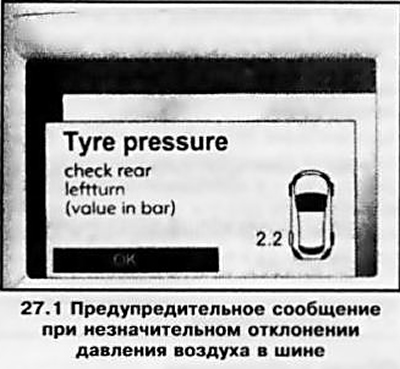
Note: On the color information display, this message appears on a yellow background.
If the pressure deviates slightly, you should reduce your speed and continue driving with caution - check the tire pressure with a verified pressure gauge as soon as possible and make the appropriate adjustments if necessary,
"Attention! Front left tyre pressure loss (value in bar)" — the graphic information display will simultaneously show a diagram indicating the front left wheel and the current tire pressure value.
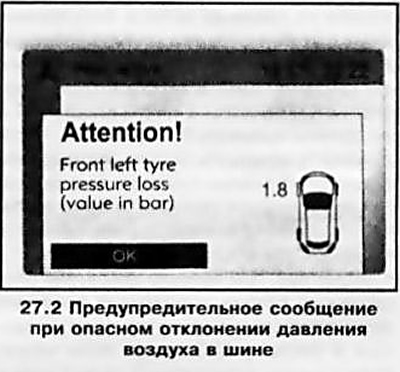
Note: On the color information display, this message appears on a red background.
This message warns of a significant deviation or complete loss of air pressure in the tire - as soon as possible, move the car out of the traffic flow, without interfering with other cars, stop and check the tires! If necessary, install a spare tire (see Introduction), or repair the tire.
In addition, the corresponding indicator lamp will light up on the instrument cluster (see section 16). If the lamp lights up yellow while driving, it indicates a malfunction in the tire pressure monitoring system.
Note: System failure may be caused, among other things, by installing a wheel without a pressure sensor.
After adjusting the tyre pressure or after replacing a tyre or wheel, the system must be initialised by pressing the relevant switch – see Section 17.
Note: The system can only be initialised if all tyres are at the specified air pressure (see Specifications).
General instructions for operating the system (option B)
- The spare wheel is not equipped with a pressure sensor - when using it, the tire pressure monitoring system does not function - the control lamp (see section 16) lights up yellow. The display shows the tire pressure symbol instead of the tire pressure value, while it is monitored in the tire pressure drop monitoring mode (see above).
- When using a complete set of wheels not equipped with tire pressure monitoring system sensors (for example, when installing a set of winter tires), no error message is displayed. The tire pressure monitoring system does not function - the air pressure will be monitored in the tire pressure loss monitoring mode (see above).
- At the user's discretion (with the appropriate vehicle configuration) tyre pressure monitoring system sensors can be installed on wheels that are not equipped with them - please contact an Opel service station.
- To manually check the tire pressure using a pressure gauge, you need to screw a special adapter/special universal device onto the valve, which is stored in a clamp on the inside of the fuel tank filler cap.
- Every time you change your tyres, the valve cores and sealing rings of the tyre pressure monitoring system should be replaced – contact your Opel service centre.
- When using commercially available liquid tyre pressure maintenance systems or repair kits, malfunctions in the system may occur - consult an Opel service station first.
- Radio transmitting devices operating in close proximity (for example, radio headphones, radio telephones), may cause disruptions in the functioning of the system.
[Source is on the website www.OPELBOOK.ru]
Visitor comments