


Contents: Technical specifications ⬇ Dynamic characteristics ⬇ Ensuring the safety of transporting…⬇ Overall dimensions ⬇ Weight characteristics ⬇
Technical data is defined according to EU standards. Subject to change. The data in the vehicle registration document always takes precedence over the data in the Operating Instructions.
Technical specifications
Note: Depending on the special equipment elements, the data may differ from those given - the relevant information can be obtained at any Opel service station.
Engine
Cm. Specifications for Chapter 2.
Transmission
Drive
2WD Models - Front
- Manual transmission - 5- or 6-speed, fully synchronized
- Easytronic - 5-speed, with automatic clutch control
- AT - 4-speed with electronic control
- AT with ActiveSelect system - 4-speed, electronically controlled
Braking system and suspension
Brake system type - Hydraulic, dual-circuit, vacuum-assisted, ABS
Front wheel brakes - Disc, ventilated
Rear wheel brakes - Disc
Parking brake drive - Cable, on the rear wheels
Front suspension - Independent, spring, McPherson type, with anti-roll bar
Rear suspension - Semi-independent, torsion bar, with coil springs
Steering
Drive type - Electrohydraulic power rack and pinion
Dynamic characteristics
Maximum speed, km/h
Note: The maximum speed can be reached with a load of no more than 200 kg. Equipping the vehicle with additional units and assemblies may lead to a decrease in the actual maximum speed relative to the given values.
5-door hatchback
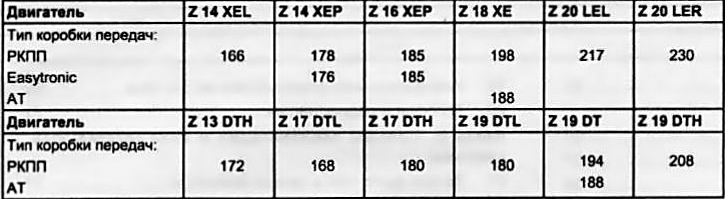
3-door hatchback

Station wagon

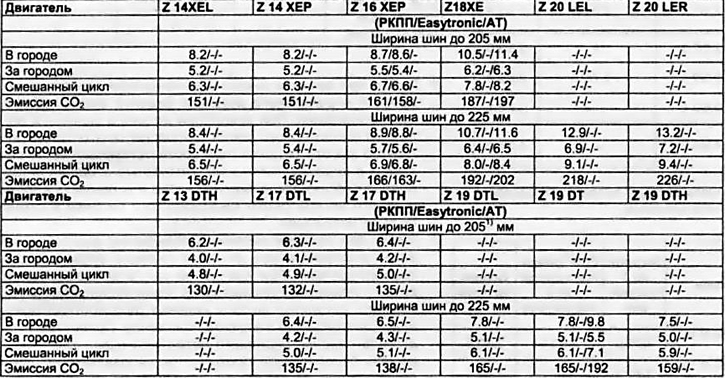
Fuel consumption, CO ₂ emissions
To determine fuel consumption, the instruction 80/1268/EWG in the latest version 1999/100/EG has been in force since 1996. The manual is based on real road conditions: driving in the city is rated with a coefficient of⅓, and outside of it: ⅔ taking into account cold starts and acceleration phases. An integral part of the instruction is an indication of the mandatory publication of carbon dioxide (CO₂) emissions.
Note: The data provided are only indicative. When determining fuel consumption according to standard 1999/100/EC, the tare weight of the vehicle, determined according to the same instructions, is taken into account. Equipping the vehicle with additional devices and units leads to a change in weight, which inevitably also affects the amount of fuel consumption and CO ₂ emissions.
5-door hatchback
(fuel consumption in l/100 km, CO ₂ emissions in g/km)
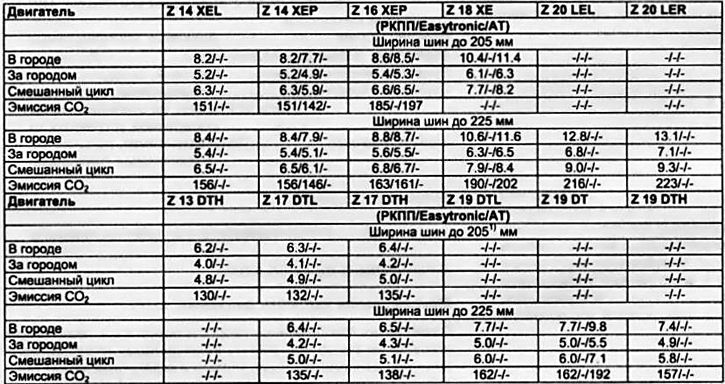
1) With the Z 17 DTH engine, tyre width up to 195 mm.
3-door hatchback
(fuel consumption in l/100 km, CO ₂ emissions in g/km)
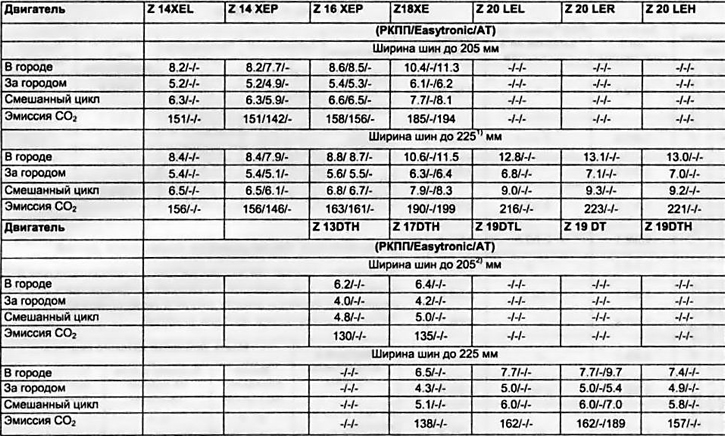
2) With the Z 17 DTH engine, tyre width up to 195 mm.
Station wagon
(fuel consumption in l/100 km, CO ₂ emissions in g/km)
Tire size and inflation pressure
Note: Not all tyres currently available on the market comply with the design requirements of the vehicles - before purchasing new tyres, please consult an Opel service station.
Please note: Tyres of sizes 215/45 R 17, 225/45 R 17, 225/40 R 18 and 235/35 R 19 cannot be used as winter tyres! When installing a spare wheel with a summer tyre on a car with winter tyres, the handling of the car may change - replace the spare wheel with a suitable new one at the earliest opportunity! The air pressure must be checked on cold tyres (see Section 27).
Caution: If the air pressure in the tires increases due to heat during a long trip, do not reduce it under any circumstances!
The tire pressure values given are the same for summer and winter tires. The spare tire should always be kept at full load pressure. The tire pressure values for a specific model are also given on the plate located on the inside of the fuel filler cap. In case of discrepancies, follow the instructions on the vehicle plate.
Astra Models
Tire pressure front/rear, bar (1 bar = 100 kPa)
Hatchback
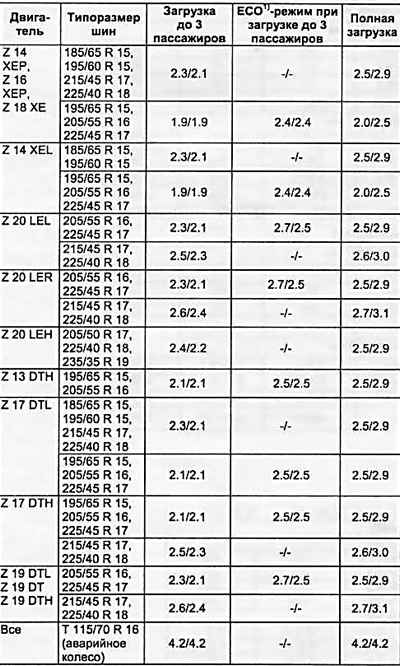
1) To achieve the lowest fuel consumption. Does not apply to puncture-resistant tires.
Station wagon
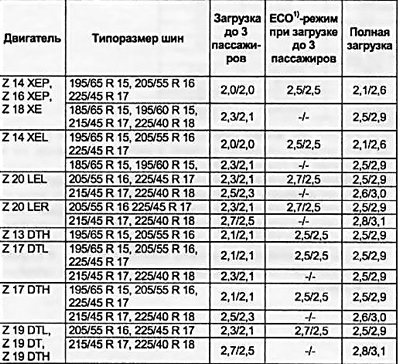
1) To achieve the lowest fuel consumption. Does not apply to puncture-resistant tires.
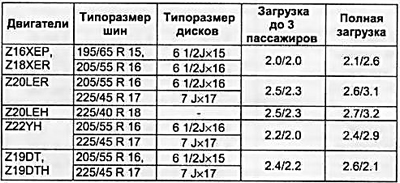
Zafira Models
Tire pressure front/rear, bar (1 bar = 100 kPa)
Ensuring the safety of transporting children
Please note: Statistics on road traffic accident fatalities and injuries show that the safest place to install child seats is in the outer rear seats!
Child seat matching chart
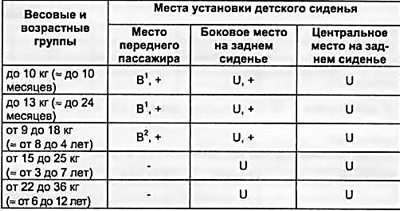
IN¹ Only with seat occupancy recognition and a special Opel child seat with transponders. When securing the child seat with a three-anchor seat belt, install the seat height adjuster (with appropriate equipment) to the top position. Move the front passenger seat all the way back and set the height of the upper passenger seat belt anchor to the lowest position.
IN² Only with seat occupancy recognition and special Opel child seat with transponders. When fastening the child restraint system with a three-anchor seat belt, install the seat height adjuster (with appropriate equipment) to the top position. Move the front passenger seat all the way back so that the seat belt runs from the guide point forward.
U Universal suitability in combination with the three-anchor seat belt.
+ For seat with ISO-FIX mounting. When using ISO-FIX mounting, only ISO-FIX child restraint systems approved for this vehicle type must be used.
- For this weight group, the installation of child seats is not permitted.
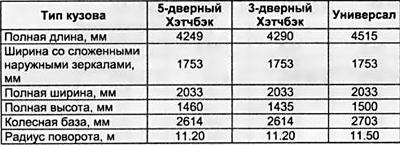
Overall dimensions
Weight characteristics
Attention: Failure to comply with standard weight characteristics leads to increased wear of all vehicle units, deterioration of controllability and, in difficult traffic situations, may cause an accident!
The payload of a vehicle is the difference between the gross standard weight and the vehicle's unladen weight. The vehicle's standard load data is provided on the manufacturer's plate located on the central pillar in the front passenger door opening and in the vehicle's registration document.
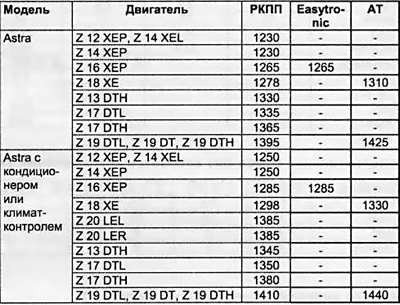
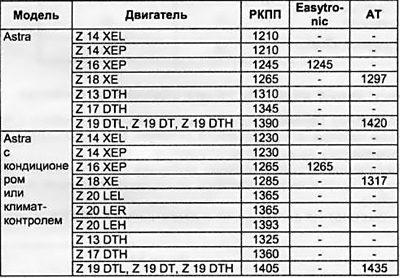
To determine the mass of the vehicle in running order, it is necessary to add up the values of the corresponding indicators for a specific configuration given in the tables (see tables).
Note: Special equipment increases the vehicle's unladen weight, but reduces the payload.
The total load on the front and rear axles must not exceed the full standard load. For example, if the front axle is loaded with the maximum standard load, then the rear axle can only be loaded to the extent that it does not exceed the full standard weight of the vehicle. In addition, it is not allowed to increase the load on another axle by reducing the load on one axle, exceeding the standard load for that axle.
When using a trailer in case of a fully loaded towing vehicle (taking into account the weight of all passengers) the load on the rear axle must not exceed the standard by more than 65 kg (hatchback models) or more than 60 kg (station wagon models). in this case, the full standard weight must not be exceeded by more than 45 kg (hatchback models) or more than 30 kg (models Universal). In extreme cases, if the standard load on the rear axle is exceeded, the vehicle is allowed to move at a speed of no more than 100 km/h.
Note: If the Rules specify lower speeds when operating a vehicle with a trailer, follow the established requirements.
The following indicators are individual depending on the design and configuration of the vehicle and are indicated on the manufacturer's plate (see Chapter "Introduction", illustration 4):
- Standard gross weight
- Standard front axle load
- Standard load on the rear axle
- Maximum permissible towable load weight
- The maximum vertical load on the towing hitch depends on the model and type of towing hitch and is indicated in the accompanying documentation of the vehicle and on the towing hitch plate.
Maximum permissible roof load, kg 75
Station wagon with roof rails - 100
Note: The roof load is made up of the weight of the roof rack and the weight of the cargo.
Vehicle mass in running order1) condition (kg)
5-door hatchback
3-door hatchback
Station wagon
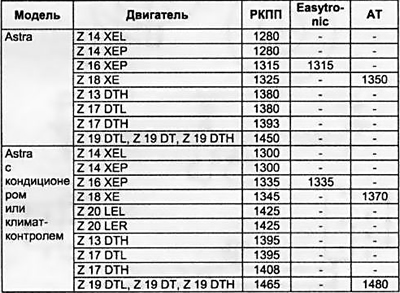
1) According to EU standards, the unladen weight of a vehicle includes the weight of the vehicle, the weight of the driver (68 kg), the weight of luggage (7 kg) and all liquids (the fuel tank is 90% full).
Additional weight (kg) of Hatchback trim levels

Additional weight (kg) of the Station wagon trim levels

Heavy additional equipment (kg)
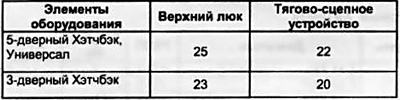
Tightening force of threaded connections, Nm
The tightening torque of the wheel bolts is 110 Nm
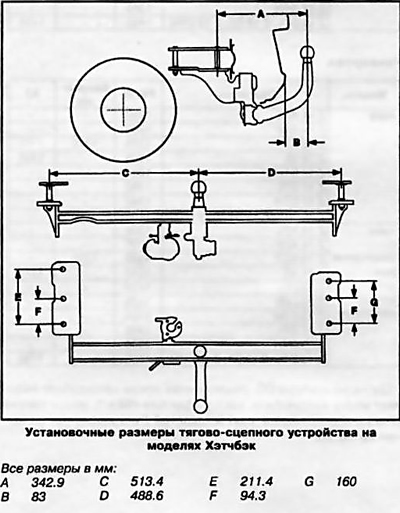
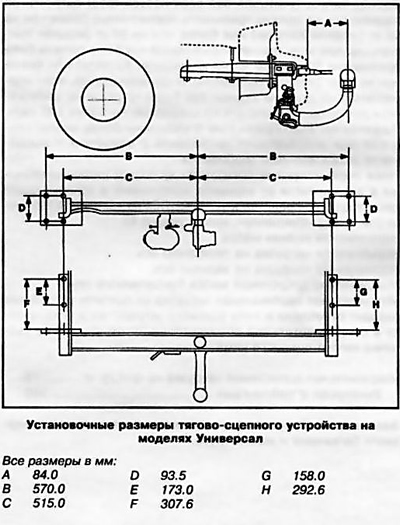
Mounting dimensions of the towing hitch
Detailed recommendations for operating a vehicle with a towing hitch are provided in Section 32.
The installation dimensions are shown below. All dimensions shown correspond to the trailer towing hitch installed at the factory.
Note: After-sales installation of a towing hitch must be carried out by Opel service station specialists. Before purchasing, consult with the service station about the designs of towing hitches approved for this model.
Please note: On vehicles with Z 20 LEH engines, installation of a towing hitch is not permitted!
Visitor comments