


Ensuring the safety of transporting children
Warning! Statistics on road traffic fatalities and injuries show that the safest place to install child seats is in the outer rear seats!
Child seat matching chart
| Weight and age groups | Child seat installation locations | ||
| Front passenger seat | Side berth in the rear seat | Central location in the back seat | |
| up to 10 kg (up to 10 months) | IN¹, + | U, + | U |
| up to 13 kg (up to 24 months) | IN¹, + | U, + | U |
| from 9 to 18 kg (from 8 to 4 years) | in², + | U, + | U |
| from 15 to 25 kg (from 3 to 7 years) | - | U | U |
| from 22 to 36 kg (from 6 to 12 years old) | - | U | U |
IN¹ - Only with seat occupancy recognition and a special Opel child seat with trans-onders. When securing the child seat with a three-anchor seat belt, install the seat height adjuster (with appropriate equipment) to the top position. Move the front passenger seat all the way back and set the height of the upper passenger seat belt anchor to the lowest position.
B² - Only with seat occupancy recognition and special Opel child seat with transponders. When fastening the child restraint system with a three-anchor seat belt, install the seat height adjuster (with appropriate equipment) to the top position. Move the front passenger seat all the way back so that the seat belt runs from the guide point forward.
U - Universal suitability in combination with the three-anchor safety belt.
"+" - For seat with ISO-FIX mounting. When using ISO-FIX mounting, only ISO-FIX child restraint systems approved for this vehicle type must be used.
"-" - For this weight group, the installation of child seats is not permitted.
Warning! The anatomical features of the structure of the child's body determine an increased risk of injury when airbags are deployed compared to adults!
In order to ensure the safety of transporting young and middle-aged children, special child seats and restraints should be used that are compatible with the vehicle's standard seat belts.
[Original posted on the website opelbook.ru]
Detailed instructions for the placement and installation of child seats should be included with them - if necessary, contact official Opel representative offices for advice. When installing a child seat, strictly follow the instructions given in the instructions supplied with the product. The list of special child seats recommended for use by Opel and the methods of placing them in the car are specified in the Specifications at the beginning of the chapter. Be careful to make sure that the product you are purchasing is suitable for both your child and for installation in your car. On models equipped with a front passenger seat occupancy recognition system (see Section 13), it is allowed to install only a special child seat equipped with transponders from Opel on the latter. If the car is equipped with another configuration, the installation of a child seat in the front is not allowed! On models that meet ISOFIX standards, the outer rear seats and the front passenger seat are equipped with special brackets for fixing child seats (see illustration 11.1). The brackets are located between the seat cushion and the backrest.
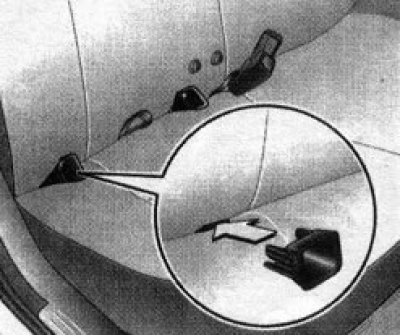
11.1 On ISOFIX compliant models, the outer rear seats and the front passenger seat are equipped with special anchorages for securing child seats
Attention! ISOFIX standard seats are designed for children weighing no more than 22 kg! Strictly follow the instructions included with the product!
Always try to seat your child in the BACK seat of the car and secure him/her properly with a special child seat or a standard seat belt. According to accident statistics, the back seat is safer for transporting children than the front seat. If the airbags are deployed in a collision, they can cause serious injury to the child or even lead to death.
When transporting children who are too old to be placed in child seats, use special booster cushions that ensure the correct placement of the shoulder section of the seat belt (see Section 10).
Visitor comments