


Contents: Adjusting engine idle speed ⬇ Checking the throttle position sensor ⬇ Adjusting the position of the…⬇ Checking the air flow meter ⬇ Checking the fuel supply pressure ⬇ Checking the fuel pressure regulator ⬇ Checking the additional air supply…⬇ Visual inspection ⬇ Resistance check ⬇ Checking the spray cone and the…⬇ Checking the resistance of the…⬇ Checking the ignition timing control…⬇ Checking the supply voltage of the…⬇
Below is a procedure for checking and adjusting the system "LE3-Jetronic", the execution of which differs from those described above for the system "LE-Jetronic".
Adjusting engine idle speed
The idle speed of the engine crankshaft is adjusted using screw 2 (see photo) for adjusting the idle air.
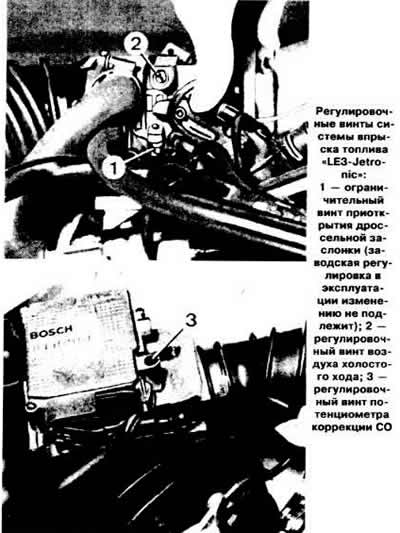
To adjust the CO content, remove the plug of the adjustment screw 3 of the CO correction potentiometer, use the screw to set the required CO content, and then replace the plug.
Checking the throttle position sensor
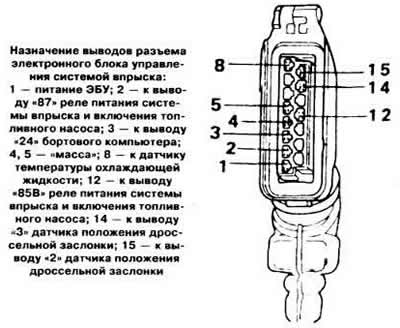
Make sure the ignition is off. Disconnect the ECU connector (see picture).
Original source on the website (opelbook)
Connect an ohmmeter to terminals "15" and "5" of the ECU connector, turn on the ignition and measure the resistance, which should be zero.
Open the throttle valve and measure the resistance, which should be equal to infinity.
Connect an ohmmeter to terminals "14" and "5" of the ECU connector and measure the resistance, which should be equal to infinity. When the throttle valve is opened at least 60% of the stroke, the resistance should drop to zero.
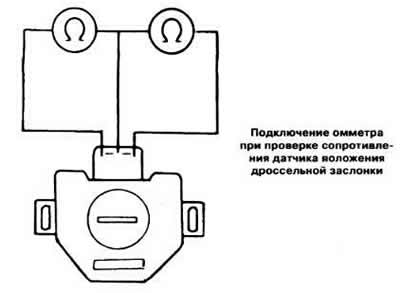
If the ohmmeter readings are different from the norm, disconnect the throttle valve connector (see picture) and repeat the above resistance test, connecting the ohmmeter to terminals "18" and "2" and "18" and "3" of the sensor block, respectively.
If the resistance values still do not match the data, replace the throttle position sensor. If after installing the new sensor the ohmmeter readings return to normal, check the wires and their connections and eliminate any faults found.
Adjusting the position of the throttle position sensor
Loosen the two screws securing the sensor, turn the sensor to the right, then slowly to the left until you hear the microswitch click. In this position, tighten the screws securing the sensor.
Checking the air flow meter
Disconnect the wire from the negative terminal of the battery and remove the ECU from the air flow meter.
By pressing on the pressure disk of the air flow meter, check the smoothness of its movement from one extreme position to the other. If necessary, remove resinous deposits with any solvent suitable for this purpose.
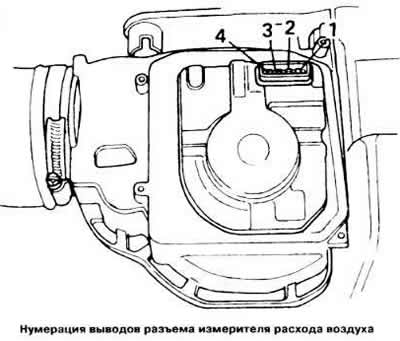
Connect the ohmmeter alternately to the pairs of terminals of the measuring block (see picture) "2" and "4", "4" and "3", "4" and "1" and compare the instrument readings with the required values specified in the "Design and specifications" subsection.
Checking the fuel supply pressure
Disconnect the fuel supply hose from the fuel line and connect the pressure gauge to the holes in the hose and the fuel line.
Start the engine at idle speed and measure the fuel supply pressure on the pressure gauge, which should be 2.0 kg/cm². Disconnect the vacuum hose from the fuel pressure regulator and make sure that the fuel pressure has increased by approximately 0.5 kg/cm².
Stop the engine and monitor the fuel pressure on the pressure gauge. If the pressure drops, pinch the hose from the fuel pump to the fuel line to check the serviceability of the fuel pump check valve. Pinch the fuel drain hose into the tank under the pressure regulator to check the tightness of the check valve. Then check for fuel leakage through the injectors, as indicated in the subsection "Fuel injection system "LE-Jetronic"".
Checking the fuel pressure regulator
Start the engine and check the fuel supply pressure. Disconnect the vacuum hose from the pressure regulator, connect a vacuum pump to the regulator and create a vacuum of 0.5 kg/cm². The fuel pressure should decrease by 0.5 kg/cm².
Checking the additional air supply valve
On a cold engine
With the engine idling, pinch the hose connecting the additional air supply valve to the intake manifold. This should reduce the engine crankshaft speed.
On a warm engine
Make sure that the additional air supply valve flap is completely closed. Pinch the hose connecting the additional air supply valve to the intake manifold. In this case, the engine crankshaft speed should decrease by no more than 50 rpm.
Visual inspection
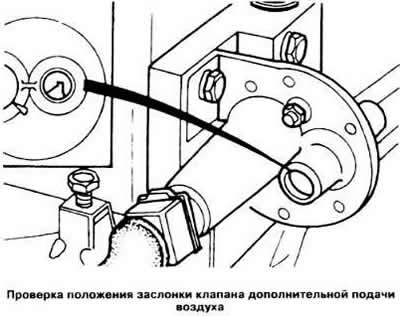
Disconnect both air hoses from the valve and visually check the position of the damper through the valve holes (see picture). When the engine is cold, the valve flap should be open.
Connect the air hoses to the valve
Disconnect the air hoses from the valve and visually check the position of the valve flap, which should be closed.
Resistance check
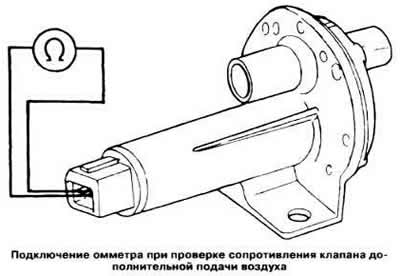
Disconnect the valve connector, connect an ohmmeter to the terminals of the valve block (see picture) and measure the resistance, which at a temperature of 20°C should be 40 Ohm.
Checking the spray cone and the tightness of the injectors
Remove the fuel line, injectors and fuel pressure regulator from the engine. Disconnect the pads from the injectors.
Install the injectors on the fuel line, connect the fuel pressure regulator, fuel supply and drain hoses and place the injection nozzles over a suitable container.
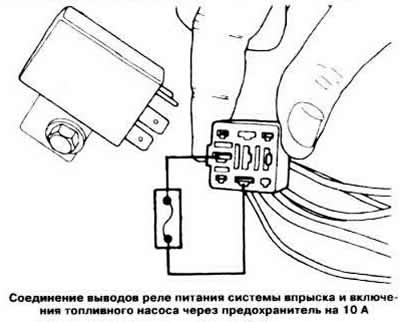
Remove the injection system power supply and fuel pump activation relay and connect terminal "30" of the relay block (red wire) with output "87b" (red-black wire) wire harness connector via 10A fuse (see picture), thereby activating the fuel pump.
Check for leakage of fuel drops through the injectors, which should not exceed one drop per minute, and replace leaky injectors.
Connect a 12 V DC power source to each nozzle in turn and check the shape of the spray cone (see the figure in the subsection "Fuel injection system "LE-Jetronic")".
Checking the resistance of the injector winding
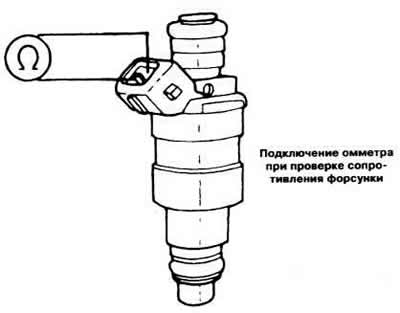
Connecting the ohmmeter to the terminals of each injector in turn (see picture), check the resistance, which should be within 15-17 Ohms.
Checking the ignition timing control circuit of the electronic control unit
Make sure the ignition is off. Disconnect the ECU connector and connect a voltmeter to terminals "5" and "1" of the ECU connector (see picture).
Turning the engine crankshaft with the starter, check for voltage fluctuations. If there are no voltage fluctuations, check the circuit between terminal "1" (-) of the ignition coil and terminal "1" of the ECU connector for wire breaks and short circuits.
Checking the supply voltage of the electronic control unit
Disconnect the ECU connector and turn on the ignition.
Connect the voltmeter to terminals "2" and "4", "5" of the ECU connector. If the voltmeter shows a voltage different from the battery voltage, perform the following checks:
- check for battery voltage at terminal "30" of the fuel injection system power relay. If the voltmeter shows low voltage or no voltage. check again for continuity between terminal "1" (—) of the ignition coil and terminal "1" of the ECU connector, as well as the ignition switch;
- check for battery voltage at terminal "86" of the relay;
- check the relay connection to "ground" by connecting an ohmmeter to the "85" terminal of the relay and to "ground". If the connection to "ground" is correct, the ohmmeter will show R=0.
Visitor comments