


Removal
1. Remove the cylinder head.
2. Remove the oil pan.
3. Turn the crankshaft so that the connecting rod bolts are most accessible.
4. Mark the connecting rods and connecting rod caps relative to the cylinder serial number. Also mark the direction of their installation. Thanks to this, the connecting rods and connecting rod caps will be installed correctly during assembly.
5. Remove carbon deposits from the top of the cylinder bore to prevent damage to the piston rings.
6. Loosen the connecting rod bolts.
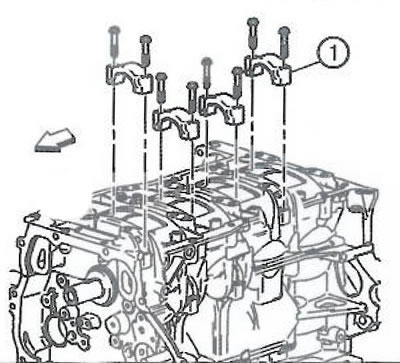
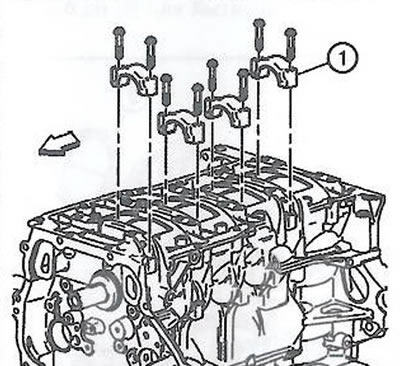
7. Remove the connecting rod caps (1).
8. Before removing the piston with the connecting rod, install the EN-43966-1 guides (1) on the connecting rod bolts.
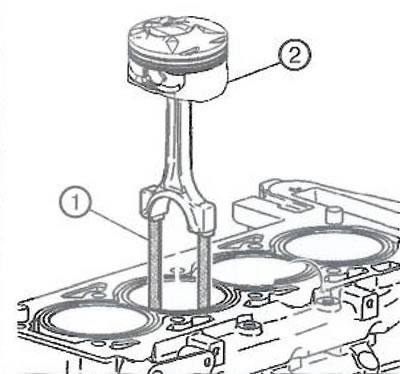
9. Remove the piston with the connecting rod assembly (2) from the cylinder.
Disassembly
1. Using a special piston ring spreader, remove the piston rings from the piston. Piston rings should not be reused.
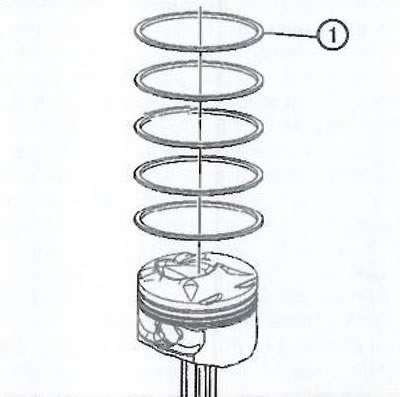
Caution: Handle the piston with care. Worn piston rings have sharp edges that can cause injury.
Note: The piston pin is held in place by two snap rings. Do not use special tools to remove the piston pin. Make sure the piston pin is not damaged. Do not reuse snap rings.
2. Remove the piston pin retaining rings using the EN-46745 tool (1) and the EN-46745-4 adapter.
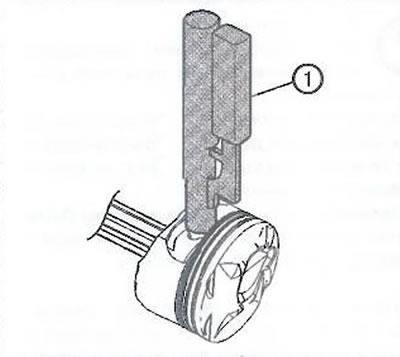
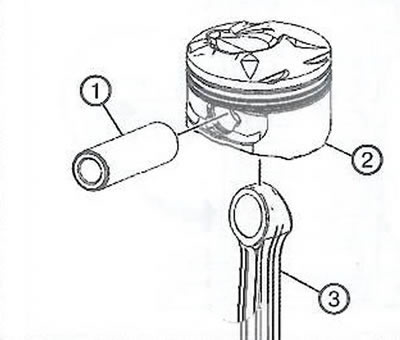
3. Remove the piston pin (1) and connecting rod (3) from the piston (2).
Assembly
1. Assemble the piston (1) with the connecting rod (2).
[Text copied from an online resource: opelbook.ru]
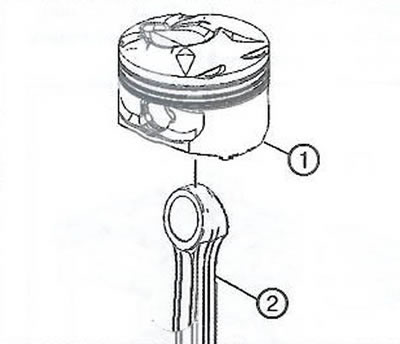
Note: Install the piston onto the connecting rod with the arrow pointing towards the front of the engine.
2. To install the piston pin and its retaining rings, do the following:
- Lubricate the piston pin with oil.
- Using the EN-46745 tool (1) and the EN-46745-4 adapter, install the piston pin retaining ring on one side of the piston into the corresponding groove.

Caution: It is necessary to install the piston pin retaining rings correctly in the grooves to prevent engine damage.
- Install the connecting rod and piston pin. Press the piston pin so that it rests against the retaining ring installed in the piston.
- Using the EN-46745 tool and the EN-46745-4 adapter, install the second piston pin retaining ring.
- Make sure the piston moves freely.
Caution: To install piston rings, it is necessary to use a special device to expand them. Piston rings can be damaged if they are expanded more than necessary.
3. Install the following components of the oil scraper piston ring:
- Expansion ring (4).
- Lower oil scraper disc (5).
- Upper oil scraper disc (3).
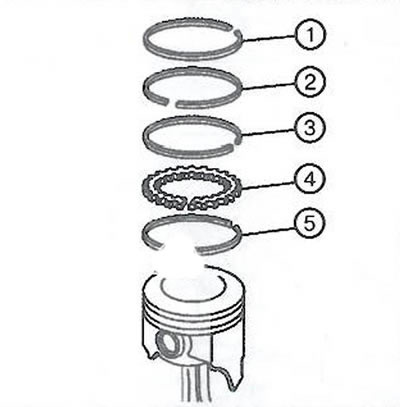
4. Install the lower compression ring (2) (second ring). The manufacturer's mark on the ring must be facing upwards.
5. Install the upper compression ring (1).
Installation
1. Install new connecting rod bearings:
- Install the bearing shells into the connecting rod and connecting rod cap.
- Lubricate the connecting rod bearings with engine oil.
2. Install EN-43966-1 guides (1) into the connecting rod bolt holes. This will protect the crankshaft journal when installing the piston and connecting rod assembly.
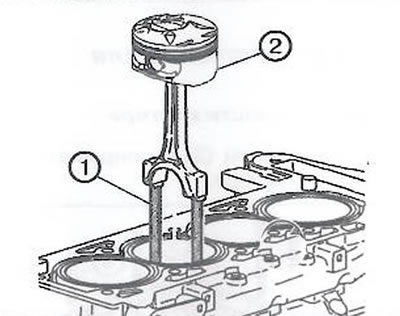
3. Install the EN-43953 piston ring compressor, then insert the piston (2) with the connecting rod into the corresponding cylinder:
- Place the piston ring locks evenly around the circumference of the piston and make sure that the established position is not disturbed.
- Lubricate the piston and piston rings with engine oil.
- The piston must be installed so that the mark on the piston bottom points towards the front of the engine.
- Insert the piston into the corresponding engine cylinder.
- Hold the EN-43953 piston ring compressor on the cylinder block until all piston rings are seated in the cylinder.
- Remove the connecting rod guides from the connecting rod bolt holes.
4. Install the connecting rod cover (1).
Note: Always use new connecting rod bolts.
5. Install new connecting rod bolts and tighten to 25 Nm, then tighten another 100°.
6. Install the remaining pistons with connecting rods in a similar manner.
7. Install the oil pan.
8. Install the cylinder head.
Visitor comments