
OpelBook.ru
Cars AvtoVAZ Cars Mitsubishi Cars BMW Cars Mercedes Cars Nissan Cars Toyota Cars Chevrolet
English Русский
Български
Беларускі
Український
Српски
Hrvatski
Română
Polski
Slovenský
Magyar
 |  Sitemap  |  Contacts  |    


Main Astra Corsa Insignia Kadett Omega Vectra Zafira Others Articles
Corsa B (1993-2000) Corsa C (2000-2006, petrol) Corsa C (2000-2006)
  • Main
  • Corsa
  • Corsa C
  • Chassis
  • Wheels and tires
  • Puncture-resistant tires (RunFlat tires)

Puncture-resistant tires (RunFlat tires) (Opel Corsa C)

            0

Puncture-resistant tires (RunFlat tires)


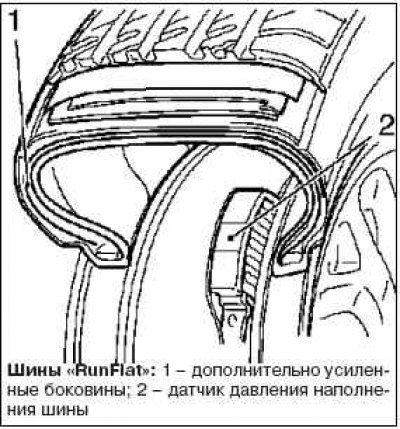
Some model series can be equipped with emergency running features as an option ("Run-Flat-Tyres"). Thanks to reinforced sidewalls, they make it possible to continue driving without any restrictions in the event of an accident. Tires with emergency running properties are in no way inferior to regular tires in their dynamic properties in motion. When deflated, handling and driving characteristics change, and the braking distance increases.

The conditions for using Run-Flat-Tyres are:
  • electronic Stability Program (ESP);
  • tire Pressure Loss Monitoring System (DDS);
  • tire Pressure Monitoring System (TPMS).

Because due to the design features and driving comfort, a puncture of the tire could, under certain circumstances, go unnoticed.

With deflated tyres, a further drive at a maximum speed of 80 mph is possible for a distance of up to 80 km. Run-flat tyres, depending on the tyre manufacturer, can be identified by the ROF or SSR marking on the sidewall of the tyre. They are only possible in combination with Opel-approved light-alloy rims, this also applies to winter tyres.

Note: Under service conditions, these tires can be installed using commercially available tire mounting equipment.


Note: Vehicles with the Z17DTH engine use 5-hole rims, while all other engines use 4-hole rims.


Note: The Combo CNG model is equipped with a tire inflation system instead of a spare wheel.


Note: Vehicles with the Z17DTH engine use 5-hole rims, while all other engines use 4-hole rims.


(Article published on the website: OPELBOOK)


This article is available at russian, bulgarian, belarusian, ukrainian, serbian, croatian, romanian, polish, slovak, hungarian
Checking the article: Kornev Georgy

Share information:

Previous articles
Opel Corsa C: Wheels and tires
Next articles

Tire replacement
Condition of tires
Wheel and tire repair
Identification of rims and tires


See similar ones from other Opel car manuals:
▶ Checking the condition of the tires and tire pressure Opel Astra G (1998-2004, petrol)
▶ Tires with the specified direction of rotation Opel Insignia A (2008-2017)
▶ Car wheels and tires Opel Kadett E (1984-1995)
▶ Wheels and tires Opel Omega A (1986-1993)
▶ What tires should I install? Opel Vectra B (1995-2002, petrol)
Link to this page in different formats

Visitor comments


No comments yet


How much will 45 + 13 =


Corsa C (2000-2006) 
  • General information
  • Introduction to guide
  • Troubleshooting
  • Vehicle device
  • User manual
  • Maintenance
  • Power unit
  • Engine repair
  • Cooling system
  • Power and exhaust system
  • Control system
  • Engine electrical equipment
  • Transmission
  • Clutch
  • Mechanical gearbox
  • Automatic gearbox
  • Drive shafts
  • Chassis
  • Brake system
  • Wheel suspension
  • Steering
  • Body
  • Exterior
  • Interior
  • Doors and windows
  • Heating and air conditioning
  • Electrical equipment
  • Equipment and devices
  • Lamps and lighting
  • Electrical circuits
Corsa C (2000-2006, petrol) 
  • User manual
  • Car access
  • Governing bodies
  • Seat control
  • Heating and air conditioning
  • Driving and maintenance
  • Engines 1.0 and 1.2 l
  • Engine repair
  • Cooling and lubrication system
  • Injection system
  • Engines 1.4, 1.6 and 1.8 l
  • Engine repair
  • Cooling and lubrication system
  • Injection system
  • Transmission
  • Clutch
  • Mechanical gearbox
  • Automatic gearbox
  • Drive shafts
  • Chassis
  • Wheels and tires
  • Wheel suspension
  • Steering
  • Brake system
  • Body
  • Exterior
  • Doors and windows
  • Electrical equipment
  • Equipment and devices
  • Lighting system
  • Electrical circuits
Corsa B (1993-2000) 
  • General information
  • Introduction to guide
  • User manual
  • Maintenance
  • Power unit
  • SOHC gasoline engines
  • DOHC gasoline engines
  • Diesel engines
  • Engine repair
  • Cooling system
  • Supply system
  • Injection system (gasoline)
  • Injection system (diesel)
  • Exhaust systems
  • Control system (gasoline)
  • Preheat system (diesel)
  • Charge and launch system
  • Transmission
  • Mechanical gearbox
  • Automatic gearbox
  • Clutch and drive shafts
  • Chassis
  • Brake system
  • Front suspension
  • Rear suspension
  • Steering
  • Body
  • Ventilation and heating
  • Exterior
  • Interior
  • Doors and windows
  • Electrical equipment
  • Equipment and devices
  • Lamps and lighting
  • Electrical circuits
OpelBook.ru © 2017–2026 · Mobile version · · Sitemap: EN BG BY UA RS HR RO PL SK HU · Feedback · Site search
Astra F, petrol · Astra G, petrol · Astra G · Astra H · Astra J, petrol · Corsa B · Corsa C, petrol · Corsa C · Insignia A · Kadett D · Kadett E · Omega A · Omega B · Omega B2 · Vectra A, petrol · Vectra A · Vectra B, petrol · Vectra B · Vectra C · Zafira A, petrol · Frontera A, petrol · Frontera B · Ascona C · Vivaro A ·
We want your visit to be comfortable 🤝! We use cookies 🍪 to make that happen.