
OpelBook.ru
Cars AvtoVAZ Cars Mitsubishi Cars BMW Cars Mercedes Cars Nissan Cars Toyota Cars Chevrolet
English Русский
Български
Беларускі
Український
Српски
Hrvatski
Română
Polski
Slovenský
Magyar
 |  Sitemap  |  Contacts  |    


Main Astra Corsa Insignia Kadett Omega Vectra Zafira Others Articles
Astra F (1991-1998, petrol) Astra G (1998-2004, petrol) Astra G (1998-2004) Astra H (2004-2009) Astra J (2009-2015, petrol)
  • Main
  • Astra
  • Astra J
  • Chassis
  • Brake system
  • Checking the brake pedal position

Checking the brake pedal position (Opel Astra J)

            0

Correct position of the brake pedal when free and when pressed all the way (working stroke of the pedal) serves as one of the criteria for checking the serviceability of the brake system. At the same time, the position of the pedal largely ensures the proper operation of the system. If the pedal is located at a distance from the floor that is greater than the standard, incomplete release of the wheels is possible when releasing the pedal (in this case, there is usually no free pedal travel). If the pedal is too low, the brake efficiency may decrease due to a decrease in the pedal travel. The pedal position cannot be adjusted; it is provided by design if all brake drive components are in good condition. If the position deviates from the nominal value, check the condition of all drive components and assemblies, and replace any that are faulty.

You will need a ruler.
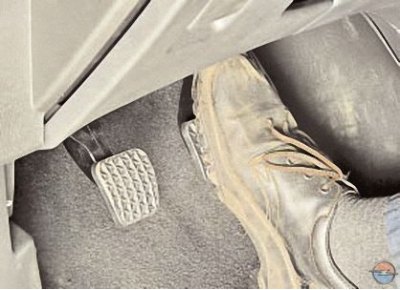
You will need a ruler.


1. Start the engine, let it idle and press the brake pedal vigorously several times.

2. Pull the brake pedal up with your hand until it stops.
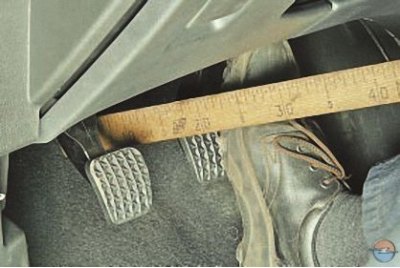
2. Pull the brake pedal up with your hand until it stops.


3. Release the pedal and measure the distance from the pedal pad to the floor.


Note: The ruler must be installed perpendicular to the floor plane.
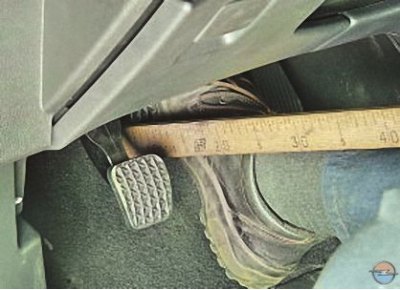

Note: The ruler must be installed perpendicular to the floor plane.


4. Press the brake pedal firmly until it stops.

5. Release the pedal and re-measure the distance from the pedal pad to the floor in a free state. The pedal should return to its original position at the distance from the pedal pad to the floor measured in step 3.

6. Check the free travel of the brake pedal by moving the pedal by hand until the pedal stops moving without resistance. Determine the free travel value using a ruler; it should be 1–3 mm. If the free travel does not match the specified value, it may be due to the following reasons:
  • increased play in the connection between the vacuum booster pushrod and the pedal. This may be due to wear of the pushrod retainer;
  • pistons seizing in the master brake cylinder;
  • jammed plunger in the brake booster.

7. If the distance from the pedal pad to the floor during repeated measurement (item 5) is less than the value measured in item 2, this indicates that the pedal is stuck on the axle, that the pistons in the working and master cylinders are jammed, or that the compensation holes in the master brake cylinder are clogged.


Note: The compensation holes in the master cylinder may be blocked by seals that have swollen due to petroleum products entering the system, as well as due to the use of low-quality brake fluid.


8. If the pedal stops almost at the floor when pressed, this indicates that there is air in the brake hydraulic drive or that the brake pads and discs are worn to the limit. If there is air in the system, the pedal stops further from the floor when pressed several times ("pumps up").

Warning! If the pedal is pressed all the way and held in this position and gradually moves to the floor, there is a fluid leak from the hydraulic drive or the master brake cylinder is faulty. These faults are very dangerous, so immediately find the leak and fix it or replace the master brake cylinder!


Article posted on Internet portal opelbook


This article is available at russian, bulgarian, belarusian, ukrainian, serbian, croatian, romanian, polish, slovak, hungarian
Checking the article: Trifonova Emilia

Share information:

Previous articles
Opel Astra J: Brake system
Next articles

Features of the brake system
Checking the tightness of the hydraulic brake system
Checking the operation of the brake booster
Checking the degree of wear of brake pads and discs
Checking the parking brake
Bleeding the hydraulic brake system
Replacing brake fluid


See similar ones from other Opel car manuals:
▶ Checking the brake pedal travel Opel Insignia A (2008-2017)
▶ Checking the brake pedal travel Opel Vectra B (1995-2002, petrol)
▶ Checking the brake system Opel Corsa B (1993-2000)
▶ Checking the band brake Opel Kadett E (1984-1995)
▶ Front Brake Pads — Checking, Removing and Installing Opel Omega B2 (1999-2003)
Link to this page in different formats

Visitor comments


No comments yet


How much will 17 + 47 =


Astra J (2009-2015, petrol) 
  • General information
  • Vehicle device
  • User manual
  • Faults en route
  • Maintenance
  • Power unit
  • Engine repair
  • Cooling and lubrication system
  • Engine power system
  • Exhaust system
  • Transmission
  • Clutch
  • Car gearbox
  • Drive shafts
  • Chassis
  • Front suspension
  • Rear suspension
  • Steering
  • Brake system
  • Wheels and tires
  • Body
  • Exterior
  • Interior
  • Doors and windows
  • Body Care
  • Heating and air conditioning
  • Security systems
  • Electrical equipment
  • Equipment and devices
  • Lighting and signaling
  • Power devices
  • Electrical circuits
Astra H (2004-2009) 
  • General information
  • Introduction to the guide
  • Troubleshooting
  • User manual
  • Maintenance
  • Power unit
  • Engine repair
  • Cooling and heating
  • Power and exhaust system
  • Ignition system
  • Launch and charge system
  • Transmission
  • Mechanical gearbox
  • Automatic gearbox
  • Drive shafts
  • Chassis
  • Brake system
  • Car suspension
  • Steering
  • Body
  • Interior
  • Exterior
  • Electrical equipment
  • Equipment and devices
  • Electrical circuits
Astra G (1998-2004) 
  • General information
  • Introduction to manual
  • User manual
  • Maintenance
  • Power unit
  • SOHC gasoline engines
  • DOHC gasoline engines
  • Diesel engines 1.7 and 2.0
  • Engine repair
  • Cooling system
  • Supply system
  • Injection system (gasoline)
  • Injection system (diesel)
  • Exhaust system
  • Charge and launch system
  • Ignition system (gasoline)
  • Preheat system (diesel)
  • Transmission
  • Manual gearbox
  • Automatic gearbox
  • Clutch
  • Drive shafts
  • Chassis
  • Brake system
  • Wheel suspension
  • Steering
  • Body
  • Exterior
  • Interior
  • Doors and windows
  • Ventilation and heating
  • Electrical equipment
  • Equipment and devices
  • Electrical circuits
Astra G (1998-2004, petrol) 
  • General information
  • User manual
  • Car care
  • Maintenance
  • Power unit
  • Single shaft engines
  • Twin shaft engines
  • Engine repair
  • Cooling and heating
  • Fuel and exhaust systems
  • Starting and charging system
  • Ignition system
  • Transmission
  • Clutch
  • Mechanical gearbox
  • Automatic gearbox
  • Drive shafts
  • Chassis
  • Brake system
  • Car suspension
  • Steering
  • Body
  • Interior
  • Exterior
  • Electrical equipment
  • Equipment and devices
  • Wiring diagrams Opel Astra
  • Wiring diagrams Opel Zafira
Astra F (1991-1998, petrol) 
  • General information
  • Maintenance
  • Power unit
  • Engine in car
  • Engine removed
  • Cooling system
  • Heating and ventilation
  • Fuel supply (carburetor)
  • Fuel supply (injector)
  • Emission control
  • Ignition system
  • Transmission
  • Clutch
  • Mechanical gearbox
  • Automatic gearbox
  • Drive shafts
  • Chassis
  • Brake system
  • Car suspension
  • Steering
  • Body
  • Exterior
  • Interior
  • Electrical equipment
  • Equipment and devices
  • Electrical circuits
OpelBook.ru © 2017–2026 · Mobile version · · Sitemap: EN BG BY UA RS HR RO PL SK HU · Feedback · Site search
Astra F, petrol · Astra G, petrol · Astra G · Astra H · Astra J, petrol · Corsa B · Corsa C, petrol · Corsa C · Insignia A · Kadett D · Kadett E · Omega A · Omega B · Omega B2 · Vectra A, petrol · Vectra A · Vectra B, petrol · Vectra B · Vectra C · Zafira A, petrol · Frontera A, petrol · Frontera B · Ascona C · Vivaro A ·
We want your visit to be comfortable 🤝! We use cookies 🍪 to make that happen.