OpelBook.ru
Cars AvtoVAZ Cars Mitsubishi Cars BMW Cars Mercedes Cars Nissan Cars Toyota Cars Chevrolet
English Русский
Български
Беларускі
Український
Српски
Hrvatski
Română
Polski
Slovenský
Magyar
 |  Sitemap  |  Contacts  |    


Main Astra Corsa Insignia Kadett Omega Vectra Zafira Others Articles
Astra F (1991-1998, petrol) Astra G (1998-2004, petrol) Astra G (1998-2004) Astra H (2004-2009) Astra J (2009-2015, petrol)
  • Main
  • Astra
  • Astra G
  • Electrical equipment
  • Equipment and devices
  • Fuses — General Information

Fuses — General Information (Opel Astra G)

            0

Various combinations of fuses, circuit breakers and fusible links can be used to protect the contact circuits of vehicle electrical equipment.

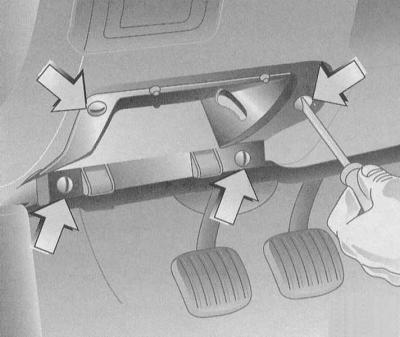
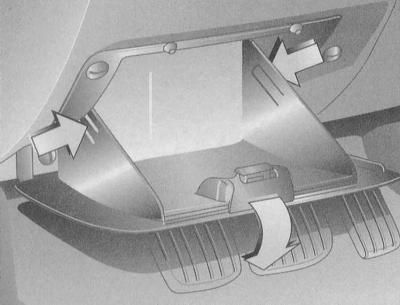
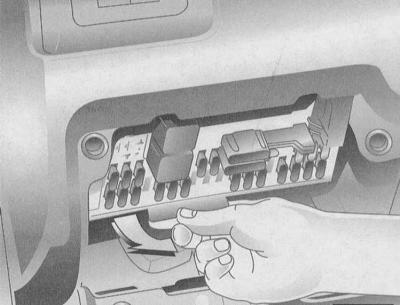
On the models of cars under consideration, a large fuse box (and relay) is located in the mounting block located on the left under the instrument panel astra models the mounting block is located behind the drawer for small items, the lining of which should first be removed from the panel, after removing the components of the drawer, you should pull the bottom of the block in order to bring it to its working position zafira models it is enough to open the cover of the mounting block on the instrument panel.
On the models of cars under consideration, a large fuse box (and relay) is located in the mounting…


Removing the small items drawer

Removing the small items drawer


Removing the bolts securing the trim of the small item box


Removing the bolts securing the trim of the small item box


To move the mounting block into the working position, pull it towards you by the lower part

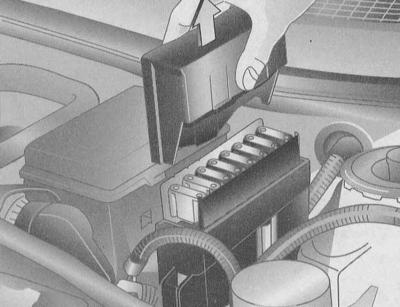
The second fuse/relay mounting block is located in the engine compartment of the vehicle, has a separate design and is equipped with removable covers.
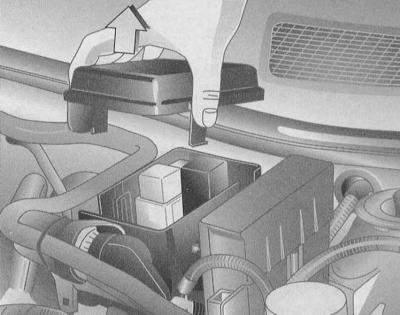
The second fuse/relay mounting block is located in the engine compartment of the vehicle, has a…


Removing the cover from the fuse box located in the engine compartment
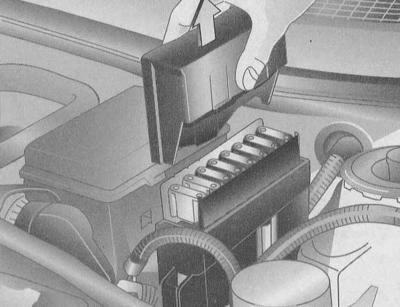
Removing the cover from the fuse box located in the engine compartment


Removing the cover from the main fuse box


Each individual fuse is used to protect a specific electrical circuit or several circuits at once. An identification card with a diagram of the location of the fuses in the mounting block is usually glued to the cover of the latter, on its inner side.

Fuses of compact design, equipped with bayonet contacts, are used in the fuse boxes and, if necessary, can be easily removed from their sockets in the box with your fingers. If any of the power consumers fails, the condition of the corresponding fuse should always be checked first. Turn the key in the ignition switch to the ON position and use a test lamp to probe the open terminals of each fuse. If the lamp lights up when connected to each terminal, the fuse is OK. If voltage is present only on the power supply side, the fuse has blown.
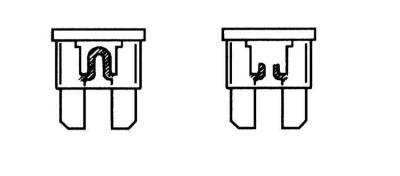
Fuses of compact design, equipped with bayonet contacts, are used in the fuse boxes and, if…


Note also that the fuse body is usually made of transparent plastic, through which it is easy to determine the state of the working jumper.

When replacing a blown fuse, make sure that the replacement element you prepare matches the type of the one that failed. Fuses designed for different nominal current strengths may not physically differ from each other, but they are not interchangeable. Each electrical circuit has different operating parameters and requires different degrees of protection, so replacing a fuse designed for a certain current strength with one that does not match its parameters is fraught with the most serious consequences (until a fire breaks out). Operating parameters of the fuse (rated current) are usually marked on its plastic body, in addition, color identification is additionally used (see Specifications).
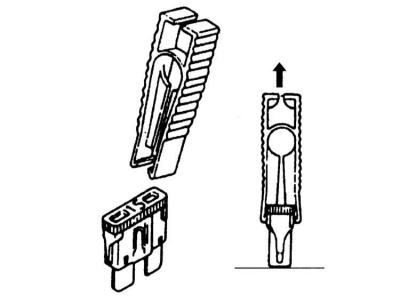


When replacing a blown fuse, make sure that the replacement element you prepare matches the type of…


A special clamp can be attached to the inside of the fuse box cover, the use of which can significantly simplify the procedure for removing the fuse.


If the new fuse also fails immediately after installation, there is no point in replacing it further - first you should identify and eliminate the cause of the overload in the circuit. In most cases, this is a short circuit in the connecting wiring caused by damage to its insulation. Spare fuses are usually placed in free terminal blocks of the mounting block.
If the new fuse also fails immediately after installation, there is no point in replacing it…


All models of vehicles covered by this Manual are provided with additional protection for electrical equipment by a maximum of eight main fuses, housed in a separate, cover-equipped unit mounted on the wall of the mounting block located in the engine compartment.


Blowing out any of the main fuses will de-energize most of the electrical equipment. Always disconnect the battery before replacing the main fuses. Replacement main fuses are always available from the supply department at your Opel service station.

If your car stereo is equipped with a security code, make sure you have the correct combination to activate the audio system before disconnecting the battery! Remember that a blown main fuse must be replaced with a replacement fuse of the same amperage.


This article is available at russian, bulgarian, belarusian, ukrainian, serbian, croatian, romanian, polish, slovak, hungarian
Checking the article: Pavlovsky Nikolay

Share information:

Previous articles
Opel Astra G: Equipment and devices
Next articles

Search for causes of electrical equipment failures
On-board electrical equipment specifications
General information and precautions
Relay — general information and checking the correct functioning
Removal and installation switches
Replacement of lamps for external lighting and signaling devices
Replacement of interior lighting fixtures
Removal and installation of external lighting/signaling devices
Adjusting the direction of the optical axes of the headlights


See similar ones from other Opel car manuals:
▶ Fuses — General Information Opel Corsa B (1993-2000)
▶ Fuses Opel Insignia A (2008-2017)
▶ Fuses and fuses Opel Kadett E (1984-1995)
▶ Fuses and relays — general description Opel Omega A (1986-1993)
▶ Fuses and Relays — General Description Opel Vectra A (1988-1995, petrol)
Link to this page in different formats

Visitor comments


No comments yet


How much will 24 + 44 =


Astra J (2009-2015, petrol) 
  • General information
  • Vehicle device
  • User manual
  • Faults en route
  • Maintenance
  • Power unit
  • Engine repair
  • Cooling and lubrication system
  • Engine power system
  • Exhaust system
  • Transmission
  • Clutch
  • Car gearbox
  • Drive shafts
  • Chassis
  • Front suspension
  • Rear suspension
  • Steering
  • Brake system
  • Wheels and tires
  • Body
  • Exterior
  • Interior
  • Doors and windows
  • Body Care
  • Heating and air conditioning
  • Security systems
  • Electrical equipment
  • Equipment and devices
  • Lighting and signaling
  • Power devices
  • Electrical circuits
Astra H (2004-2009) 
  • General information
  • Introduction to the guide
  • Troubleshooting
  • User manual
  • Maintenance
  • Power unit
  • Engine repair
  • Cooling and heating
  • Power and exhaust system
  • Ignition system
  • Launch and charge system
  • Transmission
  • Mechanical gearbox
  • Automatic gearbox
  • Drive shafts
  • Chassis
  • Brake system
  • Car suspension
  • Steering
  • Body
  • Interior
  • Exterior
  • Electrical equipment
  • Equipment and devices
  • Electrical circuits
Astra G (1998-2004) 
  • General information
  • Introduction to manual
  • User manual
  • Maintenance
  • Power unit
  • SOHC gasoline engines
  • DOHC gasoline engines
  • Diesel engines 1.7 and 2.0
  • Engine repair
  • Cooling system
  • Supply system
  • Injection system (gasoline)
  • Injection system (diesel)
  • Exhaust system
  • Charge and launch system
  • Ignition system (gasoline)
  • Preheat system (diesel)
  • Transmission
  • Manual gearbox
  • Automatic gearbox
  • Clutch
  • Drive shafts
  • Chassis
  • Brake system
  • Wheel suspension
  • Steering
  • Body
  • Exterior
  • Interior
  • Doors and windows
  • Ventilation and heating
  • Electrical equipment
  • Equipment and devices
  • Electrical circuits
Astra G (1998-2004, petrol) 
  • General information
  • User manual
  • Car care
  • Maintenance
  • Power unit
  • Single shaft engines
  • Twin shaft engines
  • Engine repair
  • Cooling and heating
  • Fuel and exhaust systems
  • Starting and charging system
  • Ignition system
  • Transmission
  • Clutch
  • Mechanical gearbox
  • Automatic gearbox
  • Drive shafts
  • Chassis
  • Brake system
  • Car suspension
  • Steering
  • Body
  • Interior
  • Exterior
  • Electrical equipment
  • Equipment and devices
  • Wiring diagrams Opel Astra
  • Wiring diagrams Opel Zafira
Astra F (1991-1998, petrol) 
  • General information
  • Maintenance
  • Power unit
  • Engine in car
  • Engine removed
  • Cooling system
  • Heating and ventilation
  • Fuel supply (carburetor)
  • Fuel supply (injector)
  • Emission control
  • Ignition system
  • Transmission
  • Clutch
  • Mechanical gearbox
  • Automatic gearbox
  • Drive shafts
  • Chassis
  • Brake system
  • Car suspension
  • Steering
  • Body
  • Exterior
  • Interior
  • Electrical equipment
  • Equipment and devices
  • Electrical circuits
OpelBook.ru © 2017–2026 · Mobile version · · Sitemap: EN BG BY UA RS HR RO PL SK HU · Feedback · Site search
Astra F, petrol · Astra G, petrol · Astra G · Astra H · Astra J, petrol · Corsa B · Corsa C, petrol · Corsa C · Insignia A · Kadett D · Kadett E · Omega A · Omega B · Omega B2 · Vectra A, petrol · Vectra A · Vectra B, petrol · Vectra B · Vectra C · Zafira A, petrol · Frontera A, petrol · Frontera B · Ascona C · Vivaro A ·
We want your visit to be comfortable 🤝! We use cookies 🍪 to make that happen.