


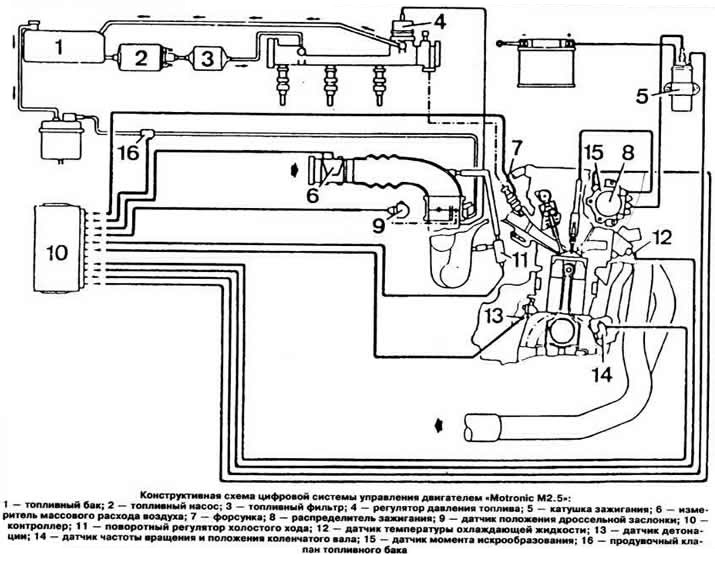
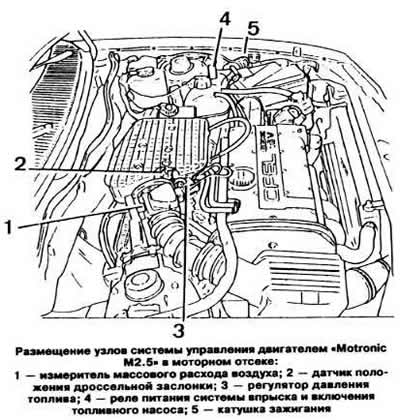
- a thermo-anemometric air flow meter is used, which measures the volume of air sucked in regardless of atmospheric pressure and air temperature. The air entering the engine flows around a thin platinum filament installed in the meter. The filament is part of a bridge circuit, the diagonal voltage of which is adjusted to zero by changing the heating current. The filament heating temperature is maintained constant by an electronic control circuit. As the mass of air sucked in increases, the filament current increases accordingly, thereby maintaining a constant filament temperature. The filament current serves as a measure of the mass of air sucked in by the engine. The parameter determining the mass flow of air entering the engine is the voltage required to maintain a constant filament temperature. For 1 s after each engine stop, the filament is heated to a very high temperature by the controller to remove contaminants that could distort the output signal.
- the "Motronic M2.5" system operates on the principle of cylinder selection, i.e. the moment and duration of fuel injection, the ignition timing and its change to prevent detonation are calculated separately for each cylinder. For this reason, in addition to the signal from the crankshaft speed and position sensor, this system requires a signal from the TDC of the compression stroke of cylinder No.1. This signal is sent to the controller from the spark timing sensor, which operates on the principle of a Hall sensor installed in the ignition distributor;
- the fuel pressure regulator is built into the distribution line and cannot be removed separately;
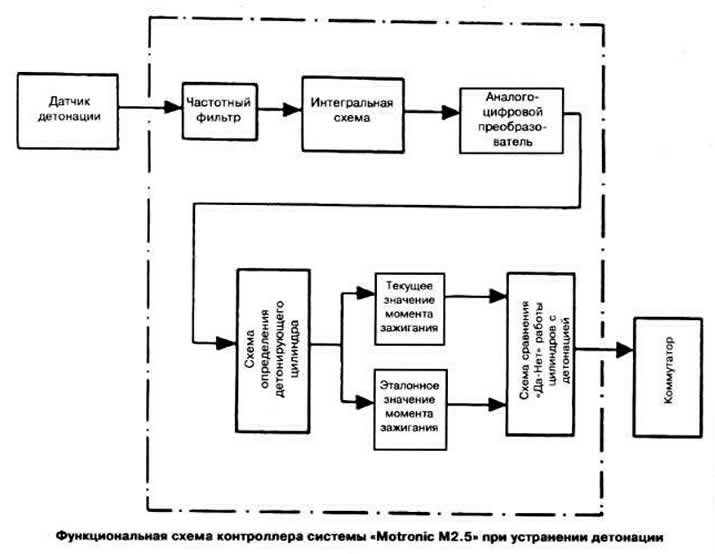
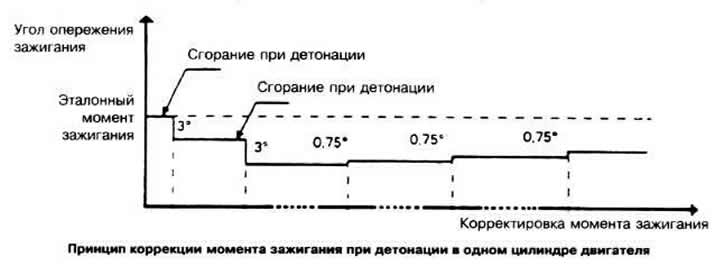
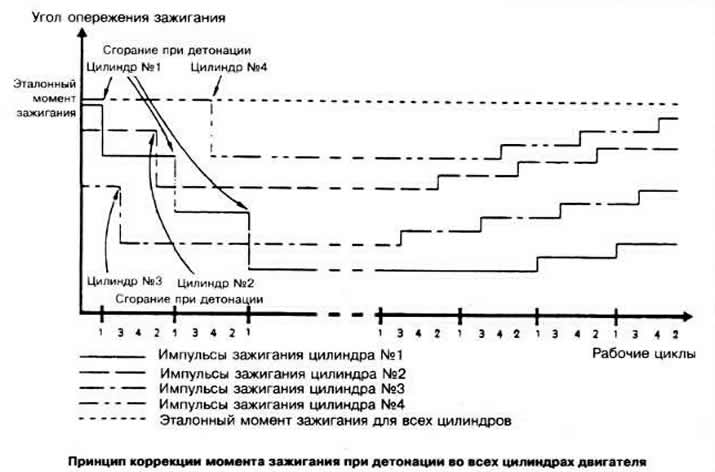
- a knock sensor is installed on the cylinder block, which detects changes in engine noise (detonation pops) and feeding the corresponding signals to the controller. The signal from the knock sensor passes through a 14 kHz partial filter at the controller input and enters the integrating circuit, provided that it corresponds to the ignition advance angle, which is within the range of 10-60° after TDC. The signal is then converted into digital form by an analog-to-digital converter and compared with the average reference value for the last 16 working cycles of the given cylinder. If the received signal is greater than the average reference value, this serves as a basis for the controller to change the ignition timing. If the received signal is less than the average reference value, it becomes the new reference value of the ignition timing for the given cylinder. If it is necessary to adjust the ignition timing, the controller shifts the ignition advance angle for the next working cycle of this cylinder by 3° towards the retardation and again by 3° for the subsequent cycle if the adjustment is insufficient. If, during 20-120 ignitions of the mixture, which take approximately 2 s, the ignition advance angle is shifted each time by 0.75° towards the advance until it reaches the reference value or detonation occurs again;
- the ignition timing control based on the detonation limit ensures automatic adaptation of the engine operation to the octane number of the fuel. The controller memory contains two ignition timing control programs depending on the octane number of the fuel used. One of them is designed for gasoline with an octane number of 95 and is activated after 50 combustions with detonation. The transition to another program, designed for engine operation on gasoline with an octane number of 98, occurs if the engine operates for 8.5 minutes without detonation;
- the "Motronic M2.5" system is a sequential phased fuel injection system. The injectors are controlled separately for each cylinder. In this case, fuel is supplied only to the cylinder that operates in the suction stroke;
- the crankshaft speed and position sensor is mounted on the engine block opposite the toothed rim mounted on the engine crankshaft. It generates a voltage pulse when the toothed rim passes through its magnetic field. When the rim teeth pass in front of the magnetic sensor, the air gap between the rim and the sensor changes. The changing leakage flux induces a sinusoidal alternating voltage in the sensor winding, the amplitude of which depends on the peripheral speed of the toothed rim, the air gap between the rim tooth and the sensor, the shape of the teeth, the magnetic characteristics of the sensor and the mounting bracket. Depending on the engine crankshaft speed, voltage pulses of 0.5-100 V are fed from the sensor to the controller, which are converted by the controller input cascade each time the counting circuit is set to zero into rectangular voltage pulses of constant amplitude required for the operation of subsequent controller circuits. The angular gap between the rim teeth is 6°. There are two teeth missing on the rim. When a toothless section of the rim passes in front of the sensor, which serves as a marker, the controller receives a pulse of the initial position of the crankshaft. If the engine does not start or starts with difficulty, then the cause may be a malfunction of this sensor.
Visitor comments