


Contents: Spark plug BOSCH ⬇ Beru spark plugs ⬇ Spark plugs from OPEL ⬇ External view of the screwed-in part…⬇
The spark plug consists of a central electrode, an insulator with a housing, and a ground electrode. The central electrode is hermetically secured in the insulator, the insulator is firmly connected to the housing. A spark jumps between the central electrode and the ground electrode, which should ignite the combustible mixture. The spark plug determines the readiness to start, idle speed, acceleration, and maximum speed. Therefore, without special reasons, you should not deviate from the recommended type of spark plug.
The main characteristic of a spark plug is its heat rating. The heat rating determines the heat resistance coefficient of the spark plug in the engine under certain operating conditions. The spark plugs are selected in such a way that they can reach the self-cleaning temperature under all operating conditions.
The lower the glow number of a spark plug, the higher its resistance to glow ignition and the lower its resistance to contamination. The higher the glow number of a spark plug, the lower its resistance to glow ignition and the higher its resistance to contamination.
The heat rating is included in the spark plug code. The code is deciphered as follows:
Spark plug BOSCH
| Example: | W | R | 7 | D | WITH |
| 1 | 2 | 3 | 4 | 5 |
- 1 W - thread M14x1.25 with flat fit,
- M - thread M18x1.5 with flat fit,
- H - thread M14x1.25 with conical fit,
- D - thread M18x1.5 with conical fit, key 21 mm or for H/F - 16 mm.
2 R - with noise suppression resistor. The noise suppression resistor does not affect the function of the ignition system.
3 - Spark plug heat rating. The school of values is divided into divisions from 06 ("cold") to 13 ("hot"). The number 7 corresponds to the old heat rating of 175 (older designation), 6 - 200, 5 - 225, etc.
4 A - thread length 12.7 mm, normal thread; B - thread length 12.7 mm, offset spark, C - thread length 19 mm, normal spark, D - thread length 19 mm, offset spark.
5 - Material from which the middle electrode is made: chromium-nickel alloy, C - nickel-copper, S - silver, P - platinum, O - standard spark plug with a hardened middle electrode.
Beru spark plugs
| Example: | 14 | R | 7 | IN | U |
| 1 | 2 | 3 | 4 | 5 |
1 - Thread diameter in mm, here M14
2 - design features, for example, R is a noise suppression resistor.
3 - heat rating (like BOSCH).
4 - thread length (like BOSCH).
5 - electrode material, for example U - copper core. A spark plug with a silver-plated middle electrode has the designation RS, for example, RS 35.
Thermal resistance is increased by using a copper core (Cu) in the middle electrode and even more by using a silver-plated middle electrode. The advantage of spark plugs with a platinum middle electrode is high ignition readiness, as well as low wear and a larger range of heat numbers.
Spark plugs from OPEL
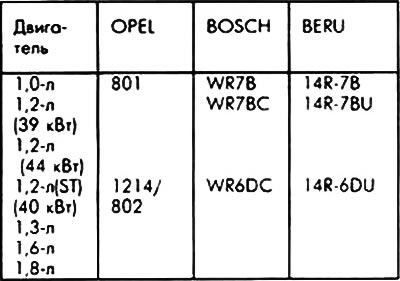
801 - thread length 12.7 mm, with noise suppression resistor.
802 - thread length 19 mm, with noise suppression resistor.
Deviations from the heat ratings recommended by the factory are only possible when operating conditions differ significantly from normal conditions and interruptions in operation occur.
If the candles are sooty, it means they do not reach the self-cleaning temperature (only on short sections of traffic), it is recommended to replace them with spark plugs with a higher heat rating. And finally, if the engine will be operated at full throttle, a spark plug with a lower heat rating can be used.
To facilitate engine starting at low outside temperatures, the distance between the electrodes can be temporarily reduced from 0.7 mm to 0.5 mm.
External view of the screwed-in part of the candle
With some experience, you can draw conclusions about the condition of the engine based on the appearance of the spark plug.
Electrodes and insulators:
- gray - correctly adjusted carburetor and correct operation of spark plugs
- black - too rich mixture
- light gray - too lean mixture
- oily - interruptions in the operation of the corresponding spark plug, worn or stuck piston rings. Spark plugs can be cleaned with a brush or sandblasted.
Platinum spark plugs have reached their wear limit when the center electrode is no longer visible in the insulator. In this case, replace the spark plugs.
Every 15,000 km, the spark plugs should be unscrewed and the appearance of their screwed-in part, the distance between the electrodes, and the wear caused by burning should be checked. If necessary, the spark plugs should be replaced.
Tighten all spark plugs to 20 Nm.
Spark plug types for KADETT D
Visitor comments