OpelBook.ru
Cars AvtoVAZ Cars Mitsubishi Cars BMW Cars Mercedes Cars Nissan Cars Toyota Cars Chevrolet
English Русский
Български
Беларускі
Український
Српски
Hrvatski
Română
Polski
Slovenský
Magyar
 |  Sitemap  |  Contacts  |    


Main Astra Corsa Insignia Kadett Omega Vectra Zafira Others Articles
Astra F (1991-1998, petrol) Astra G (1998-2004, petrol) Astra G (1998-2004) Astra H (2004-2009) Astra J (2009-2015, petrol)
  • Main
  • Astra
  • Astra J
  • Electrical equipment
  • Equipment and devices
  • Location of fuses and fusible links and their replacement

Location of fuses and fusible links and their replacement (Opel Astra J)

            0

Most of the power circuits of the car's electrical equipment are protected by fuses. Headlights, fan motors, fuel pump and other powerful consumers of current are connected via relays. Fuses and relays are installed in mounting blocks, which are located in the trunk of the car under the side paneling on the left side, in the engine compartment next to the battery and under the instrument panel on the left side.

Most of the power circuits of the car's electrical equipment are protected by fuses. Headlights,…


In addition, fuse links of power circuits are mounted on the tip of the positive terminal wire of the battery.
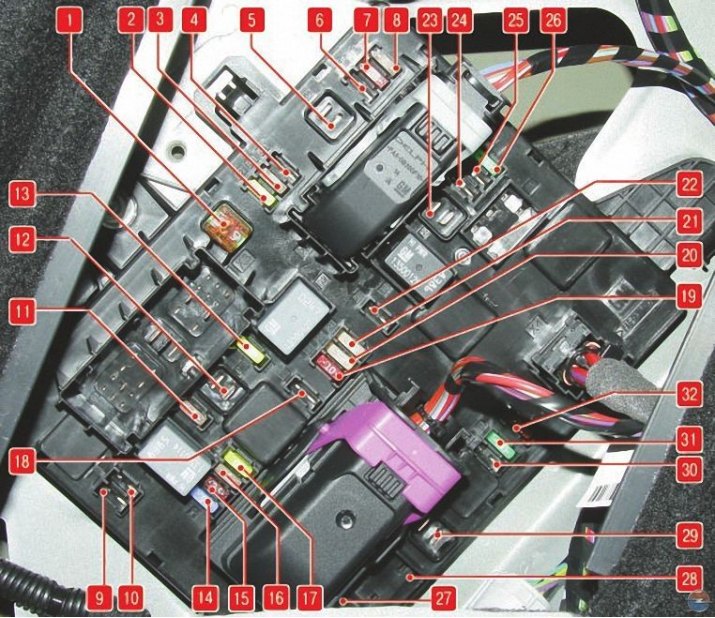
Fig. 1. Designations of fuses and fusible links installed in the trunk mounting block

Fig. 1. Designations of fuses and fusible links installed in the trunk mounting block


The designations of the fuses in the mounting block installed in the trunk under the left side panel trim are shown in Fig. 1.


Table 1. Purpose of fuses and fusible links installed in the trunk mounting block


№Protected circuits
1Trailer module
2Trailer Nest
3Parking assistance system
4 —
5 —
6 —
7 —
8 Anti-theft alarm
9 —
10 —
11 Trailer module, trailer socket
12 —
13 —
14 —
15 —
16 —
17 —
18 —
19 Steering wheel heater
20 Roof vent
21 Heated seats
22 —
23 —
24 —
25 —
26 —
27 —
28 —
29 —
30 —
31 Acoustic system
32 Active Damping System, Lane Departure Warning System

Table 1 shows the purpose of these fuses and fuse links, but some circuits listed in the table may not be present on a particular vehicle model.
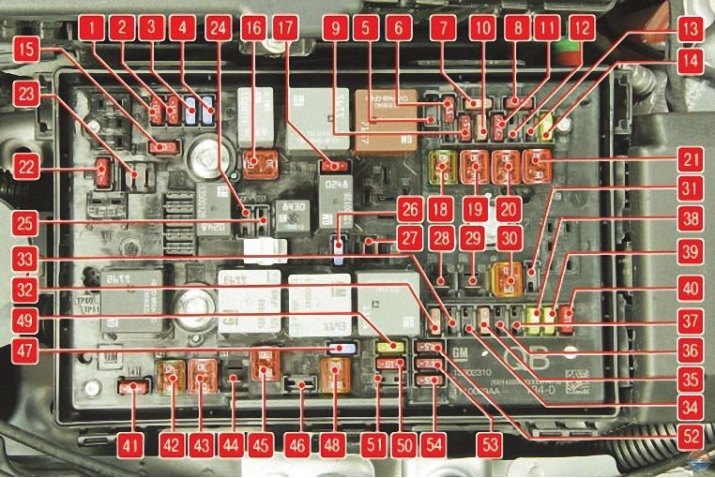
Fig. 2. Designations of fuses and fusible links installed in the engine compartment mounting block

Fig. 2. Designations of fuses and fusible links installed in the engine compartment mounting block


The designations of the fuses and fusible links of the mounting block installed in the engine compartment are shown in Fig. 2.

Table 2. Purpose of fuses and fusible links installed in the engine compartment mounting block


№Protected circuits
1 Engine control unit
2 Oxygen concentration sensor
3 Fuel injection, ignition system
4 Fuel injection, ignition system
5 —
6 Heated mirrors
7 Fan controller
8 Oxygen concentration sensor
9 Rear window sensor
10 Battery sensor
11 Trunk opening lever
12 Adaptive Front Lighting Module
13 —
14 Rear window cleaner
15 Engine control unit
16 Starter
17 Gearbox control unit
18 Rear window heating
19 Front electric windows
20 Rear electric windows
21 ABS
22 Left headlight (high beam)
23 Headlight washer
24 Right headlight (low beam, xenon)
25 Left headlight (low beam, xenon)
26 Fog lights
27 Heating of diesel fuel
28 —
29 Electric parking brake
30 ABS
31 —
32 Airbag
33 Adaptive headlight system
34 —
35 Electric windows
36 —
37 Evaporative Evaporative Canister Purge Solenoid Valve
38 Vacuum pump
39 Fuel injection system control unit
40 Windscreen washer, rear window washer
41 Right headlight (high beam)
42 Radiator fan of the engine cooling system
43 Windscreen cleaner
44 —
45 Engine cooling fan
46 —
47 Sound signal
48 Radiator fan of the engine cooling system
49 Fuel pump
50 Headlight corrector
51 Throttle assembly
52 Heating of crankcase gases
53 Transmission Control Module, Engine Control Module
54 Electrical wiring inspection


Table 2 shows the purpose of these fuses and fuse links, but some circuits listed in the table may not be present on a specific vehicle model.
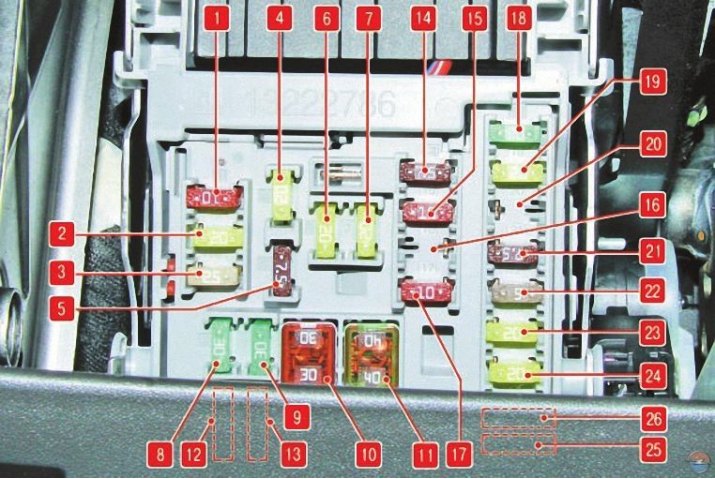
Fig. 3. Designations of fuses and fusible links installed in the instrument panel mounting block

Fig. 3. Designations of fuses and fusible links installed in the instrument panel mounting block


The designations of the fuses and fusible links of the mounting block installed in the instrument panel are given in Fig. 3.

Table 3. Purpose of fuses and fusible links installed in the instrument panel mounting block


№ Protected circuits
1 Display
2 Outdoor lighting
3 Same
4 Audio system
5 Information and measuring system
6 Front power socket
7 Rear power socket
8 Left headlight (low beam, halogen)
9 Right headlight (low beam, halogen)
10 Door locks
11 Heating systems (ventilation) and air conditioning
12 —
13 —
14 Diagnostic connector
15 Airbag
16 —
17 Air conditioner
18 —
19 Brake lights, reversing lights, interior lights
20 —
21 Devices
22 Ignition switch
23 Body electrical equipment control unit
24 Same
25 —
26 —

Table 3 shows the purpose of these fuses and fuse links, but some circuits listed in the table may not be present on a specific vehicle model.
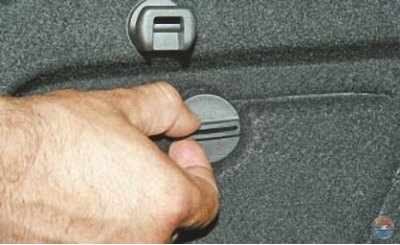
Table 3 shows the purpose of these fuses and fuse links, but some circuits listed in the table may…


1. To gain access to the mounting block located in the trunk, turn the hatch cover lock in the left side trim by 90°…
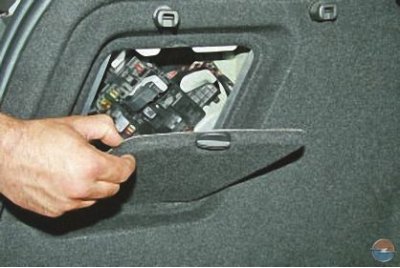


1. To gain access to the mounting block located in the trunk, turn the hatch cover lock in the left…


2. …and fold the lid down.

2. …and fold the lid down.


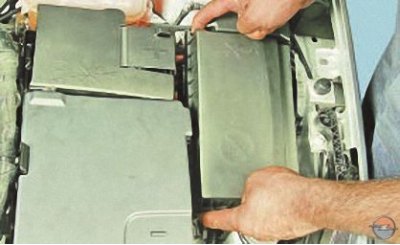
3. To gain access to the mounting block located in the engine compartment, use a screwdriver to press the two fasteners…
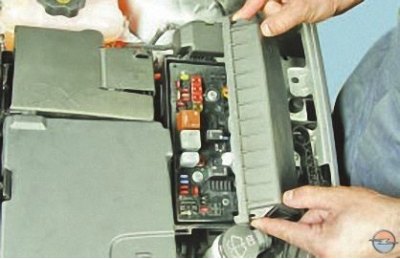
3. To gain access to the mounting block located in the engine compartment, use a screwdriver to…


4. …and remove its cover.

4. …and remove its cover.


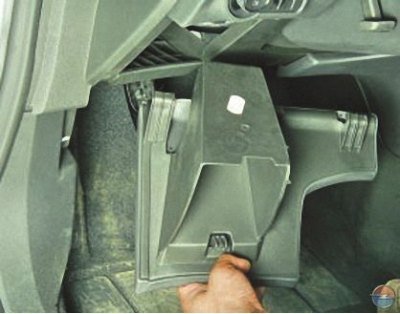
5. To gain access to the mounting block located in the instrument panel, remove the left glove compartment (see Removal and installation storage boxes).
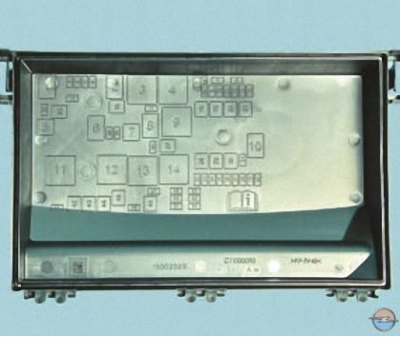


5. To gain access to the mounting block located in the instrument panel, remove the left glove…


The inside of the cover of the fuse box located in the engine compartment has a diagram of the location of the fuses and fusible links.
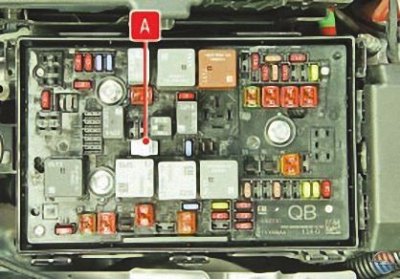
The inside of the cover of the fuse box located in the engine compartment has a diagram of the…


A pair of tweezers is attached to a special socket in the housing of this mounting block A to remove fuses.

6. Before replacing a blown fuse or fusible link, determine the cause of the blown fuse and eliminate it. When searching for a fault, look at the circuits listed in Tables 1–3 that are protected by the fuse or fusible link.

Warning! Do not replace fuses with fuses rated for a different amperage or with homemade jumpers - this may damage electrical equipment and even cause a fire.
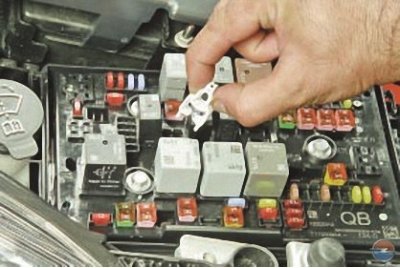

Warning! Do not replace fuses with fuses rated for a different amperage or with homemade jumpers -…


7. Remove the tweezers from the base of the mounting block located in the engine compartment.
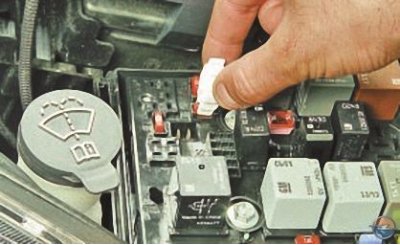


7. Remove the tweezers from the base of the mounting block located in the engine compartment.


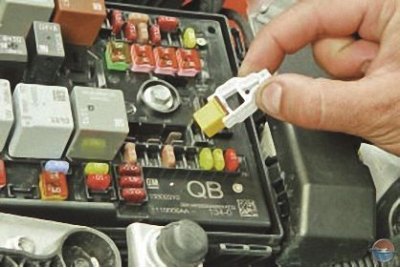
8. Grasp the fuse with tweezers…
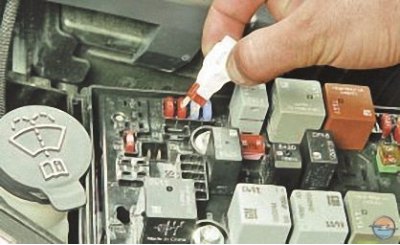
8. Grasp the fuse with tweezers…


9. …and remove it from the connector.
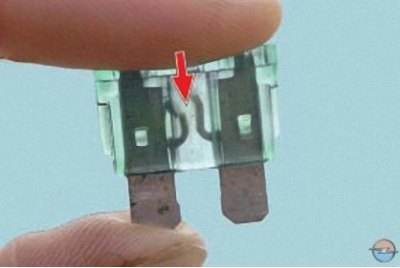
9. …and remove it from the connector.


This is what a blown fuse looks like (the jumper shown by the arrow inside the holder has burned out and opened).

To replace a fuse, use a spare fuse of the same rating (and color).

10. Install a fuse of the same rating as the one removed into the contact connector.
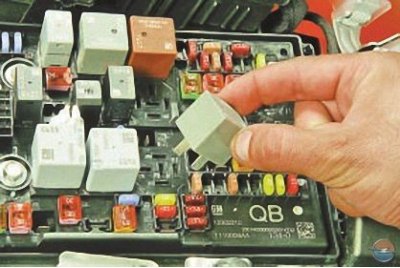


10. Install a fuse of the same rating as the one removed into the contact connector.


11. If replacement is necessary, remove the relay from the mounting block by rocking it from side to side..
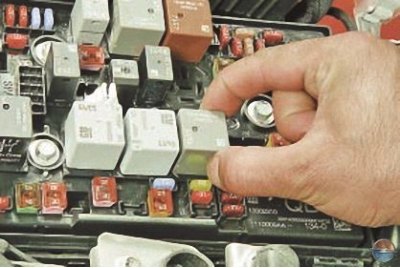
11. If replacement is necessary, remove the relay from the mounting block by rocking it from side…


12. …and install a new relay.

12. …and install a new relay.


13. Replace fuse links in the same way as replacing relays.

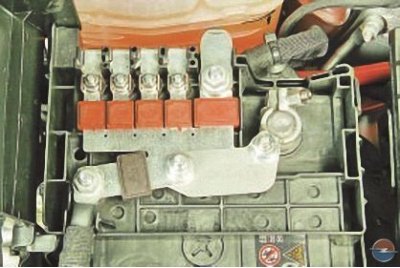
For replacement power fuse do the following.

[Material provided by this website: OpelBook]

You will need a 13 mm socket head.
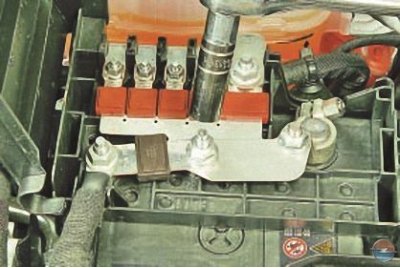


You will need a 13 mm socket head.


1. Loosen the two fuse mounting nuts…
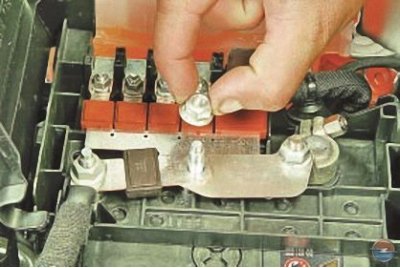
1. Loosen the two fuse mounting nuts…


2. …unscrew both nuts…
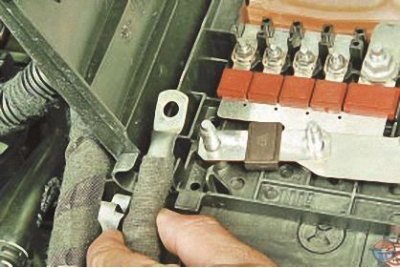
2. …unscrew both nuts…


3. …disconnect the power cable tip…
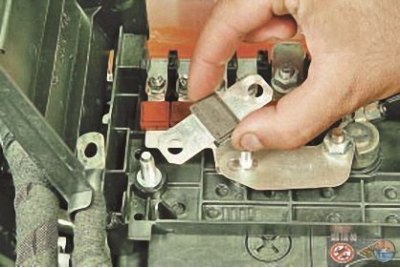
3. …disconnect the power cable tip…


4. …and remove the power fuse.
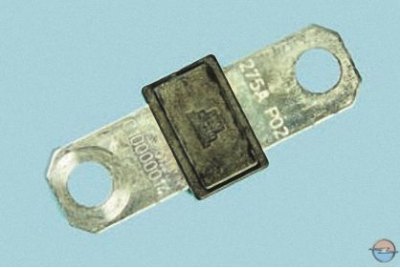
4. …and remove the power fuse.


5. Install the new power fuse in the reverse order of removal.


This article is available at russian, bulgarian, belarusian, ukrainian, serbian, croatian, romanian, polish, slovak, hungarian
Checking the article: Trifonova Emilia

Share information:

Previous articles
Opel Astra J: Equipment and devices
Next articles

Diagnostics of faults of on-board electrical equipment
Features of the design of electrical equipment
Removal and installation the trunk mounting block
Design and testing of the ignition switch (lock)
Replacing the ignition switch (lock) contact group
Replacing the ignition switch (lock) cylinder
Removal and installation the ignition switch (lock)
Replacement and maintenance of spark plugs


See similar ones from other Opel car manuals:
▶ Fuses and relays — location and designation Opel Corsa C (2000-2006)
▶ Location and purpose of fuses Opel Omega B2 (1999-2003)
▶ Fuses and relays — location and purpose Opel Vectra C (2002-2008)
▶ Fuses — description and location Opel Frontera A (1991-1998, petrol)
▶ Fuses Opel Insignia A (2008-2017)
Link to this page in different formats

Visitor comments


No comments yet


How much will 21 + 42 =


Astra J (2009-2015, petrol) 
  • General information
  • Vehicle device
  • User manual
  • Faults en route
  • Maintenance
  • Power unit
  • Engine repair
  • Cooling and lubrication system
  • Engine power system
  • Exhaust system
  • Transmission
  • Clutch
  • Car gearbox
  • Drive shafts
  • Chassis
  • Front suspension
  • Rear suspension
  • Steering
  • Brake system
  • Wheels and tires
  • Body
  • Exterior
  • Interior
  • Doors and windows
  • Body Care
  • Heating and air conditioning
  • Security systems
  • Electrical equipment
  • Equipment and devices
  • Lighting and signaling
  • Power devices
  • Electrical circuits
Astra H (2004-2009) 
  • General information
  • Introduction to the guide
  • Troubleshooting
  • User manual
  • Maintenance
  • Power unit
  • Engine repair
  • Cooling and heating
  • Power and exhaust system
  • Ignition system
  • Launch and charge system
  • Transmission
  • Mechanical gearbox
  • Automatic gearbox
  • Drive shafts
  • Chassis
  • Brake system
  • Car suspension
  • Steering
  • Body
  • Interior
  • Exterior
  • Electrical equipment
  • Equipment and devices
  • Electrical circuits
Astra G (1998-2004) 
  • General information
  • Introduction to manual
  • User manual
  • Maintenance
  • Power unit
  • SOHC gasoline engines
  • DOHC gasoline engines
  • Diesel engines 1.7 and 2.0
  • Engine repair
  • Cooling system
  • Supply system
  • Injection system (gasoline)
  • Injection system (diesel)
  • Exhaust system
  • Charge and launch system
  • Ignition system (gasoline)
  • Preheat system (diesel)
  • Transmission
  • Manual gearbox
  • Automatic gearbox
  • Clutch
  • Drive shafts
  • Chassis
  • Brake system
  • Wheel suspension
  • Steering
  • Body
  • Exterior
  • Interior
  • Doors and windows
  • Ventilation and heating
  • Electrical equipment
  • Equipment and devices
  • Electrical circuits
Astra G (1998-2004, petrol) 
  • General information
  • User manual
  • Car care
  • Maintenance
  • Power unit
  • Single shaft engines
  • Twin shaft engines
  • Engine repair
  • Cooling and heating
  • Fuel and exhaust systems
  • Starting and charging system
  • Ignition system
  • Transmission
  • Clutch
  • Mechanical gearbox
  • Automatic gearbox
  • Drive shafts
  • Chassis
  • Brake system
  • Car suspension
  • Steering
  • Body
  • Interior
  • Exterior
  • Electrical equipment
  • Equipment and devices
  • Wiring diagrams Opel Astra
  • Wiring diagrams Opel Zafira
Astra F (1991-1998, petrol) 
  • General information
  • Maintenance
  • Power unit
  • Engine in car
  • Engine removed
  • Cooling system
  • Heating and ventilation
  • Fuel supply (carburetor)
  • Fuel supply (injector)
  • Emission control
  • Ignition system
  • Transmission
  • Clutch
  • Mechanical gearbox
  • Automatic gearbox
  • Drive shafts
  • Chassis
  • Brake system
  • Car suspension
  • Steering
  • Body
  • Exterior
  • Interior
  • Electrical equipment
  • Equipment and devices
  • Electrical circuits
OpelBook.ru © 2017–2026 · Mobile version · · Sitemap: EN BG BY UA RS HR RO PL SK HU · Feedback · Site search
Astra F, petrol · Astra G, petrol · Astra G · Astra H · Astra J, petrol · Corsa B · Corsa C, petrol · Corsa C · Insignia A · Kadett D · Kadett E · Omega A · Omega B · Omega B2 · Vectra A, petrol · Vectra A · Vectra B, petrol · Vectra B · Vectra C · Zafira A, petrol · Frontera A, petrol · Frontera B · Ascona C · Vivaro A ·
We want your visit to be comfortable 🤝! We use cookies 🍪 to make that happen.