


Sequence of execution
1. Prepare the car for work (see "Preparing the car for maintenance and repair").
2. Remove the front wheel (see "Wheel - replacement").
3. When checking the pads of the left brake mechanism, turn the steering wheel all the way to the left; when checking the pads of the right brake mechanism, turn it all the way to the right.
4. Through the inspection hole in the caliper, visually determine the thickness of the brake pads (the photo shows the thickness of the inner pad).
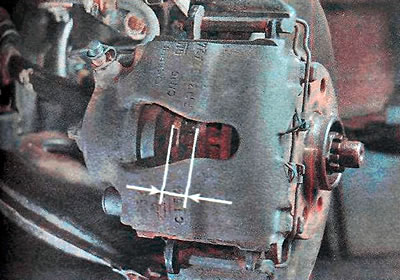
If the thickness of at least one pad is less than the permissible value (see "Reference data"), we replace all the brake pads of the left and right brake mechanisms (see "Front brake pads - replacement").
5. Using a caliper, measure the thickness of the brake disc. If it is less than the permissible value (see "Reference data"), we replace the disks on both sides of the car (see "Front brake discs - replacement").
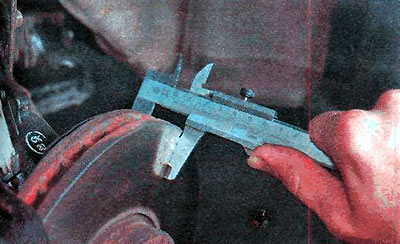
Note: When measuring the thickness of the brake disc, keep in mind that when the disc wears, a ridge forms along its edges, the thickness of which is greater than the thickness of the disc itself.
6. We check the mobility of the brake cylinder pistons by pressing the piston into the cylinder using a screwdriver as a lever.
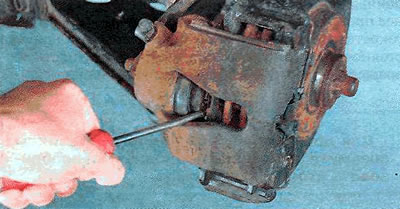
If the piston becomes stuck, replace the caliper assembly (see "Front Brake Caliper - Removal, Repair and Installation").
7. Check for any leaks of brake fluid from under the caliper cylinder seals. If there are any signs of leaks, it is necessary to replace the caliper assembly or only its seals (see "Front Brake Caliper - Removal, Repair and Installation").
8. Make sure there are no traces of oil or other technical fluids on the brake disc. If necessary, degrease it, for example, using a brake cleaner.
(Material copied from the portal: www.OPELBOOK.ru)
9. Install the wheel.
10. We check the brake mechanism of the second wheel in the same way.
11. After checking, press the brake pedal several times to bring the pads to the brake discs.
Visitor comments