


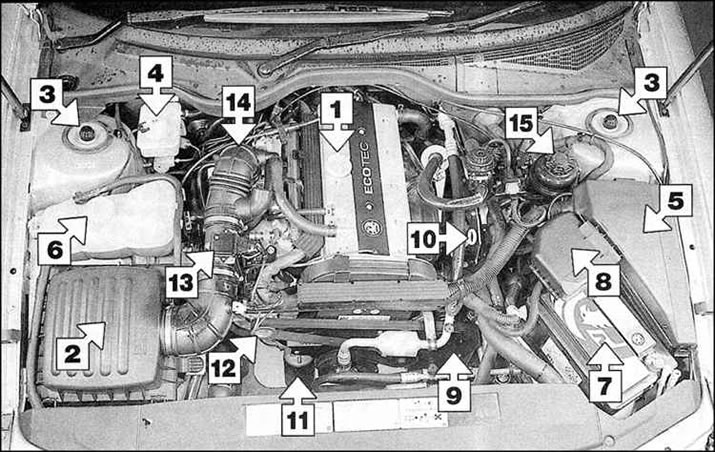
1. Engine oil filler cap
2. Air filter housing
3. Upper mount of the front suspension strut
4. Brake fluid reservoir
5. Relay block
6. Expansion tank
7. Battery
8. Block of burnable jumpers
9. Power steering system pump
10. Dipstick for checking engine oil level
11. Oil filter
12. Generator
13. Air flow sensor
14. Throttle body housing
15. Power steering fluid reservoir
View of the engine compartment of models with a 2.5L engine (3.0L engine is similar)
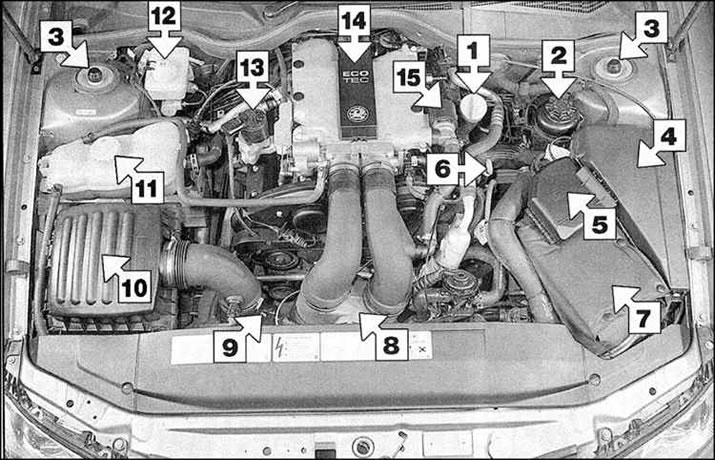
1. Engine oil filler cap
2. Power steering fluid reservoir
3. Upper mount of the front suspension strut
4. Relay block
5. Block of burnable jumpers
6. Dipstick for checking engine oil level
7. Battery
8. Air chamber
9. Air flow sensor
10. Air filter
11. Expansion tank of the cooling system
12. Brake fluid reservoir
13. Exhaust gas recirculation valve
14. Intake manifold
15. Idle speed control valve
Bottom view of engine compartment for 2.0L DOHC models (the other models are similar)
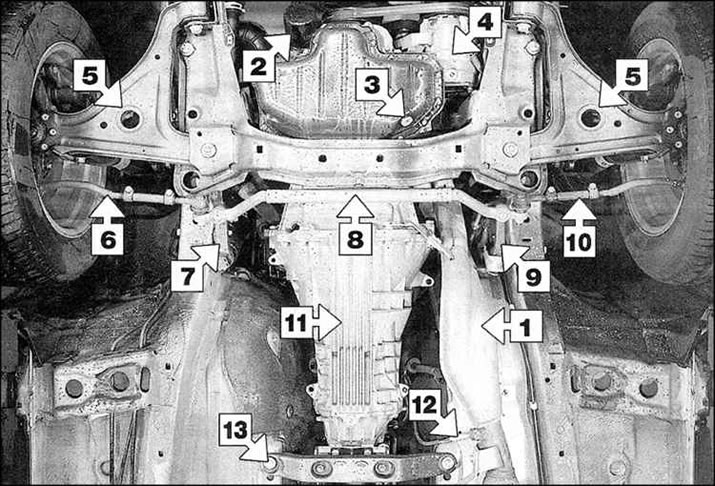
1. Exhaust system inlet pipe
2. Oil filter
3. Engine oil drain plug
4. Air conditioning compressor
5. Lower suspension arm
6. Outer steering rod
7. Steering knuckle
8. Central steering rod
9. Steering knuckle
10. Outer tie rod
11. Manual transmission
12. Oxygen sensor
13. Gearbox mounting crossmember
In this manual, the term "maintenance" refers to the totality of the work performed, not to a specific procedure.
If, from the moment you purchase a new car, you strictly follow the maintenance procedure, frequently check the level of fluids and parts subject to increased wear, as is strongly recommended in the Manual, then the engine will retain high performance qualities and the amount of additional work will be reduced to a minimum.
(Original article on the web portal Opelbook.ru)
However, if maintenance is not carried out regularly, the engine will most likely perform poorly. This is especially true for the engine of a used car that has not been regularly checked. In such cases, in addition to periodic maintenance, additional adjustment work must be carried out.
Any type of maintenance work or search for the cause of abnormal engine operation should begin with a compression test in the cylinders. A compression test in the cylinders provides valuable information about the general condition of many parts of the engine's internal structure, which can be used as a basis for both routine maintenance and repair procedures. If, for example, the compression is such that severe engine wear is evident, then routine maintenance will not restore normal performance and all work will be reduced to an unnecessary waste of time and money.
Below is a list of works, the implementation of which often leads to the restoration of normal engine operation.
Primary checks:
- clean, inspect and test the battery;
- check oil and coolant levels;
- check the condition and tension of the drive belt;
- replace spark plugs;
- check the air filter and replace it if necessary;
- check the fuel filter;
- check the condition of all hoses and inspect them for leaks.
If the above steps are not effective, perform secondary checks - all steps listed above, plus:
- check the battery charging system;
- check the ignition system;
- check the power supply system.
Visitor comments