
OpelBook.ru
Cars AvtoVAZ Cars Mitsubishi Cars BMW Cars Mercedes Cars Nissan Cars Toyota Cars Chevrolet
English Русский
Български
Беларускі
Український
Српски
Hrvatski
Română
Polski
Slovenský
Magyar
 |  Sitemap  |  Contacts  |    


Main Astra Corsa Insignia Kadett Omega Vectra Zafira Others Articles
Omega A (1986-1993) Omega B (1993-1999) Omega B2 (1999-2003)
  • Main
  • Omega
  • Omega B
  • General information
  • Maintenance (gasoline)
  • Every 2 years regardless of mileage

Every 2 years regardless of mileage (Opel Omega B)

            0

Contents: Brake fluid ⬇ Battery for remote control of…⬇ Coolant ⬇

Brake fluid


Replacing the brake fluid is done in the same way as bleeding the brake system. Bleed until only new brake fluid flows out of the exhaust valves.

Old brake fluid is significantly darker than new, so they are easy to tell apart.

Battery for remote control of central locking


Remove the cover of the remote control and replace the battery. The battery must be replaced within 3 minutes, otherwise the unit will need to be reprogrammed.

Coolant


Warning! Wait until the engine has cooled down before draining. Be careful not to let coolant with antifreeze come into contact with your skin or painted surface of the car body.


Many typical engine failures are caused by a faulty cooling system. On vehicles with automatic transmission, the condition of the cooling system, which also cools the transmission fluid, significantly affects the durability and reliability of the transmission.

Replacement


1. The cooling system is checked on a cold engine. Check the system before driving or at least 3 hours after stopping the engine.

2. Turn the radiator cap all the way to the left. If you hear a hissing sound (which indicates residual pressure in the cooling system), do not remove the plug until the pressure is completely released. Now press the plug with your palm, turn it to the left and remove the plug. Rinse the plug thoroughly with clean water, wipe the radiator neck with a clean rag. Remove all traces of corrosion. The coolant in the radiator should be transparent. If the coolant is colored rust, the system should be flushed and the fluid changed. If the coolant level is below the edge of the filler neck, add a mixture of water and antifreeze.


3. Check the condition of the upper and lower radiator hoses and the heater hoses that lead from the engine to the wall of the engine compartment. Inspect the hoses along their entire length; if you find swelling of the hoses, cracks, or general deterioration in their condition, replace the hose. Cracks are easily detected if the hose is pinched. Regardless of the condition of the hoses, it is recommended to replace them every two years.

4. Make sure all connections are tight. Coolant leaks can be detected by a white or brown coating near the leak. If the hoses are secured with wire clamps, these should be replaced with clamps with screw fastening.

5. Use compressed air or a brush to remove insects, plants and foreign objects from the inter-fin spaces of the radiator and air conditioner condenser, without damaging the fins of the radiator or condenser. Be careful, as the fins have sharp edges.

6. During subsequent checks or in case of abnormal operation of the cooling system, check the condition of the radiator cap and the pressure in the system. If there is no pressure gauge, you should contact the car service, where this service will be provided for a minimal fee.

7. Remove the expansion tank cap.

8. Remove the engine undershield if necessary and install a coolant collection container.
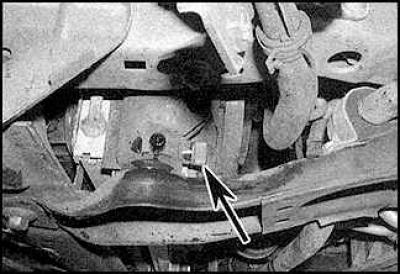
8. Remove the engine undershield if necessary and install a coolant collection container.


9. Unscrew the drain plug (arrow) and drain the coolant.


10. Replace the plug.

Flushing the cooling system


If the cooling system is clogged, it must be flushed.

Radiator flushing


1. Disconnect all hoses from the radiator.

2. Insert a water hose into the upper radiator hose and flush it with clean water or cleaning solution.

Engine flush


1. Remove the thermostat and temporarily reinstall the thermostat cover. Reconnect the upper radiator hose.

2. Insert the water hose into the upper radiator hose and flush the engine with clean water.

Filling with coolant


1. Check the condition of all cooling system hoses and clamps.
1. Check the condition of all cooling system hoses and clamps.


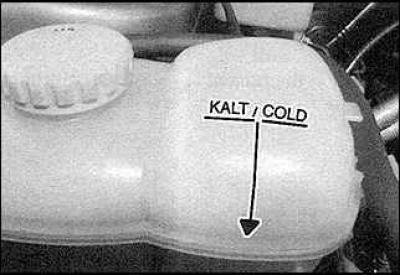
2. Remove the expansion tank cap and slowly fill the coolant to the KALT/COLD mark on the tank.

3. Tighten the tank cap.

4. Start the engine and warm it up to normal operating temperature.

5. Turn off the engine, wait until it cools down, and check the coolant level.

Coolant containing antifreeze


Replace coolant containing antifreeze regularly, as over time antifreeze loses its anti-corrosion properties.


This article is available at russian, bulgarian, belarusian, ukrainian, serbian, croatian, romanian, polish, slovak, hungarian
Checking the article: Fedorova Varvara

Share information:

Previous articles
Opel Omega B: Maintenance (gasoline)
Next articles

After 112,000 km or every 7 years
After 64,000 km or every 4 years
After 32,000 km or every 2 years
After 16,000 km or every 12 months
After 8000 km or every 6 months
Routine maintenance


See similar ones from other Opel car manuals:
▶ Every 2 years regardless of mileage Opel Astra G (1998-2004, petrol)
▶ Every 2 years regardless of the vehicle mileage Opel Vectra B (1995-2002)
Link to this page in different formats

Visitor comments


No comments yet


How much will 16 + 35 =


Omega B2 (1999-2003) 
  • General information
  • User manual
  • Maintenance
  • Troubleshooting
  • Power unit
  • Petrol 4-cylinder
  • Petrol 6-cylinder
  • Engine overhaul
  • Diesel engines 2.0 l
  • Diesel engines 2.5 l
  • Cooling and heating
  • Injection system (gasoline)
  • Fuel system (diesel)
  • Fuel system
  • Exhaust system
  • Ignition system
  • Transmission
  • Clutch
  • Mechanical gearbox
  • Automatic gearbox
  • Main gear and shafts
  • Chassis
  • Brake system
  • Car suspension
  • Steering
  • Body
  • Body elements
  • Electrical equipment
  • Equipment and devices
  • Electrical circuits
Omega B (1993-1999) 
  • General information
  • User manual
  • Tips for the car owner
  • Maintenance (gasoline)
  • Maintenance (diesel)
  • Power unit
  • Petrol engine SOHC 2.0 l
  • Petrol engine DOHC 2.0 l
  • Petrol engines 2.5 and 3.0 l
  • Repair of gasoline engines
  • Diesel engine 2.0 l
  • Diesel engine repair 2.0 l
  • Diesel engine 2.5 l
  • Cooling and heating
  • Power system (petrol)
  • Emission reduction
  • Fuel system (diesel 2.0 l)
  • Fuel system (diesel 2.5 l)
  • Launch system
  • Ignition system
  • Transmission
  • Clutch
  • Mechanical gearbox
  • Automatic gearbox
  • Drive shafts
  • Chassis
  • Brake system
  • Wheel suspension
  • Steering
  • Body
  • Exterior
  • Interior
  • Doors and windows
  • Electrical equipment
  • Equipment and devices
  • Wiring diagrams (early)
  • Wiring diagrams (late)
Omega A (1986-1993) 
  • General information
  • User manual
  • Maintenance
  • Changes and additions
  • Troubleshooting
  • Power unit
  • Gasoline engines
  • Diesel engines
  • Cooling system
  • Fuel system (gasoline)
  • Fuel system (diesel)
  • Ignition system
  • Transmission
  • Clutch
  • Mechanical gearbox
  • Automatic gearbox
  • Cardan shaft
  • Drive shafts
  • Chassis
  • Brake system
  • Car suspension
  • Steering
  • Body
  • Exterior
  • Interior
  • Electrical equipment
  • Power devices
  • Lighting and appliances
  • Electrical circuits
OpelBook.ru © 2017–2026 · Mobile version · · Sitemap: EN BG BY UA RS HR RO PL SK HU · Feedback · Site search
Astra F, petrol · Astra G, petrol · Astra G · Astra H · Astra J, petrol · Corsa B · Corsa C, petrol · Corsa C · Insignia A · Kadett D · Kadett E · Omega A · Omega B · Omega B2 · Vectra A, petrol · Vectra A · Vectra B, petrol · Vectra B · Vectra C · Zafira A, petrol · Frontera A, petrol · Frontera B · Ascona C · Vivaro A ·
We want your visit to be comfortable 🤝! We use cookies 🍪 to make that happen.