
OpelBook.ru
Cars AvtoVAZ Cars Mitsubishi Cars BMW Cars Mercedes Cars Nissan Cars Toyota Cars Chevrolet
English Русский
Български
Беларускі
Український
Српски
Hrvatski
Română
Polski
Slovenský
Magyar
 |  Sitemap  |  Contacts  |    


Main Astra Corsa Insignia Kadett Omega Vectra Zafira Others Articles
Kadett D (1979-1984) Kadett E (1984-1995)
  • Main
  • Kadett
  • Kadett D
  • Power unit
  • Gasoline engines
  • Starting the engine from an auxiliary source

Starting the engine from an auxiliary source (Opel Kadett D)

            0

There are some rules that need to be followed here:

The cross-sectional area of the males should be about 16 mm², ∅ 5 mm, for gasoline engines with a working volume of up to 2.5 liters. For diesel and gasoline engines with a working volume of more than 2.5 liters, the cross-section of the male should be at least 25 mm². In this case, the battery of the "donor" car must be charged.

Both batteries must be 12V.

A discharged battery can freeze at temperatures as low as -10°C. A frozen battery must be defrosted before connecting the cable.

The discharged battery must be connected to the vehicle's electrical system.
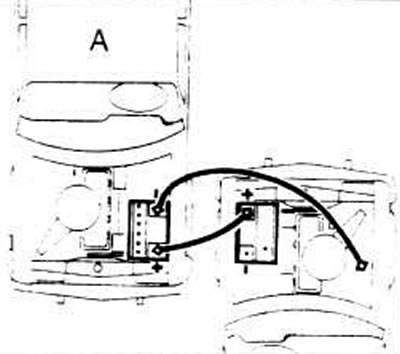
The discharged battery must be connected to the vehicle's electrical system.


Check the electrolyte condition in the discharged battery. If necessary, add distilled water.

Place the cars so that their metal parts do not touch.

Put both vehicles on the handbrake, gearboxes in neutral, and automatic transmission in position "P".

Disconnect all consumers.

The donor car must operate at idle speed.

Connect the males in the following sequence.

1. Connect the red cable to the positive terminal of the discharged battery.

2. Connect the other end of the red cable to the positive terminal of the donor battery.


3. Connect the black cable to the negative terminal of the donor battery.

4. Connect the other end of the black cable to ground, for example, the cylinder block of the car being started. This will eliminate losses. Under unfavorable circumstances, when connecting the cable to the negative of a discharged battery, the battery may explode due to the formation of a spark and the release of detonating gas.

Check again that the cable connections are secure and that they do not come into contact with moving parts such as the fan belt, etc.

Caution: Cables must not touch each other; cables must not touch the ground.


Start the engine of the car with a discharged battery and let it run. When starting, do not keep the starter in the on position for more than 15 seconds, since due to the high current consumption, the pole clamps and cables may heat up. Between starts, make a delay of at least 1 minute.

Let the donor car idle well to avoid generator failure due to peak voltages during startup. If the idle speed drops, give it some gas.

When starting, remove any open flame from the battery, as the battery produces flammable gas.

After starting, disconnect the cables in reverse order.

Caution: Failure to comply with these rules is dangerous to your health and the technical condition of the machine.


This article is available at russian, bulgarian, belarusian, ukrainian, serbian, croatian, romanian, polish, slovak, hungarian
Checking the article: Kornev Georgy

Share information:

Previous articles
Opel Kadett D: Gasoline engines
Next articles

Checking the compression in the cylinders
Checking the cylinder block surface for flatness
Checking the flatness of the mating surface of the cylinder head
Adjusting valve clearances
Replacing the valve stem seals
Grinding valves to seats
Engine malfunctions


See similar ones from other Opel car manuals:
▶ Starting the engine from an auxiliary power source Opel Astra H (2004-2009)
▶ Starting the engine from an auxiliary power source Opel Corsa B (1993-2000)
▶ Starting the engine from an auxiliary power source Opel Vectra C (2002-2008)
▶ Starting the engine from an auxiliary power source Opel Frontera A (1991-1998, petrol)
▶ Starting the engine from an external power source Opel Insignia A (2008-2017)
Link to this page in different formats

Visitor comments


No comments yet


How much will 10 + 21 =


Kadett E (1984-1995) 
  • General information
  • Vehicle description
  • Operation and maintenance
  • OHV power unit
  • Engine design
  • Check and repair
  • Engine work
  • OHC power unit
  • Engine design
  • Engine repair
  • Ignition system
  • Cooling and lubrication
  • Supply system
  • Fuel injection «LE-Jetronic»
  • Fuel injection «LE3-Jetronic»
  • Motronic ML4.1 system
  • Motronic M1.5 system
  • Motronic M2.5 system
  • Transmission
  • Clutch
  • Gearbox F10 and F13
  • Gearbox F16 and F20
  • Automatic gearbox
  • Drive shafts
  • Chassis
  • Front suspension
  • Rear suspension
  • Steering
  • Brake system
  • Electrical equipment
  • Equipment and devices
  • Electrical circuits
Kadett D (1979-1984) 
  • General information
  • Car care
  • Maintenance
  • Power unit
  • Gasoline engines
  • Lubrication system
  • Cooling system
  • Power system (gasoline)
  • Carburetor Solex 35 PDSI
  • Carburetor Varajet II
  • Carburetor 1B1
  • Fuel injection (gasoline)
  • Diesel engines
  • Fuel system (diesel)
  • Transmission
  • Clutch
  • Manual gearbox
  • Chassis
  • Front suspension
  • Rear suspension
  • Steering
  • Brake system
  • Wheels and tires
  • Body
  • Body elements
  • Doors and windows
  • Electrical equipment
  • Equipment and devices
  • Lighting system
  • Power devices
  • Ignition system
  • Electrical circuits
OpelBook.ru © 2017–2026 · Mobile version · · Sitemap: EN BG BY UA RS HR RO PL SK HU · Feedback · Site search
Astra F, petrol · Astra G, petrol · Astra G · Astra H · Astra J, petrol · Corsa B · Corsa C, petrol · Corsa C · Insignia A · Kadett D · Kadett E · Omega A · Omega B · Omega B2 · Vectra A, petrol · Vectra A · Vectra B, petrol · Vectra B · Vectra C · Zafira A, petrol · Frontera A, petrol · Frontera B · Ascona C · Vivaro A ·
We want your visit to be comfortable 🤝! We use cookies 🍪 to make that happen.