


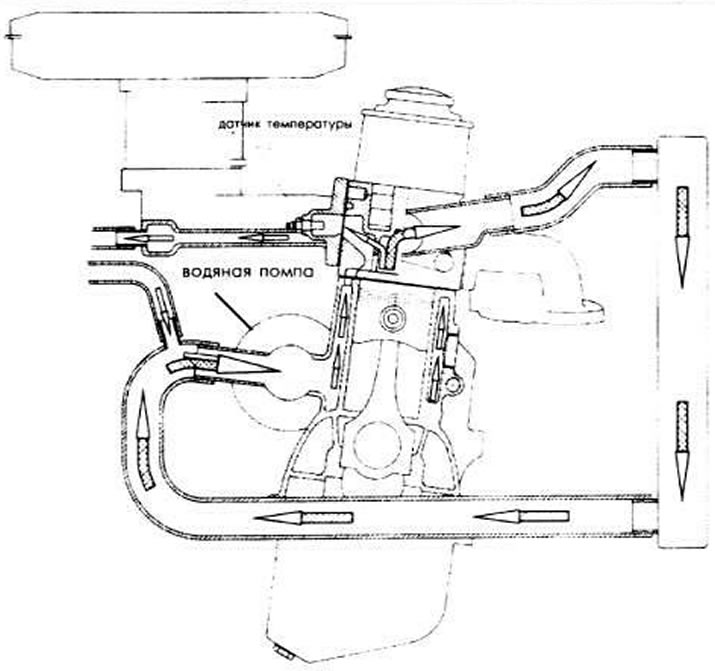
The cooling system operates under the influence of a water pump and a thermostat. Frost-resistant coolant should be used both in winter and summer. Before the onset of the cold season, the frost resistance of the coolant should be checked. The system is equipped with a valve to maintain increased pressure from 1.20 to 1.35 bar in the cooling system and, therefore, increase the boiling point of the coolant to 120°C.
To prevent the coolant hoses from collapsing during cooling, the radiator is equipped with another valve that opens at a pressure of 0.06 to 0.10 bar and allows air to enter the cooling system from the outside.
The coolant flows through the radiator from top to bottom and is cooled by the air flow. It is taken by the water pump from the lower tank of the radiator and supplied to the cylinder head.
The cylinder head is designed so that the coolant is supplied through a channel directly to the valve seats for intensive cooling. From here the coolant is supplied to the crankcase jacket and then it is again on the front side of the cylinder head and through the open thermostat through a hose into the upper radiator tank, where the circulation begins again. At coolant temperatures below 92°C the thermostat remains closed, and then the coolant is sucked by the water pump directly from the cylinder head and supplied for a longer time into the cooling system channels.
This ensures fast and uniform heating of the engine. At 92°C the thermostat opens, and at 107°C it is already fully open (1.3 l engine 103°C).
Volume of cooling system
- Engines 1.0-l - 6.1 l
- Engines 1.2-l - 5.9 l
- Engines ONS 1.2-/1.3-l/manual gearbox — 6.3 p
- Engines 1.3-liter/automatic transmission - 7.1 liters
- Engines 1.6-liter/manual transmission - 7.9 l
- Engines 1.6-liter/automatic transmission - 7.6 liters
- Engines 1.8-liter/manual transmission, diesel - 7.6 l
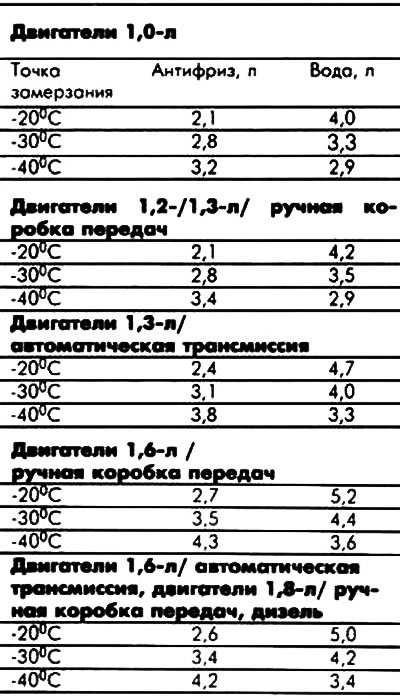
Coolant Mixture Ratio
Visitor comments