


- Monitoring battery voltage and assessing battery health.
- Performing corrective actions by increasing the idle speed and adjusting the voltage in the on-board network.
- Diagnostics and driver notification.
The state of the battery is assessed when the ignition is turned off and on. When the ignition is turned off, the battery charge level is determined by measuring the open circuit voltage. The battery charge depends on the electrolyte concentration and the internal resistance of the battery. These parameters are indirectly determined by measuring the voltage in the vehicle's on-board network when the vehicle's ignition is turned off for several hours.
During engine operation, the initial determination of the battery charge level is performed by the battery current sensor built into the circuit.
In addition, the energy management system provides battery voltage regulation in autonomous mode, extending battery life and fuel economy. This is achieved by using battery charge level and electrolyte temperature data to set the charging voltage in optimal ranges.
The charging system provides power supply to all vehicle consumers and constant recharging of the battery while the engine is running. The charging system has six operating modes:
- Battery sulfation mode.
- Charging mode.
- Fuel economy mode.
- Headlight mode.
- Start-up mode.
- Voltage reduction mode.
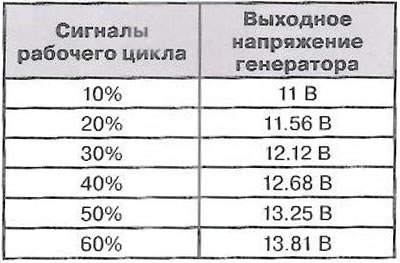
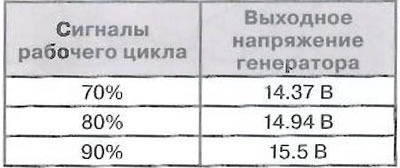
The engine control module controls the alternator via a signal circuit. The engine control module monitors the alternator performance using alternator circuit duty cycle signals. The signals are 128 Hz pulses with a duty cycle of 0-100%. The normal duty cycle is 5-95%. The 0-5% and 95-100% ranges are used for diagnostics. The following table shows the alternator duty cycle signals and output voltage values:
[Text copied from an internet website: www.opelbook.ru]
The alternator provides output voltage feedback signals via the duty cycle signal circuit to the engine control unit. This information is then transmitted to the body control unit. The signal is pulsed at 128 Hz and has a duty cycle of 0-100%. The normal duty cycle is 5-99%. The 0-5% and 100% ranges are used for diagnostics.
Visitor comments