OpelBook.ru
Cars AvtoVAZ Cars Mitsubishi Cars BMW Cars Mercedes Cars Nissan Cars Toyota Cars Chevrolet
English Русский
Български
Беларускі
Український
Српски
Hrvatski
Română
Polski
Slovenský
Magyar
 |  Sitemap  |  Contacts  |    


Main Astra Corsa Insignia Kadett Omega Vectra Zafira Others Articles
Astra F (1991-1998, petrol) Astra G (1998-2004, petrol) Astra G (1998-2004) Astra H (2004-2009) Astra J (2009-2015, petrol)
  • Main
  • Astra
  • Astra J
  • General information
  • Faults en route
  • Starting the engine from external power sources

Starting the engine from external power sources (Opel Astra J)

            0

If you cannot start the engine due to a partially or completely discharged battery, you can use another car's battery to start it. Use special connecting cables with crocodile clips to connect the "donor" battery.

Warning!
  • When starting the engine from an additional battery, carefully follow the operating sequence described in this subsection. Otherwise, a fire or explosion may occur, which will lead to damage to both vehicles. Before connecting the external battery, make sure that the ignition is off. Also turn off all electrical consumers (headlights, car radio, windshield wipers, etc.).
  • When connecting or disconnecting wires, do not allow them to touch each other or allow wires to come into contact with fans, drive belts, or other rotating parts.
  • Do not disconnect the booster battery cables until the engine is running at normal idle speed.
  • Leaving the audio system on while jump starting the engine with an additional battery can cause serious damage to the audio system. Always turn off the audio system before jumping the engine with another vehicle's battery.


1. Place the vehicle with the discharged battery next to the donor vehicle within reach of the jumper cables.

Warning! The cars must not touch each other under any circumstances. Otherwise, an unwanted short circuit to ground may occur, as a result of which you will not be able to start the engine of a car with a discharged battery, and the electrical systems of both cars may be damaged.


2. Apply the parking brake on both vehicles.


3. Check the electrolyte level in the discharged battery (see Battery Care).

Warning! If the electrolyte level is very low or the electrolyte appears frozen, do not attempt to jump start the engine using the booster battery! In this case, the discharged battery may explode.

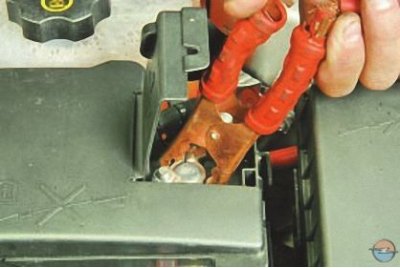
Warning! If the electrolyte level is very low or the electrolyte appears frozen, do not attempt to…


4. Open the protective cover…

4. Open the protective cover…


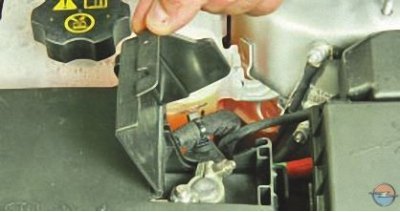
5. …and connect the clamp of the connecting cable with red handles to the positive terminal of the discharged battery.
5. …and connect the clamp of the connecting cable with red handles to the positive terminal of the…


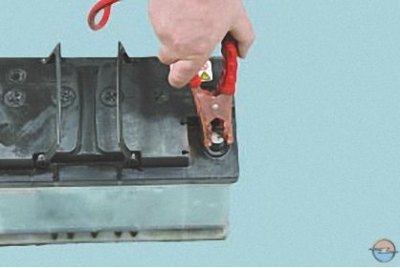
6. Connect the second cable clamp with red handles to the positive terminal of the donor battery.


Note: For clarity, the operation is shown with the battery removed.

Note: For clarity, the operation is shown with the battery removed.


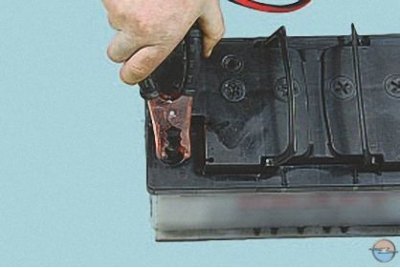
7. Clamping the second cable (with black handles) connect to the negative terminal of the donor battery..
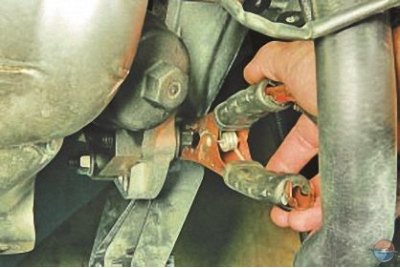
7. Clamping the second cable (with black handles) connect to the negative terminal of the donor…


8. …and the second clamp of the cable with black handles – to the "ground" of the car with the discharged battery in a place located at the maximum possible distance from the battery. It is most convenient to attach the clamp to the transport eye of the engine.

Note: The requirement to connect the wire at the maximum distance from the battery is explained by the possibility of sparking at the moment of connection.
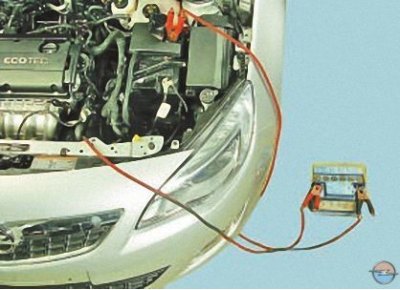

Note: The requirement to connect the wire at the maximum distance from the battery is explained by…


9. Make sure that the cables are connected in the correct sequence and that they do not come into contact with moving parts of the engine.


10. When using a battery installed in a donor vehicle, start the engine of that vehicle and let it idle for a few minutes until it runs smoothly.

11. Start the engine of the car with a discharged battery and let it run until it reaches a stable idle speed.

12. Disconnect the cables in the exact reverse order of their connection.


This article is available at russian, bulgarian, belarusian, ukrainian, serbian, croatian, romanian, polish, slovak, hungarian
Checking the article: Trifonova Emilia

Share information:

Previous articles
Opel Astra J: Faults en route
Next articles

Checking electrical equipment
Low battery warning light
Checking the cooling system
Coolant temperature gauge
Checking the lubrication system
Oil pressure warning light
Electrical equipment faults
Extraneous knocking noises in the engine
Extraneous knocks in the suspension and transmission
Vibration and shock on the steering wheel
Signals for urgent brake check
Bleeding the brake system


See similar ones from other Opel car manuals:
▶ Starting the engine from an external power source Opel Insignia A (2008-2017)
▶ Starting the engine from an auxiliary power source Opel Corsa B (1993-2000)
▶ Starting the engine from an auxiliary power source Opel Vectra C (2002-2008)
▶ Starting the engine from an auxiliary power source Opel Frontera A (1991-1998, petrol)
▶ Starting the engine Opel Kadett E (1984-1995)
Link to this page in different formats

Visitor comments


No comments yet


How much will 33 + 34 =


Astra J (2009-2015, petrol) 
  • General information
  • Vehicle device
  • User manual
  • Faults en route
  • Maintenance
  • Power unit
  • Engine repair
  • Cooling and lubrication system
  • Engine power system
  • Exhaust system
  • Transmission
  • Clutch
  • Car gearbox
  • Drive shafts
  • Chassis
  • Front suspension
  • Rear suspension
  • Steering
  • Brake system
  • Wheels and tires
  • Body
  • Exterior
  • Interior
  • Doors and windows
  • Body Care
  • Heating and air conditioning
  • Security systems
  • Electrical equipment
  • Equipment and devices
  • Lighting and signaling
  • Power devices
  • Electrical circuits
Astra H (2004-2009) 
  • General information
  • Introduction to the guide
  • Troubleshooting
  • User manual
  • Maintenance
  • Power unit
  • Engine repair
  • Cooling and heating
  • Power and exhaust system
  • Ignition system
  • Launch and charge system
  • Transmission
  • Mechanical gearbox
  • Automatic gearbox
  • Drive shafts
  • Chassis
  • Brake system
  • Car suspension
  • Steering
  • Body
  • Interior
  • Exterior
  • Electrical equipment
  • Equipment and devices
  • Electrical circuits
Astra G (1998-2004) 
  • General information
  • Introduction to manual
  • User manual
  • Maintenance
  • Power unit
  • SOHC gasoline engines
  • DOHC gasoline engines
  • Diesel engines 1.7 and 2.0
  • Engine repair
  • Cooling system
  • Supply system
  • Injection system (gasoline)
  • Injection system (diesel)
  • Exhaust system
  • Charge and launch system
  • Ignition system (gasoline)
  • Preheat system (diesel)
  • Transmission
  • Manual gearbox
  • Automatic gearbox
  • Clutch
  • Drive shafts
  • Chassis
  • Brake system
  • Wheel suspension
  • Steering
  • Body
  • Exterior
  • Interior
  • Doors and windows
  • Ventilation and heating
  • Electrical equipment
  • Equipment and devices
  • Electrical circuits
Astra G (1998-2004, petrol) 
  • General information
  • User manual
  • Car care
  • Maintenance
  • Power unit
  • Single shaft engines
  • Twin shaft engines
  • Engine repair
  • Cooling and heating
  • Fuel and exhaust systems
  • Starting and charging system
  • Ignition system
  • Transmission
  • Clutch
  • Mechanical gearbox
  • Automatic gearbox
  • Drive shafts
  • Chassis
  • Brake system
  • Car suspension
  • Steering
  • Body
  • Interior
  • Exterior
  • Electrical equipment
  • Equipment and devices
  • Wiring diagrams Opel Astra
  • Wiring diagrams Opel Zafira
Astra F (1991-1998, petrol) 
  • General information
  • Maintenance
  • Power unit
  • Engine in car
  • Engine removed
  • Cooling system
  • Heating and ventilation
  • Fuel supply (carburetor)
  • Fuel supply (injector)
  • Emission control
  • Ignition system
  • Transmission
  • Clutch
  • Mechanical gearbox
  • Automatic gearbox
  • Drive shafts
  • Chassis
  • Brake system
  • Car suspension
  • Steering
  • Body
  • Exterior
  • Interior
  • Electrical equipment
  • Equipment and devices
  • Electrical circuits
OpelBook.ru © 2017–2026 · Mobile version · · Sitemap: EN BG BY UA RS HR RO PL SK HU · Feedback · Site search
Astra F, petrol · Astra G, petrol · Astra G · Astra H · Astra J, petrol · Corsa B · Corsa C, petrol · Corsa C · Insignia A · Kadett D · Kadett E · Omega A · Omega B · Omega B2 · Vectra A, petrol · Vectra A · Vectra B, petrol · Vectra B · Vectra C · Zafira A, petrol · Frontera A, petrol · Frontera B · Ascona C · Vivaro A ·
We want your visit to be comfortable 🤝! We use cookies 🍪 to make that happen.