


- devices for stripping battery terminals and wire terminals;
- voltmeter;
- charger.
When servicing the battery, it is necessary to observe safety precautions (see "Safety precautions when servicing and repairing a car").
Regular battery maintenance
1. Prepare the car for work (see "Preparing the car for maintenance and repair"),
2. Wipe the top of the battery case with a cloth soaked in a 10% solution of baking soda or ammonia, and then with clean water.
3. Check the reliability of the battery fastening on the car, if necessary, tighten the pressure plate mounting bolt (see "Battery - Removal and Installation").
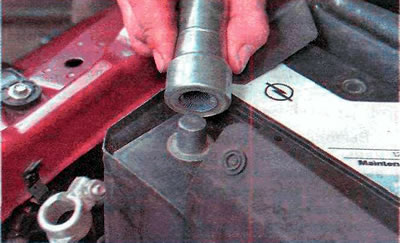
4. Check the condition of the battery terminals. If they are covered with a layer of oxides, remove the terminals from the battery terminals. Clean the battery terminals with a special device.
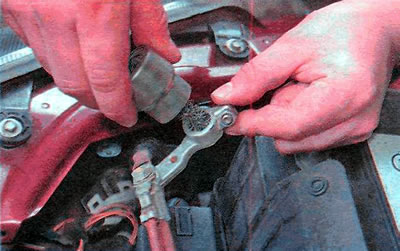
5. Check the condition of the power cable terminals. If they are covered with a layer of oxides, remove the terminals from the battery terminals, clean the inner surfaces of the terminals until they shine, apply conductive grease and install the terminals in place.
Checking and charging
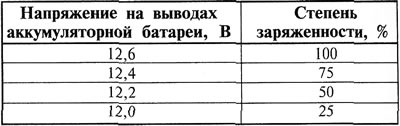
1. To roughly estimate the degree of contamination of the battery, measure the voltage at its terminals and compare it with that given in Table 14.4 (voltage values are given at a battery temperature of 20-24°C. If the degree of contamination of the battery is less than 50%, it must be charged).
Table 14.4
2. To check the battery under load, remove fuse Ef6 (see "Fuse and relay mounting blocks").
3. Turn the key in the ignition switch to position III (an assistant should do this), we measure the voltage at the terminals of the battery. If the voltage is less than 8.6 V, the battery needs to be charged.
4. Remove the battery from the vehicle or disconnect the wire terminals from the battery terminals (see "Battery - Removal and Installation").
5. To charge, connect the charger to the terminals of the battery, observing the polarity, and only then plug the charger into the power grid. The charging current should not exceed 10% of the battery capacity in amperes, i.e. for a battery with a capacity of 66 Ah, the maximum charging current is 6.6 A.
6. Charge the battery. We control the process, periodically checking the degree of contamination, as described above. The charging time of a completely discharged battery is not less than ten hours at maximum charging current.
7. Stop charging the battery after the voltage at the terminals with the charger disconnected reaches 12.6 V: first disconnect the charger from the power supply, and only then disconnect the wires from the terminals of the battery.
8. Place the power cable terminals on the battery terminals. Tighten the clamping bolt nuts of the terminals and apply protective varnish to the terminals and battery terminals.
Visitor comments