
OpelBook.ru
Cars AvtoVAZ Cars Mitsubishi Cars BMW Cars Mercedes Cars Nissan Cars Toyota Cars Chevrolet
English Русский
Български
Беларускі
Український
Српски
Hrvatski
Română
Polski
Slovenský
Magyar
 |  Sitemap  |  Contacts  |    


Main Astra Corsa Insignia Kadett Omega Vectra Zafira Others Articles
Kadett D (1979-1984) Kadett E (1984-1995)
  • Main
  • Kadett
  • Kadett E
  • Chassis
  • Rear suspension
  • Design and technical characteristics

Design and technical characteristics (Opel Kadett E)

            0

Contents: Rear suspension spring…⬇ Rear suspension shock absorbers ⬇ Anti-roll bar ⬇ Diameter of the anti-roll bar ⬇ Rear wheel alignment angles ⬇ Rear wheel hubs ⬇
The rear suspension is semi-independent with short coil conical springs, hydraulic telescopic double-acting shock absorbers (with gas-filled shock absorbers on cars with the 20XE engine), anti-roll bar (two anti-roll bars on cars with the 20XE engine) and longitudinal arms elastically connected by a V-shaped cross beam.

The Combo and Delvan models use a rear suspension with leaf semi-elliptical springs, a rigid beam, and double-acting hydraulic telescopic shock absorbers.

Rear suspension spring characteristics
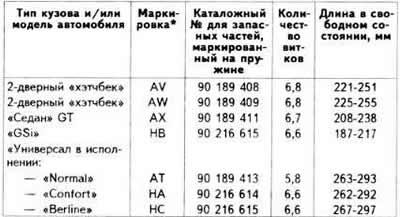


Rear suspension spring characteristics

* Marking may be indicated on the label or applied with paint.

Rear suspension shock absorbers


Brand: Delco Products.

The car uses dual-action telescopic hydraulic shock absorbers. The lower end of the shock absorber is attached to the suspension arm, the upper end to the body.

Anti-roll bar


Diameter of the anti-roll bar
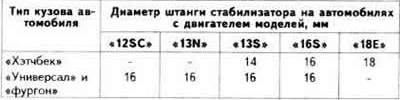


Diameter of the anti-roll bar

On cars with the "20XE" engine, the anti-roll bar is made in the form of two rods, one of which, with a diameter of 18 mm, is built into the rear suspension cross member and works as a torsion bar, and the second, with a diameter of 15 mm, is connected by rods to the rear suspension arms.


Rear wheel alignment angles


The rear wheel alignment angles are not adjustable. For cars with engines of all models except "20XE", with a half-filled fuel tank and under a load distributed over /0 kgf on the front seats, the rear wheel alignment angles should have the following values:
  • camber: from 0° to -1° (0°30')*;
  • toe-in, mm: 0-4 (0°15').

*The maximum permissible difference when measuring on the left and right wheels is indicated in brackets.

Rear wheel alignment angles for a car with a 20XE engine with a half-filled fuel tank and a load distributed at 70 kgf on the front seats:
  • camber: -1°40' (0°30')*;
  • camber angle tolerance: from -1°40' to 2°10'.
  • toe-in, mm: from -1 to +4 (0°15').

The maximum permissible difference when measuring on the left and right wheels is indicated in brackets.

Rear wheel hubs


The rear wheel hub is mounted on two tapered roller bearings.


This article is available at russian, bulgarian, belarusian, ukrainian, serbian, croatian, romanian, polish, slovak, hungarian
Checking the article: Shapovalov Yaroslav

Share information:

Previous articles
Opel Kadett E: Rear suspension
Next articles

Tightening torques of main threaded connections, kgf m
Removal and installation rear suspension springs
Replacing rear suspension shock absorbers
Replacing rubber shock absorber bushings on cars
Removal and installation the anti-roll bar


See similar ones from other Opel car manuals:
▶ Technical characteristics of the steering system Opel Astra F (1991-1998, petrol)
▶ Specifications and technical characteristics of cars Opel Corsa B (1993-2000)
▶ Technical characteristics of the brake system Opel Vectra A (1988-1995)
▶ Technical characteristics of fuel injection system… Opel Vivaro A (2001-2014)
▶ Traction and dynamic characteristics Opel Insignia A (2008-2017)
Link to this page in different formats

Visitor comments


No comments yet


How much will 27 + 43 =


Kadett E (1984-1995) 
  • General information
  • Vehicle description
  • Operation and maintenance
  • OHV power unit
  • Engine design
  • Check and repair
  • Engine work
  • OHC power unit
  • Engine design
  • Engine repair
  • Ignition system
  • Cooling and lubrication
  • Supply system
  • Fuel injection «LE-Jetronic»
  • Fuel injection «LE3-Jetronic»
  • Motronic ML4.1 system
  • Motronic M1.5 system
  • Motronic M2.5 system
  • Transmission
  • Clutch
  • Gearbox F10 and F13
  • Gearbox F16 and F20
  • Automatic gearbox
  • Drive shafts
  • Chassis
  • Front suspension
  • Rear suspension
  • Steering
  • Brake system
  • Electrical equipment
  • Equipment and devices
  • Electrical circuits
Kadett D (1979-1984) 
  • General information
  • Car care
  • Maintenance
  • Power unit
  • Gasoline engines
  • Lubrication system
  • Cooling system
  • Power system (gasoline)
  • Carburetor Solex 35 PDSI
  • Carburetor Varajet II
  • Carburetor 1B1
  • Fuel injection (gasoline)
  • Diesel engines
  • Fuel system (diesel)
  • Transmission
  • Clutch
  • Manual gearbox
  • Chassis
  • Front suspension
  • Rear suspension
  • Steering
  • Brake system
  • Wheels and tires
  • Body
  • Body elements
  • Doors and windows
  • Electrical equipment
  • Equipment and devices
  • Lighting system
  • Power devices
  • Ignition system
  • Electrical circuits
OpelBook.ru © 2017–2026 · Mobile version · · Sitemap: EN BG BY UA RS HR RO PL SK HU · Feedback · Site search
Astra F, petrol · Astra G, petrol · Astra G · Astra H · Astra J, petrol · Corsa B · Corsa C, petrol · Corsa C · Insignia A · Kadett D · Kadett E · Omega A · Omega B · Omega B2 · Vectra A, petrol · Vectra A · Vectra B, petrol · Vectra B · Vectra C · Zafira A, petrol · Frontera A, petrol · Frontera B · Ascona C · Vivaro A ·
We want your visit to be comfortable 🤝! We use cookies 🍪 to make that happen.