


Since April 1986 (. the following changes have been made to the design of the 4- and 5-speed gearbox type "F10":
- the diameter of the locking rings of the synchronizer of the first and second gears has been increased from 51 to 58 mm. Accordingly, the design of the fork of the rod of switching the first and second gears and the intermediate lever of the drive of switching gears has been changed. The parts of the old and new design are not interchangeable;
- all split "open" type ball bearings have been replaced by sealed type ball bearings, which can also be used for gearboxes manufactured before April 1986:
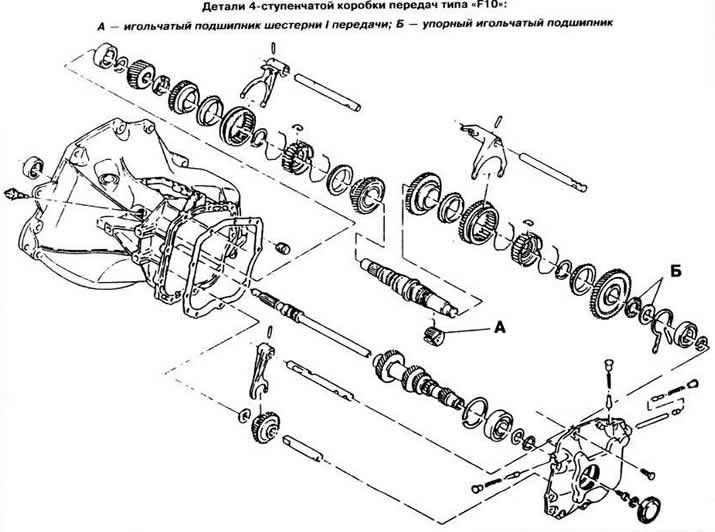
- in the 4-speed gearbox "F10" the 1st gear pinion rotates on a split needle bearing "A" (see picture), and instead of the thrust washer of this gear, a thrust needle bearing "B" is installed.
Cars with the "16SV" engine are equipped with a 4- or 5-speed gearbox of the "F13" type, which is a modification of the "F10" type gearbox.
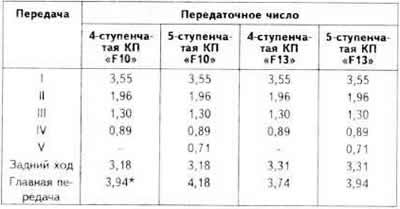
The F13 type gearbox has the same gear ratios as the F10 type gearbox, except for the reverse gear ratio, and is basically the same design, except for the following changes:
- reinforced crankcase;
- synchronizer of 1st and 2nd gears with three locking rings is used;
- in a 4-speed gearbox, the 1st gear pinion rotates on a split needle bearing. Instead of the thrust washer of the 1st gear pinion, a thrust needle bearing is installed;
- the design of the gears of the first and second gears is adapted to a synchronizer with three locking rings.
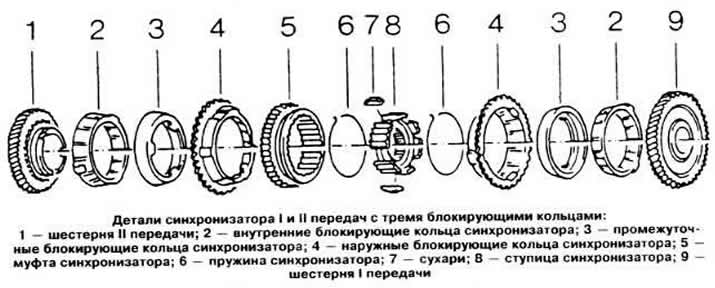
The synchronizer of the first and second gears includes the gear shifting parts (see picture): gear 1 II gear; internal blocking rings 2; intermediate blocking rings 3; external blocking rings 4; coupling 5; springs 6; crackers 7; hub 8 and gear 9 of the 1st gear. After the clutch has been moved from the neutral position to the 1st gear position, the synchronizer operates as follows: under the action of the springs, the three crackers are displaced by the clutch in the axial direction toward the outer locking ring. As a result, the gap between the three locking rings is selected at the points of their contact. The torque on the inner conical surface of the rings, arising from the difference in rotation speeds, causes the outer locking ring to move until it touches the projections of the inner locking ring, while the synchronizer clutch is installed on the same axial line with the outer locking ring. As soon as the clutch moves further, it comes into contact with the outer locking ring of the synchronizer. This process is called preliminary synchronization.
Under the action of the force applied to the gearshift lever, which increases in accordance with the gear ratio of the gearshift mechanism, all three synchronizer locking rings are pressed against each other. As long as the difference in the rotation speeds of the pinion and the clutch remains, the locking rings are subject to torques, the sum of which is much greater than the torque that occurs in a conventional synchronizer, which ensures a significant reduction in the force required to change gears. The method that allows the rotation speeds of the synchronizer clutch and the corresponding pinion to be completely equalized is called basic synchronization.
- all open type split ball bearings have been replaced with sealed type bearings.
Marking
The gearbox code number is stamped on the rear cover. For example 26412... 394, where:
- 264 — ordinal number of the day of the year;
- 1 - the last digit of the year of manufacture;
- 2 — shift number that assembled the gearbox (1 — morning shift. 2 — evening shift);
- ... — a place for applying special codes from 0 to 99;
- 394 - final drive ratio. In this example it is 3.94.
Gear ratios
Article posted on a web portal (OPELBOOK.ru)
For cars with a sedan and hatchback body with engines "12SC", "13N" and "13S", for station wagons with these engines the final drive ratio is 4.18, for vans with "13N" and "13S" engines - 4.53.
Differential
The differential box rotates on two tapered roller bearings. The bearing preload is adjusted with a nut.
Moment of resistance to rotation of differential box bearings
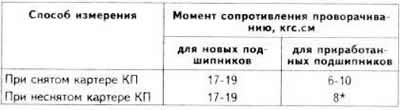
*Not counting the torque measured during disassembly.
Visitor comments