


Contents: VIN Decoding ⬇ Decoding engine designation ⬇
The new car is equipped with a magnetic identification card (the size of a credit card), which contains all vehicle data.
Improving the manufactured products is a continuous process of any flow production. At the same time, in the automotive industry, except for cases of major design changes of models coming off the conveyor, the results of the modification process are not covered in the vehicle operating manual. However, the manufacturer draws up numbered lists of manufactured spare parts, due to which the information encoded in the identification numbers of the car is of particular importance when purchasing the latter. When ordering the required spare part, try to provide the seller with as complete information about your car as possible. Be sure to provide the model name, year of manufacture, as well as the body/chassis and powertrain numbers.
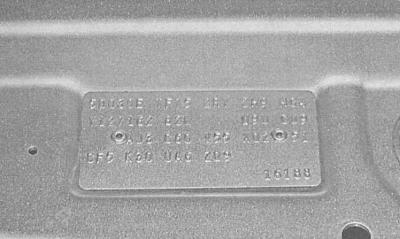
The vehicle identification number (VIN) plate is attached under the hood on the upper crossbar of the front panel; in addition, the VIN is stamped to the right of the front passenger seat - there is a special valve in the carpet.
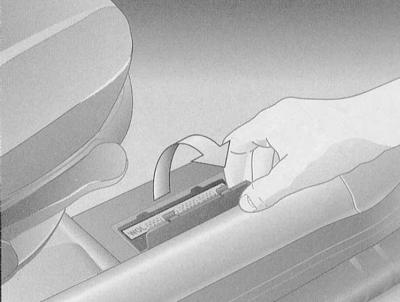
On some models, the VIN is stamped on a plate attached to the vehicle's dashboard on the left side under the windshield.
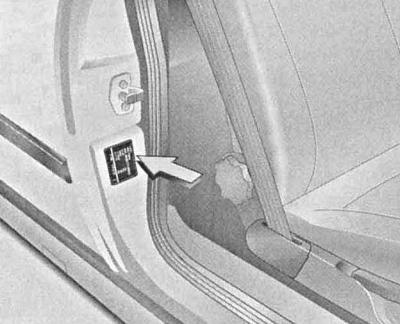
The VIN is also duplicated on the certification label, which is attached to the front edge of the right B-pillar.
VIN Decoding
Contents of the certification label
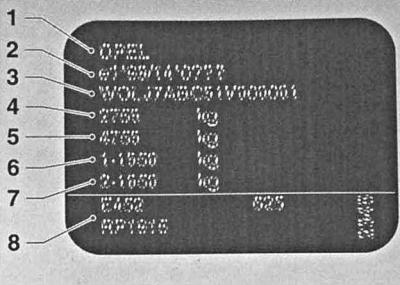
1 - Manufacturing company
2 — License permit number
3 — Vehicle Identification Number (VIN)
4 — Permissible total mass of the vehicle
5 — Permissible total trailer weight
6 — Maximum permissible load on the front axle of the vehicle
7 — Maximum permissible load on the rear axle of the vehicle
8 - Vehicle specific/country specific data
On some models, the certification label may be attached to the right side of the front panel in front of the radiator.
The table below provides a detailed breakdown of the information encoded in the VIN.
|
WOL |
O |
T |
G |
F |
35 |
2 |
1 |
123456 |
| 1 | 2 | 3 | 4 | 5 | 6 | 7 | 8 | 9 |
1. Code
WOL = Adam Opel AG.
2. Special position:
O = except ….. vehicles.
3. Name code:
T = Astra
J = Vectra
V = Omega
4. Model range:
G = Astra-G.
6. Body type:
35 = 4-door Combi.
7. Year of model release:
W = 1998
X = 1999
Y = 2000
1 = 2001
2 = 2002
3 = 2003 etc.
8. Manufacturer's code:
1 = Rüsselsheim
2 = Bochum.
9. Serial number
Decoding engine designation
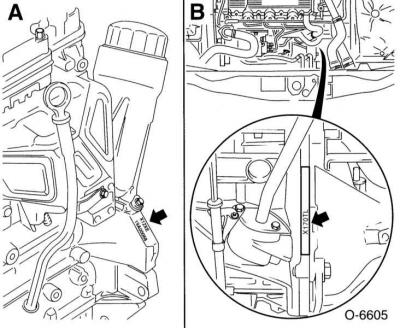
The designation and number of the engine on petrol models is stamped on the left side of the power unit, the number of the diesel engine is on the right side of the unit, directly under the fuel injection pump.
A — Petrol models
B - Diesel models
The table below provides a detailed breakdown of the information encoded in the engine designation.
|
X |
16 |
X |
E |
L |
- |
| X | 17 | - | D | T | L |
| 1 | 2 | 3 | 4 | 5 | 6 |
1. Exhaust toxicity standards
X — Models since 1996. Petrol: D3, D4. Diesel: Euro 2
Y — Models since 1998. Petrol: D4, Euro 3. Diesel: Euro 3 (A)
Z — Models since 1998. Petrol: Euro 4 (B)
2. Volume
16 - 1.6 l
17 - 1.7 l
3. Compression ratio
G = 8.5
L = 8.5 – 9.0
N = 9.0 – 9.5
S = 9.5 – 10.0
X = 10.0 – 11.5
Y > 11.5
4. Preparation of the mixture
E — Distributed injection
Z — Central injection
D — Diesel
5. Features
R — High Power
L - Low power
T — Turbocharging
V — Volumetric model
1 — Engine family I (block design as in 1.4, 1.6 l engines)
Visitor comments