


The service life of the drive depends on the condition of its joints. Joints are quite durable and, provided the car is used carefully, can last more than 100 thousand km. As a rule, the outer joints of the drives fail earlier than the inner ones. The service life of the joints is reduced by: an active driving style, interference with the design of the car's suspension, but most of all - damage to their protective rubber covers. When the cover ruptures, water and dirt get into the internal cavity of the joint. As a result, grease is washed out of the joint, its wear accelerates. Rupture of the protective cover can occur as a result of natural aging of rubber and mechanical damage (when driving a car in a deep rut; when the front wheels of the car dig into the ground, sand or icy snow; as a result of ice freezing or clay hardening on the outer hinge cover).
If the cover breaks under adverse conditions (dirt, dust, snow) the hinge can become unusable after several tens of kilometers. A damaged protective cover can be replaced if the malfunction is detected before the hinge fails. In this case, the hinge must be disassembled, washed and new grease must be applied (see "Outer drive joint - removal, replacement of protective cover and installation", "Inner drive joint - removal, replacement of protective cover and installation").
Wear of the outer joint may be indicated by clicking sounds in the area of the front wheel hub when driving in a sharp turn. As the joint wears, the clicking sounds will increase and will quickly develop into a constant crunching sound even when driving straight. Untimely repairs will lead to the destruction of the joint.
To perform the work, you will need an inspection pit or overpass. We perform the work with an assistant.
Sequence of execution
1. Prepare the vehicle for work and (see "Preparation for maintenance and repair"), hang the front wheels of the vehicle on stands and engage neutral gear.
2. We inspect the protective covers of the hinges of the left and similarly the right drives, we make sure that they are intact and that there is no lubricant leakage from them.
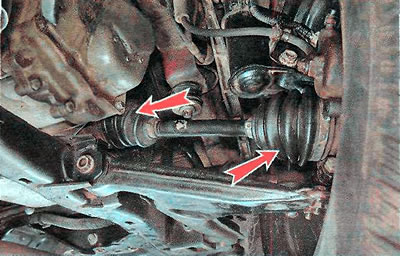
3. Set the wheels in the direction of straight-line movement. Move and rotate the drive shafts in different directions by hand. This ensures that there is no play between the drive parts.
4. Rotate the front wheels by hand to check the drive shafts for any wobble.
(Source is on the website OPELBOOK.ru)
5. By alternately turning the front wheels first one way, then the other and rotating them, we make sure that there are no extraneous sounds (knocks and crunches) in external and internal hinges.
A functioning hinge should not have any extraneous sounds during operation or play between parts. A faulty hinge should be replaced (either separately or the entire drive assembly). A torn cover should only be replaced if the hinge is intact.
Visitor comments